
5 years of implementing Resolution 30a - Part 2: What can we learn from these economic models?
(Baonghean) - In the three districts of Que Phong, Tuong Duong, and Ky Son, the general orientation in economic development with the support of Resolution 30a is to build models and chains of commercial agricultural production, thereby replicating them and aiming to build supply areas according to the plan. After 5 years of launching the program, 84 agricultural and forestry extension models have been built with the main form of support being seedlings and livestock; among them, some models have "brands" associated with each locality such as passion fruit in Que Phong; clean vegetables in Tuong Duong or livestock farms in Ky Son,... Alongside the successful models that are continuing to develop, there are also quite a few failures. Comparing, acknowledging, and evaluating successes as well as failures is necessary to draw lessons for the future implementation of Resolution 30a.
| RELATED NEWS |
|---|
Successful models
Speaking of the implementation of Resolution 30a in Que Phong, the first thing to mention is the passion fruit model in Tri Le and Nam Giai communes. Starting with 2 hectares in 2010, the model has now expanded to 16.1 hectares, potentially yielding an income of over 200 million VND per hectare. This is undeniably a success – a prime example illustrating the clear shift in the mindset and production methods of the people. Although a relatively new project, the rattan planting, regenerating bamboo forest management, and harvesting project in Hanh Dich, Dong Van, and Thong Thu communes is equally promising. This project, invested in by the Que Phong District People's Committee, was implemented from 2014 to 2016. The project's goal was to plant 12 hectares of rattan in Hanh Dich commune and 600 hectares of bamboo in Dong Van and Thong Thu communes within three years. Estimated income from rattan cultivation reaches 50-70 million VND/ha/year; total harvest of bamboo and reeds from the entire project reaches 45,000 tons, production value reaches 60-70 million VND/ha/year, and product consumption value reaches 45-55 million VND/ha/year.
Arriving in Hanh Dich commune (Que Phong district), we found households registering their rattan planting areas at the commune's People's Committee to receive seedlings and fertilizer. It is known that participating households will receive 100% support for seedlings and NPK fertilizer for three years (2014-2016). The funding comes from Program 30a and a small portion from local contributions. A noteworthy aspect of the rattan and bamboo planting project in Que Phong in general, and in Hanh Dich in particular, is the involvement of businesses and non-governmental organizations in various stages of the production process.
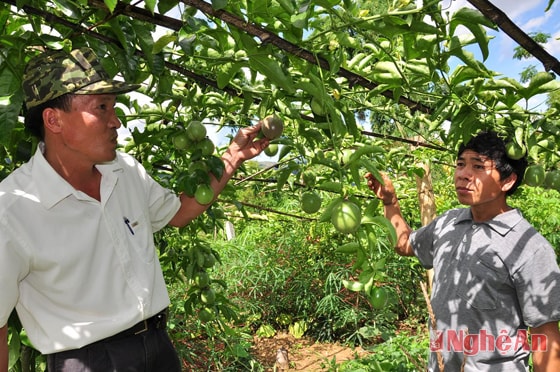 |
| Developing passion fruit cultivation in Tri Le commune (Que Phong). Photo: Tran Hai |
Supporting local people in cultivation techniques and seedling propagation is the OXFAM Project from Hong Kong. Mr. Luong Quoc Viet, Vice Chairman of the Commune People's Committee, led us to see the rattan and bamboo seedling nursery just as Mr. Cao Anh Sang, an OXFAM technical officer, was instructing local people on how to prepare seedlings and harvest them. Launched in October 2013, 60,000 rattan seedlings are now ready for planting in the nursery. 20,000 bamboo seedlings are being prepared by members of the nursery team. Mr. Luong Quoc Viet stated that the nursery not only ensures healthy rattan growth but also provides local people with access to technology and improves their production skills.
Furthermore, the commune acts as an "intermediary," "buying" seedlings from local farmers for nursery purposes, and then distributing them to farmers for cultivation, ensuring the full utilization of the support funds from Program 30a and increasing people's income. To date, 2 hectares of rattan have been planted in Hanh Dich, divided equally among 8 households. Mr. Cao Anh Sang has been demonstrating and guiding the farmers in rattan cultivation. Mr. Sang is optimistic: "Rattan is a native plant. Its advantages are that it is suitable for the local soil and climate, and the planting and care methods are not complicated, making it easy for farmers to implement. Therefore, when this project was implemented, all the farmers wholeheartedly agreed and were receptive to the instructions of the technical staff and the guidance of the commune and district."
That's about the production stage. Regarding consumption, the project has attracted Duc Phong Co., Ltd. (headquartered in Nghi Phu) – a company specializing in exporting rattan and bamboo products – which has committed to purchasing all the rattan (and bamboo), ensuring a market for the farmers and allowing them to produce with peace of mind. The Hanh Dich Rattan and Bamboo Cooperative, established in 2013 and headed by Mr. Ha Van Huy, is legally responsible for transactions with the company. This marks the beginning of integrating farmers into a value chain linking farmers, businesses, scientists, and the government. This means the rattan and bamboo project has transcended the limitations of a single model (like the passion fruit model in Tri Le) and built a closed value chain, bringing sustainable economic benefits and creating strong links between various components of society, thereby providing impoverishment for poor farmers.
In Ky Son district, the local strength is identified as livestock farming based on family and farm models, so the funding from Program 30a is focused on providing breeding stock, especially cattle. From 2010 to 2014, a total of 3,931 cattle were distributed to 20 communes. At the time of our visit, the District Department of Agriculture was handing over 45 30a cattle, worth over 400 million VND, to 45 poor households in Son Ha and Hoa Son villages – Ta Ca commune. Mr. Vi Van Man, Vice Chairman of Ta Ca commune, said that out of 11 villages in the commune, all have received cattle from Program 30a. This policy is in line with the needs of the people, so they have responded very positively. Excitement, eagerness, and hope were evident on the faces of the villagers. They arrived at the handover point early, admiring and stroking each cow, then discussing with each other about the households that had received cows first, and about their future plans...
Comrade Lầu Chông Vừ, Deputy Secretary of the Kỳ Sơn District Party Committee, stated: "The livestock support under Program 30a has made a positive contribution to poverty alleviation, but with the evenly distributed number of animals (one per household), it's difficult to escape poverty quickly. In reality, some households have boldly used personal capital combined with state loans (at preferential interest rates) to develop household, family, and farm-based livestock farming models. These are exemplary examples of successful economic development, serving as a catalyst for poverty alleviation." We visited the livestock farming model of Mr. Lô Khắc Lợi in Xốp Nhị village, Hữu Lập commune. While chopping vegetables for his pigs, Mr. Lợi shared with us the process of building his business from scratch.
In 2007, Mr. and Mrs. Loi borrowed 200 million VND from the bank, benefiting from preferential loan mechanisms for farms, to invest in a comprehensive farm model with initial capital including: 10 pigs, 100 chickens, 48 Quy breed ducks, a fish pond with 5 kg of fish fry, and 3.2 hectares planted with 300 longan, mango, and forestry trees. To date, their livestock and poultry have grown to include 1 cow, 24 pigs, 400 chickens, 80 geese, and 30 ducks. Although they still owe the bank, the farm provides a stable income, especially the chickens, which the couple has decided to focus on raising for eggs. So, what kind of support do households with a self-motivated and proactive approach to wealth creation like Mr. Loi receive from Program 30a in particular and from poverty reduction programs in general? Mr. Loi said that around the beginning of the fourth quarter of this year, the district supported his farm with over 50 Quy breed chickens and ducks using funds from Program 30a. Apart from a small number that died due to weather and disease, basically 75% are now developing relatively healthily.
Comrade Nguyen Van Thanh - Vice Chairman of the People's Committee of Huu Lap commune, added that Mr. Loi's family is one of 20 households supported by Program 30a with Quy breed ducklings (50 ducklings/household). This shows that with the trend and strengths of farm-based livestock farming in Ky Son, the concentrated distribution of small, short-term breeds like chickens and ducks brings higher value than the widespread distribution of large breeds like buffaloes and cows. Of course, this means that support and investment cannot be spread thinly, but can only be invested in a few households. What concerns us is whether this will raise questions among the people about the fairness and transparency of the mechanism and policies? Comrade Nguyen Van Thanh explained: "After a period of distributing aid evenly, we realized that this method neither yielded significant economic benefits nor had a profound impact on the people. Instead, if we encourage and support a few households with the awareness and ability to engage in economic activities to rise up and become wealthy, it will create a good example for the people to follow. Building trust among people who are accustomed to traditional production methods and have limited understanding of commercial production is very difficult. Cadres doing mass mobilization work can't be as persuasive as a household that has escaped poverty and become wealthy through practical experience."
Lessons learned
From the examples of the highly successful model farms mentioned above, lessons can be learned so that a production model can be put into practice and contribute to poverty alleviation in the 30a districts of Nghe An province.
The first lesson is that the model must originate from the natural and social characteristics of the locality. Specifically, it is necessary to understand the soil and climate to select suitable plant and animal breeds, prioritizing native species if possible. These should not only be suitable for the land but also familiar to the people, for two reasons: Firstly, people are more receptive to things they already know and are familiar with, making community engagement easier. Secondly, it minimizes the gap between the requirements and the technical skills of the people, increasing the success and efficiency of the model. In other words, this first lesson is: if you want to go fast, you must go slowly. Rushing to introduce new plant and animal breeds that are unfamiliar to the local people's farming and livestock practices will not only make success difficult but also force you to start from scratch to create new habits and production methods for the people.
In fact, many models in the 30a districts have failed for the aforementioned reasons. For example, the peanut cultivation model in Chau Thon commune (Que Phong district) – where the Thai ethnic minority people are not accustomed to growing cash crops; the pink banana cultivation model in Tien Phong commune (Que Phong district) and Luu Kien commune (Tuong Duong district) – two arid areas lacking irrigation systems, while bananas prefer soil with high moisture content; furthermore, the practice of free-range livestock farming conflicts with banana cultivation. Many livestock farming models also fail to sustain themselves due to unsuitable breeds for the climate, frequent disease outbreaks, and low awareness among the people regarding veterinary practices. Once a model suitable for the land and people is selected, the work of mobilizing the people, training, and guiding them will naturally be easier.
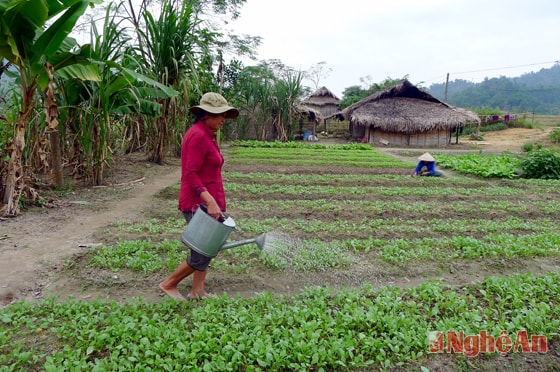 |
| The clean vegetable farming model in Chau Kim (Que Phong) is supported by Program 30a. |
The second lesson in economic modeling is selectivity. Selectivity here means choosing the target groups for implementation and focused support. It cannot be denied that the awareness of the majority of people in the high mountainous districts is limited, with significant inertia and a low level of self-motivation – this poses a difficult question for public relations and awareness-raising efforts in poverty eradication. The answer lies with the people themselves, but where? In households with awareness and the potential to escape poverty quickly and sustainably. This means we must view Program 30a as a catalyst to stimulate demand, accelerating the progress of those already on the path to escaping poverty, rather than a "miracle" that can lift households with excessively passive inertia. Because, if the people's mentality of dependence is not changed, no matter how much support is provided, it cannot change the fundamental nature of society as a whole, which is essentially bearing and compensating for the poverty and hunger of a segment of the population.
The final lesson, and the last step in the "production chain," is product consumption. A well-developed model is not necessarily a successful one until a stable market is found, ensuring economic value for the people. There are two reasons why products fail to find a market: Firstly, low productivity does not meet the requirements for guaranteed purchase agreements. Secondly, productivity is very high, but no businesses or individuals are willing to guarantee the purchase of the products. In reality, most of the models currently being developed are small-scale, with trading activities mainly taking place spontaneously within households with private traders. However, two drawbacks arise from this situation: firstly, people risk being disadvantaged when traders force down prices; sometimes, even with a good harvest, prices are low, ultimately failing to yield high economic returns. Secondly, due to the lack of a stable purchasing mechanism and distribution units, the product has not been able to develop a brand and establish a foothold in the market. In the long term, this is the ultimate goal of Program 30a: building stable and sustainable end-to-end production chains.
In short, the central and crucial element of all three lessons mentioned above is people. This includes the people, who need to change their perceptions and develop a sense of self-improvement to become proactive agents in the fight against poverty. It also includes scientists, whose role is to research, advise, and propose feasible and optimal economic development plans suitable for each locality. Finally, it includes businesses – the final link in the production chain, creating a bridge between farmers and the consumer market. Encompassing all these links is the State, whose role in guiding, directing, supporting, encouraging, and stimulating demand is most concretely demonstrated through the role of officials at all levels. This is also why strengthening the workforce and attracting highly qualified young intellectuals to the 30a localities is one of the key objectives. Answering the question of human resources not only allows us to evaluate and explain the achievements of the past period, but also determines the direction for the road ahead.
Thuc Anh


