
6 notable aspects of the trial of Mr. Dinh La Thang
The absence of a dock, the summoning of investigators, and the isolation of the defendant during the trial were some of the unusual aspects of the trial of Mr. Dinh La Thang.
The first-instance trial concerning the cases of Dinh La Thang and Trinh Xuan Thanh, revolving around irregularities at the Vietnam Oil and Gas Group (PVN) and the Vietnam Oil and Gas Construction Corporation (PVC), has just concluded 10 days of work, with each day lasting nearly 10 hours. Currently, the panel of judges is adjourned for deliberation, and the verdict will be announced on the morning of January 22nd.
The trial took place at a time when the 2015 Criminal Procedure Code and the 2015 Criminal Code had just come into effect (January 1, 2018). Therefore, many forms, procedures, and procedural contents were applied for the first time.
In addition, the interrogation methods, the work schedule, and the backgrounds of the defendants also created many unique aspects for the trial.
Mr. Dinh La Thang apologizes to all the people.
This is the first trial in which the Hanoi People's Court applied Circular 01 of the Supreme People's Court on courtroom design, which came into effect on January 1, 2018.
When answering questions, the defendants stand before a wooden witness stand, not a dock. During confrontations, two or three defendants stand together before the stand, possibly looking directly at each other.
The courtroom also has several platforms, each corresponding to a different position. The highest platform is where the panel of judges sits, including the presiding judge, the judges, and the jurors. The court clerk sits on a lower platform, in front.
The lawyers sit alongside the prosecutors. On either side of the defendants' seating area are rows of seats reserved for related parties, civil plaintiffs, etc.
Many lawyers, upon entering the questioning and debate phase, thanked the panel of judges for applying the courtroom model according to the new Criminal Procedure Code. They were seated on equal footing with the prosecution, receiving fairness between the prosecution and the defense.
Investigators confronted each other right in court.
The indictment states that during the investigation, Mr. Trinh Xuan Thanh (former chairman of PVC) made untruthful and evasive statements, denying guilt. He also absconded, hindering the investigation, and therefore these circumstances should be considered "to apply a severe punishment."
During the session on January 10th, arguing that the investigating agency's assessment that Mr. Trinh Xuan Thanh "did not honestly confess" affected his client's rights, the defendant's lawyer requested the court to summon the investigating officer to the court.
A few hours later, during the afternoon session, the investigator was summoned.
Mr. Thanh's lawyer publicly requested that investigators provide evidence of Mr. Thanh's "evasive denials of guilt." Asserting that Mr. Thanh's statements did not reflect the truth of the case, the investigator explained: "The evidence and testimonies of the other defendants over the past two days have relatively clearly demonstrated the actions of defendant Trinh Xuan Thanh. However, the case file shows that Trinh Xuan Thanh did not confirm these contents."
Lawyer Vu Tien Vinh argues that the presence of investigators at the trial of Mr. Dinh La Thang is justified.Article 296 of the 2015 Criminal Procedure Code. This is one of the new points of the 2015 Criminal Procedure Code, effective from January 1, 2018, which was not stipulated in the previous Criminal Procedure Code.Accordingly, when deemed necessary during the trial, the panel of judges may summon the investigator, the person authorized to conduct the proceedings who handled and resolved the case, and other individuals to the trial to present issues related to the case.
Lawyer Nguyen Van Quynh believes that the trial, taking place in the context of the 2015 Criminal Procedure Code, which has just come into effect, will be a good opportunity to implement the judicial reforms mentioned here, especially the principle of presumption of innocence and ensuring thorough adversarial proceedings.
Isolate the 'main' defendant right from the start of the trial.
|
Mr. Dinh La Thang on January 18th.Photo: VNA |
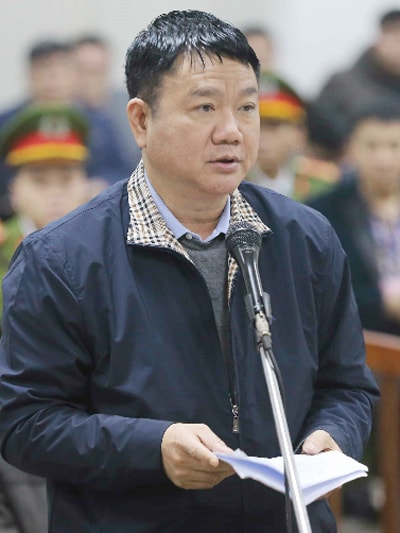
On the morning of January 8th, at the opening of the trial, before the Procuratorate announced the indictment against 22 former leaders, lawyer Nguyen Van Chien (one of the six lawyers defending defendant Nguyen Quoc Khanh - former deputy general director of PVN) stated that this was a large and complex case with many conflicting testimonies. He requested the court to separate the defendants and witnesses with conflicting testimonies during questioning.
That afternoon, after the prosecutor finished reading the indictment, defendant Dinh La Thang was escorted from the courtroom to the isolation area. The court also applied isolation measures during the questioning of defendant Trinh Xuan Thanh.
Unlike other major trials, the panel of judges did not question the defendants with key roles first at the beginning of the questioning phase. While their subordinates were being questioned, defendants Dinh La Thang and Trinh Xuan Thanh were escorted out of the courtroom to a separate area. They were not brought back throughout the afternoon's proceedings.
Not only the main defendant, but also the defendants who played a role as accomplices, such as former PVC general director Vu Duc Thuan and Pham Tien Dat, were subjected to isolation due to conflicting testimonies regarding interests with other defendants.
Special request
In his final statement on the morning of January 17th, Mr. Trinh Xuan Thanh said that his wife and two children, the youngest being 6 years old, are living in Germany. Feeling sorry for his wife raising the children in difficult circumstances, he hoped that after the trial concludes, the court would allow him to "go there to have the opportunity to take care of the children."
Earlier, claiming he posed no danger to society, at the beginning of the afternoon session on January 16, Mr. Dinh La Thang requested a change in the preventive measure to being released on bail.
He reiterated this request the following morning in his final statement. He wanted to spend one last Lunar New Year with his family, friends, and loved ones before serving his prison sentence.
The defendant thanked the panel of judges.
Many defendants, in their final statements, thanked the panel of judges for conducting a democratic trial. The head of the case, Mr. Dinh La Thang, also thanked the presiding judge and the panel of judges for conducting the trial in a spirit of innovation, democracy, and objectivity in accordance with the Constitution and the spirit of judicial reform.
|
Defendant Trinh Xuan Thanh.Photo: VNA |
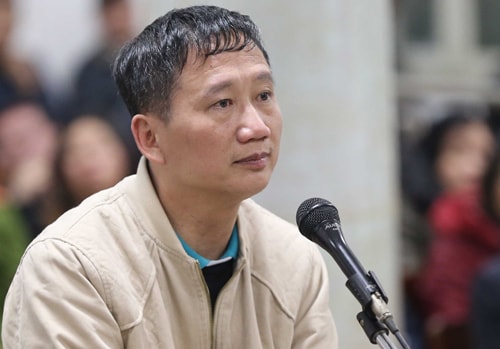
Trials were held throughout the weekend.
The trial opened on the morning of January 8th with a scheduled start time of 8:00 AM. However, that day, the court gates were already open at 5:00 AM, lights were on throughout the building, and security forces were stationed throughout the court area, the streets in front of the court, and the surrounding areas. At 6:15 AM, the convoy carrying the defendants began entering the court. That day's trial lasted until 6:00 PM.
For a whole week afterward, the convoy carrying the defendants arrived at the courthouse before 7:00 AM every day. The court adjourned at nearly 12:00 PM, and the afternoon session began at 1:30 PM, usually ending at 6:30 PM, sometimes later.
The trial continued on Saturday and Sunday morning (January 13th and 14th).


