
6 of the most notable global defense events of 2017
North Korea's testing of intercontinental ballistic missiles and nuclear weapons, and the driving of ISIS out of Iraq and Syria, were two of the most notable defense events of the year.
2017 was a turbulent year for the world, marked by unpredictable security developments. The focus of the year seemed to shift to the Korean Peninsula, with a series of ballistic missile launches and nuclear weapons tests. The South Korean and US militaries repeatedly conducted joint exercises, bringing the Korean Peninsula to the brink of war on several occasions.
North Korea launches missiles and conducts nuclear tests.
2017 saw an unprecedented frequency of missile launches by North Korea in many years. By the end of November, Pyongyang had conducted 23 ballistic missile launches of various types.
Specifically, Pyongyang kicked off a turbulent year on the Korean Peninsula with the testing of the Pukguksong 2 medium-range ballistic missile, which has a range of 2,000km.
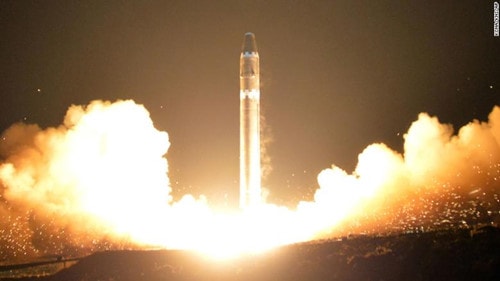 |
| The Hwasong-15 intercontinental ballistic missile lifts off the launch pad in a test that broke all of North Korea's records. Photo: CNN. |
On July 4th, Pyongyang stunned the world by announcing the successful test launch of the Hwasong-14 intercontinental ballistic missile (ICBM). The missile reached an orbital altitude of 2,500 km and traveled a distance of approximately 930 km. This was Pyongyang's first ICBM test, a major breakthrough in North Korea's missile technology.
Experts estimate that the missile could reach a range of 7,000-8,000 km, capable of striking Alaska, Hawaii, and Seattle if launched on a standard trajectory. Beyond these regular missile launches, Pyongyang also launched ballistic missiles that flew over Japan twice, on August 29th and September 15th.
Most recently, on November 29th, Pyongyang test-fired an unprecedentedly large ballistic missile called the Hwasong-15. It reached an orbital altitude of 4,500 km and traveled a distance of 992 km. If launched on a standard trajectory, the Hwasong-15 could achieve a range of up to 13,000 km, capable of striking the entire United States.
On September 3rd, Pyongyang rocked the Korean Peninsula with its sixth nuclear test. The North Korean government stated that it had tested a thermonuclear bomb (hydrogen bomb) that could be fitted to an ICBM. The South Korean Meteorological Agency estimated the explosion had a yield of approximately 50 kt. US intelligence agencies believe the explosion yielded around 100 kt.
This was North Korea's most powerful nuclear test to date. The test met with strong condemnation from the international community.
US and South Korea increase joint military exercises.
In response to North Korean provocations, the U.S. and South Korean militaries have stepped up joint exercises to warn Pyongyang. In addition to annual exercises such as Young Eagle and Ulchi Freedom Guardian, the U.S. and South Korea are conducting larger-scale drills than in many years.
Most recently, the US and South Korea concluded a massive military exercise called Vigilant Ace, involving 230 fighter jets of various types and 12,000 troops. This included, for the first time, joint exercises between F-22 and F-35 stealth fighters on the Korean Peninsula.
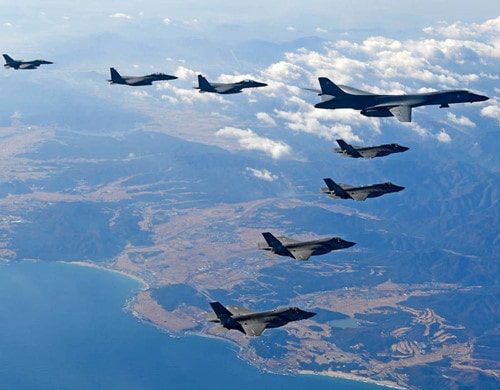 |
| A US fighter squadron participates in the Vigilant Ace exercise, which concluded on December 8th. Photo: USAF. |
Pyongyang has consistently and vehemently opposed joint military exercises by the US and South Korea, viewing them as preparations for an invasion of North Korea. These exercises, coupled with Pyongyang's repeated missile launches, brought the Korean Peninsula to the brink of war in 2017.
ISIS has been driven out of Iraq.
2017 marked significant successes in the fight to eliminate the self-proclaimed Islamic State (IS) in Iraq and Syria. After IS was driven out of its largest stronghold in Aleppo, Syria, it retreated to Mosul, Iraq, considered the terrorist organization's last remaining stronghold.
The Iraqi army, with air support from the US-led coalition, began its campaign to liberate Mosul on October 16, 2016. The Iraqi military forces, supported by the coalition, numbered up to 108,000. Approximately 6,000-12,000 ISIS fighters were entrenched in the city.
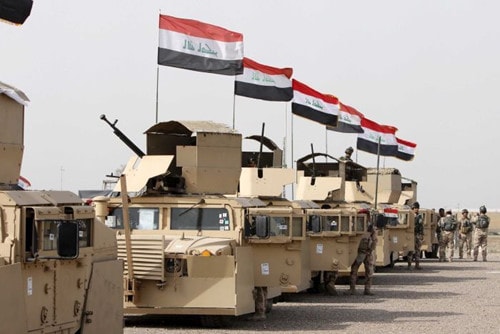 |
| Iraqi army armored vehicles prepare for an offensive to liberate Mosul. Photo: ABC News. |
It took more than 10 months of fierce fighting for IS to be driven out of Mosul, the organization's last stronghold in Iraq, which officially fell. On December 9th, the Iraqi government declared the complete liberation of Iraq from IS occupation.
This event marks a new chapter in the reconstruction of Iraq after more than three years of ISIS's reign of terror. However, analysts warn that although ISIS has been driven out of Iraq, remnants of the organization remain very dangerous and could carry out terrorist attacks in retaliation.
Russia achieves its objective in Syria.
In 2017, the Russian military in Syria continued to conduct operations supporting the Syrian government forces against the remaining remnants of ISIS, as well as other illegal armed groups opposing the government in Syria.
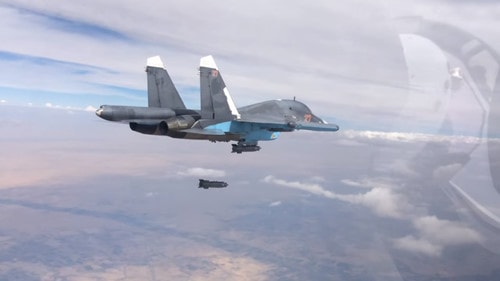 |
| A Russian Su-34 fighter-bomber during a combat mission in Syria. Photo: Russian Air Force. |
In addition, the Russian military also monitored the ceasefire with the opposition and assisted the Syrian army in clearing landmines and unexploded ordnance left over from the war. On December 11, the Syrian government declared that it had completely liberated the country from ISIS. Shortly afterward, Russian President Vladimir Putin visited a Russian military base in Syria and ordered the withdrawal of troops from Syria.
Hours after President Putin's announcement, Russian Defense Minister Sergei Shoigu said that Russian troops had begun withdrawing from Syria. However, analysts believe that Russia will not completely withdraw from Syria but will only reduce the size of its forces there.
Syria plays a strategic role in Russia's presence in the Middle East, so Moscow certainly cannot abandon its position there. Russia's announcement of troop withdrawal suggests that Moscow's primary strategic objective of maintaining the government of Syrian President Bashar al-Assad has been achieved.
Bad luck plagued the US Navy in 2017.
In 2017, the US Navy in the Pacific increased its operations with unprecedented frequency and scale in recent years. However, it was also a year of misfortune for the world's number one naval force.
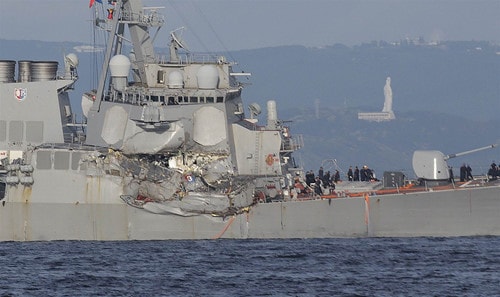 |
| The destroyer USS Fitzgerald was severely damaged after a powerful collision with a container ship. Photo: AP. |
The U.S. Navy experienced five accidents in the Pacific in 2017, including two extremely serious collisions that killed 17 sailors. These were among the worst accidents for the U.S. Navy in recent years.
On June 17, the Arleigh Burke-class destroyer USS Fitzgerald (DDG-62) collided with a container ship off the coast of Japan. The Fitzgerald sustained a large dent on its starboard side. The collision resulted in the deaths of seven sailors.
In the early hours of August 21st, the Arleigh Burke-class destroyer USS John S. McCain (DDG-56) collided with an oil tanker east of Singapore. The collision resulted in the deaths of 10 sailors and left a large hole in the McCain's port side. These consecutive serious accidents have led many to question the operational capabilities of the world's leading navy.
Argentinian submarine mysteriously disappears.
On November 15th, the Argentinian submarine San Juan mysteriously disappeared in San Jorge Bay, about 200 nautical miles off the southern coast of Patagonia. The vessel was carrying a crew of 44, and nearly a month has passed without a trace.
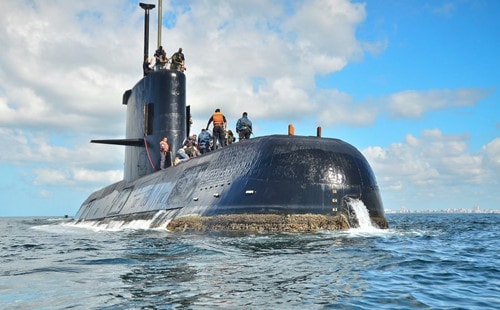 |
| The submarine San Juan has mysteriously disappeared for nearly a month. Photo: Argentine Navy. |
The Argentine Navy, with the assistance of seven other nations and numerous aircraft and warships, has been scouring the South Atlantic for the submarine but has yet to find it. On November 18, the Argentine Navy reported receiving seven satellite calls that may have originated from the missing submarine, but communication could not be established.
On November 23, the Argentine Navy reported detecting an unusual event resembling an explosion near where the submarine San Juan went missing. However, all information remains speculative, and the vessel has yet to be found.
According to Knowledge


