
60 Years Since the Liberation of Hanoi: Echoes of the Triumphal Song
The victorious army returned to Hanoi to a joyful and enthusiastic welcome from the people of the capital. Lines of "Uncle Ho's soldiers" celebrated triumphantly amidst a sea of people and flowers.
On the morning of October 8, 1954, the French army held a flag-lowering ceremony. The military band played the French national anthem. The flag was lowered. The faces of many French officers were wet with tears.
On October 9, 1954, the last colonial soldiers left Hanoi across the Long Bien Bridge. The capital city of Hanoi was completely liberated.
On October 10, 1954, the victorious army returned to Hanoi to a joyful and enthusiastic welcome from the people of the capital. Lines of "Uncle Ho's soldiers" marched triumphantly amidst a sea of people and flowers. The streets were adorned with red flags bearing yellow stars.
Cheers erupted like a surging wave. Radiant faces, smiles, sparkling eyes, waving hands, tears of joy…
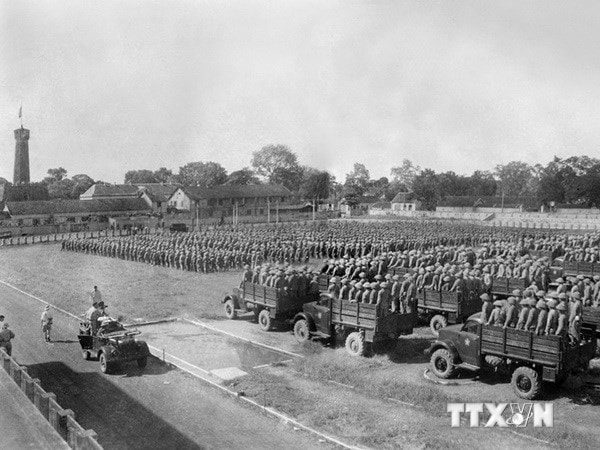 |
| Flag-raising ceremony at the Hanoi Flagpole on October 10, 1954. (Photo: VNA) |
Five city gates welcome
Amidst the autumn weather of Hanoi, Major General Vu Ngoc Diep, a former officer of the Air Defense and Air Force Command, Ministry of National Defense, fondly recalls the momentous days of the nation: the Liberation of the Capital.
At that historic moment, Mr. Diep was a young soldier from Hanoi, not yet 20 years old, serving in the 308th Vanguard Army Division, alongside countless "Uncle Ho's soldiers" who had come from the resistance capital, from the Dien Bien Phu basin filled with gunpowder and enemy corpses, and from the triumphant songs of victory, advancing into Hanoi through all five gates.
Stepping onto the soil of Thang Long, the capital city, the young soldier Vu Ngoc Diep's vision blurred. Before him, the soldiers of Uncle Ho's army, the streets with their dark brown tiled roofs, stained whitewashed walls, and glimpses of low-lying trees were now draped in the vibrant red of the national flag. Thousands upon thousands of red flags with yellow stars fluttered over every city gate, every street corner, and every house.
Thousands upon thousands of young and old faces, a sea of hands waving flags and flowers, welcomed the soldiers of Uncle Ho's army. There were young women, children, and elderly mothers who couldn't contain their emotions, reaching out to grasp the hands of the returning sons of Hanoi.
Like General Diep, "that glorious day" also flooded back into the mind of Mr. Tang Tuan Khang, from Tu Lien ward, Tay Ho district, a historical witness to the hunt, murder, and revenge against the villagers of Tu Tong for failing to surround the French Capital Regiment during the early days of the nationwide resistance.
Recounting the moments of welcoming the victorious army, Mr. Khang enthusiastically said: "At 5 a.m. on October 10, 1954, the curfew had just ended. The villagers of Tu Tong opened their doors to welcome the new day, the day of the Liberation of the Capital. The villagers hung the flags they had sewn themselves on their doors. Everyone wore their best clothes and went out to Nghi Tam and Quang Ba streets to welcome the returning Viet Minh soldiers, following them towards Hoan Kiem Lake."
"It was around 8 a.m. on October 10th. People from Cau Go, Hang Gai, Hang Bong, Hang Dao, and Hang Ngang streets poured out, creating a lively and joyful atmosphere. Everyone held flags and flowers, clapping and singing together. Meanwhile, the soldiers, in their neat uniforms and with the 'Dien Bien Soldier' badge pinned to their chests, returned to the embrace of the people, walking amidst a sea of flags and flowers, receiving a warm welcome from the people. Watching the army march into Hanoi, many people burst into tears. These were tears of joy, elation, and pride. Fresh bouquets of flowers from Hanoi's young women in their elegant ao dai dresses were thrown onto the cars, which the soldiers received with outstretched arms."
Historic flag-raising ceremony
On the afternoon of October 10th, the entire city turned its attention to the Imperial Citadel. On the flagpole, infantry, artillery, engineering, and mechanized units, among others, assembled in a square formation, solemnly performing the flag-raising ceremony.
Atop the Monument, the national flag fluttered in the wind against the clear blue autumn sky. Major General Vuong Thua Vu, Chairman of the Hanoi City Military and Political Committee, stepped forward to read President Ho Chi Minh's appeal to the people of the capital. In it, President Ho Chi Minh instructed: "...After the great transformation, restoring normal life will be complex and difficult, but if the Government strives with determination, and all the people of Hanoi wholeheartedly contribute their efforts with the Government, then we will certainly overcome all difficulties and achieve the common goal of making Hanoi a peaceful, joyful, and prosperous capital."
Recalling that sacred flag-raising ceremony, Lieutenant General Pham Hong Cu was deeply moved: "Looking up at the sky that day, it was so clear and blue. In that autumn sky, the red of the national flag blazed brightly. Even with my eyes closed, it was incredibly beautiful, like a flower in the sky. Below, at the Flagpole Stadium, the troops lined up, consisting of units from the 308th Division and the 57th Regiment of the 304th Division, coordinating to take over Ha Dong town, were lined up in neat rows. The soldiers sat on their vehicles with their bayonets drawn. The scene was so moving that many people shed tears."
"Amidst the joy of victory, there is still a lingering memory of comrades who sacrificed themselves for the country and were not present on this day of return," Mr. Hong Cu said, a hint of sadness on his face.
The old general shared that 60 years have passed since that historic flag-raising ceremony. Soon, the Vietnam People's Army will celebrate its 70th anniversary. Looking back at history, from the Vietnam Propaganda and Liberation Army with 34 people in civilian clothes and handguns, that army has grown into a victorious force in every battle.
This significant growth and maturity is marked by two great wars of national liberation. While in the war against the French, Vietnamese soldiers wore bamboo hats and uniforms bearing the Dien Bien Phu emblem, in the period of fighting for the liberation of the South, they wore steel helmets and drove tanks. This army was honored and praised by the people as "Uncle Ho's soldiers," an armed force of the people, originating from the people, and fighting for the people.
"That army is loyal to the Party and devoted to the people, as Uncle Ho taught, ready to fight for the independence and freedom of the Fatherland, for Socialism, completing every task, overcoming every difficulty, and defeating every enemy. That is the revolutionary heroism of the Vietnamese People's Army created by the Communist Party of Vietnam," Lieutenant General Hong Cu emphasized.
According to Vietnam+


