
8 million migrant workers move from villages to cities.
Approximately 8 million migrant workers from rural to urban areas are facing difficulties accessing public services, social problems, and poor living and working conditions.
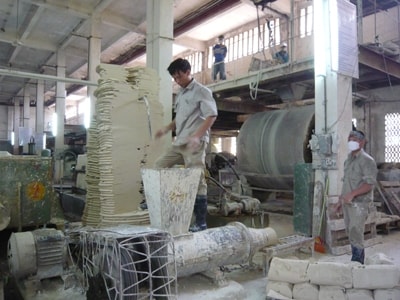
Many migrant workers are working in hazardous and life-threatening environments. Photo: Phong Cam.
The main reason for labor migration is the lack of jobs or low-paying jobs in the local area. Migrant workers under 30 years old account for 69.9%, with an average age of 25 (the majority of migrant workers have a high school diploma).
According to Mr. Pham Vu Dung Ha, who participated in the survey, up to 18.6% of migrant workers face difficulties due to not having registered their permanent residence. The most common difficulties include finding jobs, finding schools for their children, accessing healthcare through health insurance; difficulty obtaining loans, registering businesses, and accessing local support policies.
Mr. Ha also stated that, in response to questions about their current work, 30.5% of migrant workers reported facing noise pollution and dust; 14.1% worked in hazardous conditions; and 10.4% worked in dangerous conditions. A troubling reality is that most migrant workers pay for electricity and water at prices demanded by their landlords, often 2-3 times higher than the regulated rates.
According to Mr. Dao Dinh Long, Director of the Institute for Research and Development Consulting, survey data shows that 61% of workers lack technical skills. This demonstrates that the Ministry of Labor, Invalids and Social Affairs still has much work to do in improving the skills of workers. Up to 90% of respondents said they are renting their homes.
"The biggest concern for migrant workers today is the difficulty in their children accessing public education. Without migrant workers, it would be difficult to achieve the economic growth rates of recent years," Mr. Long said.
What policies are in place for migrant workers?
According to Ms. Nguyen Thi Dan, Head of the Wages - Labor - Employment Department (Ho Chi Minh City Department of Labor, War Invalids and Social Affairs), Ho Chi Minh City is currently attracting a large number of migrant workers from the northern, central, and western provinces.
The government needs a specific policy for migrant workers, identifying their needs (housing, employment, living expenses, etc.) in order to provide assistance. The goal is to prevent migrant workers from being deceived by labor brokers and falling into situations where they lose money and suffer harm. "If migrant workers are left to operate freely as they do now without any organization, they are very likely to fall into social vices," Ms. Dan said.
To support migrant workers, the Ministry of Labour, Invalids and Social Affairs is drafting a Decision on policies to support migrant workers from rural areas to urban areas and industrial zones, which will be submitted to the Prime Minister for approval soon. Deputy Director of the Employment DepartmentLe Quang Trung |
According to Ms. Dan, solutions must come from the localities where migrant workers originate, to understand where they want to go, what they want to do, and how they want to get there. “Ho Chi Minh City does not discriminate against migrant workers from Nghe An and Ha Tinh. The reason migrant workers have difficulty accessing public services is not due to discrimination, but because the city's infrastructure is overloaded and cannot meet the demand, so priority is given to local workers,” Ms. Dan said.
Meanwhile, Ms. Nguyen Thi Kim Oanh, Director of the Department of Labor, War Invalids and Social Affairs of Binh Duong province, informed that the province does not discriminate against migrant workers. However, due to the inability to invest in meeting their needs, migrant workers often suffer disadvantages when accessing public services, from healthcare and education to housing and meals.
"The central government allocates resources based on population. Binh Duong has 1.8 million people, but the budget only serves 1.4 million; while the workforce in businesses within the province adds approximately 1 million people," Ms. Oanh said.
According to Ms. Oanh, in 2013, Binh Duong province saw an increase of approximately 24,000 students. To meet this demand, the province needed 2 trillion VND to build schools. "Even if we wanted to meet the educational needs of migrant workers' children, it would be difficult because the allocated funds are limited, let alone a school project which takes 3-4 years from commencement to completion," Ms. Dan said.
According to Mr. Le Quang Trung, Deputy Director of the Employment Department, there is a positive trend where many localities are now "joining forces" with about 30 other provinces to supply labor to businesses in need.
"In the long term, to attract migrant workers, major provinces and cities must have policies to invest in housing, provide information about the labor market, and have specific policies for migrant workers," Mr. Trung said.
According to Mr. Trung, planning must precede implementation, with the early involvement of the Ministry of Labor, Invalids and Social Affairs, so that localities can proactively manage their human resources. "Many projects are currently stalled because localities cannot meet the human resource needs of businesses," Mr. Trung asserted.
According to Tien Phong-PH


