
9 misconceptions about saving gasoline
Filling the tank completely to prevent evaporation, shifting to neutral when stopped, or using fuel additives are just some of the misconceptions about fuel efficiency.
Regardless of whether fuel prices rise or fall, drivers always know how to apply various methods to make their vehicles operate as fuel-efficiently as possible. Many fuel-saving techniques are effective for older cars but useless for newer cars equipped with electronic fuel injection systems.
1. Fill the fuel tank completely to prevent evaporation.
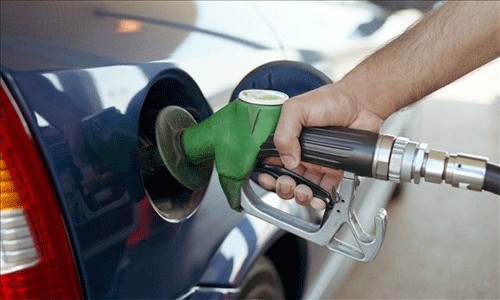 |
Keeping your gas tank full while traveling is a good idea, as you never know how far the next gas station is. Some people believe that letting the tank get nearly empty causes the fuel to evaporate faster. This might be true for older cars, but newer models are often equipped with fuel vapor sensors. These newer models also use a fuel compression system, accompanied by a warning light on the dashboard, informing the driver if the fuel cap is loose or not properly tightened.
2. Regarding neutral (N) gear when stopping the vehicle.
This method was once used by many drivers with vehicles equipped with carburetors. However, modern vehicles are equipped with pre-programmed electronic fuel injection systems. When the vehicle is stopped, the amount of fuel injected into the combustion chamber is minimal, even when in gear. This only causes the gearbox to wear out faster.
3. Manual transmissions are more fuel-efficient.
Skilled drivers often choose manual transmissions because they can better control the engine's RPM through smooth gear changes. Nowadays, automatic transmissions use advanced technology that handles the engine better than a driver combining clutch and gear shifting. Whether or not it's fuel-efficient depends on driving skill, not the type of transmission.
4. A dirty air filter wastes fuel.
In older cars, air was typically drawn directly into the carburetor through an air filter. This made the air filter prone to clogging, which could affect fuel consumption. Nowadays, thanks to the ECM (Engine Control Module), the air-to-fuel ratio is precisely regulated. In modern cars, air passes through a filter and an air sensor, and the ECM calculates and adjusts the ratio accordingly. This means less air entering the engine means less fuel goes into the carburetor. Therefore, a dirty air filter will have less impact on fuel consumption and more on the car's performance. A weak and sluggish car will feel less powerful.
5. Refueling on a cool day (or early morning) will yield more gasoline.
Many people still believe that refueling on a cool day or early in the summer morning will give their car more fuel because the gasoline evaporates less at these times. This might be true if pumping directly from a tanker truck, but it's no different if pumping at a gas station. Gas at stations is usually stored in large underground tanks, so the outside temperature is unlikely to affect the tanks.
6. Cruise control helps save fuel.
Cruise control helps the car maintain a constant speed, and most drivers believe it saves fuel. This might be true on long journeys and flat terrain. However, on inclines, the system will suddenly accelerate, thus burning more fuel. To avoid sudden acceleration, drivers can temporarily disable cruise control and manually control the accelerator pedal to avoid danger and save fuel.
7. Use of additives
Most car owners want to save fuel, which is why auto parts stores always offer fuel-saving additives with enticing advertisements. But do these additives actually save fuel? Some may even cause clogging or blockages, leading to increased maintenance and repair costs. Furthermore, the effects of these additives on the engine are often not addressed.
8. The age of a car is directly proportional to its fuel consumption.
In fact, the age of the car doesn't significantly affect fuel consumption, as long as it's regularly maintained and cared for.
9. Lower the rear door of the truck.
Many pickup truck drivers believe that lowering the tailgate increases aerodynamics, thus improving fuel efficiency. However, according to General Motors engineers, driving with the tailgate closed is what actually creates aerodynamic efficiency.
According to Vneconomy


