
Who "magically" transformed Chinese oranges into Vinh oranges?
(Baonghean) - From March to August each year, Vinh oranges are not yet harvested, but many stalls are still overflowing with them, including oranges imported from China that are always advertised as Vinh oranges to make a profit.Every day, around 2-3 AM, 4-5 trucks carrying Chinese oranges arrive at Vinh market for sale.
>>> Discovering the orange capital of Vinh
Market chaos
The chaotic state of the orange market is a pressing issue we have observed in orange-growing regions across the province. Many orange growers in the orange-growing areas of Quy Hop, Con Cuong, Yen Thanh, and Dinh Son (Anh Son)... have expressed this concern, as numerous small traders involved in the sale and distribution of Vinh oranges have profited by mixing in lower-quality, less valuable oranges.
Orange growers also assert that from March to August each year, there are no Vinh oranges available, but many stalls in the province still import oranges from other regions, including those imported from China, and always present them as Vinh oranges for sale.
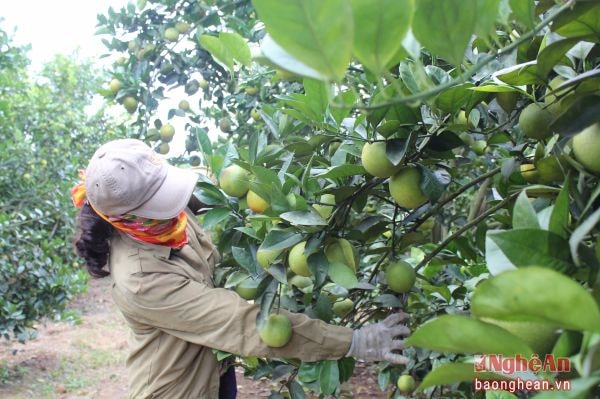 |
| People in Dinh Son commune, Anh Son district, are tending their orange orchards. |
Mr. Trinh Xuan Giao, the owner of a large orange farm in Dong Thanh commune (Yen Thanh district), wrote on his Facebook page about the counterfeiting of Vinh oranges as follows: “Currently, in the Nghe An market, besides Vinh oranges (grown in Quy Hop, Nghia Dan, Yen Thanh districts…), there are also Cao Phong oranges from Ha Giang and China.”
Among them, Chinese oranges lead with the largest consumption volume (estimated at about 30-40 tons/day) because of their low price, diverse and attractive designs, and quality; "every day, around 2-3 AM, 4-5 trucks carrying Chinese oranges arrive at Vinh market for sale."
They have all the necessary import documents, but the concern is that after being placed on stalls or transported to other places, Chinese oranges are no longer Chinese oranges. Customers are often confused with Vinh oranges in general because Chinese oranges have changed their appearance to the point that consumers can't tell the difference! I myself have been growing oranges for 12 years, but when faced with Chinese oranges, I'm at a loss. Only the sellers know the truth!"
In reality, the warnings from orange growers like Mr. Trinh Xuan Giao are true. In the centers, everywhere you look, every kiosk and shop displays signs advertising Vinh oranges, Quy Hop oranges, etc., but there's no evidence to support this claim. Meanwhile, market management officials acknowledge that Chinese agricultural products, including oranges, are still present in Nghe An!
Or, during the months of May to July each year, traveling along National Highway 48, the section passing through the towns of Tuan, Nghia Thuan..., and National Highway 7, the section through Dinh Son commune (Anh Son district), Bong Khe (Con Cuong district), even though it's not the peak season, you can still see many oranges being sold. The oranges are still a vibrant golden color, the fruits are uniform in size, and the leaves are still green.
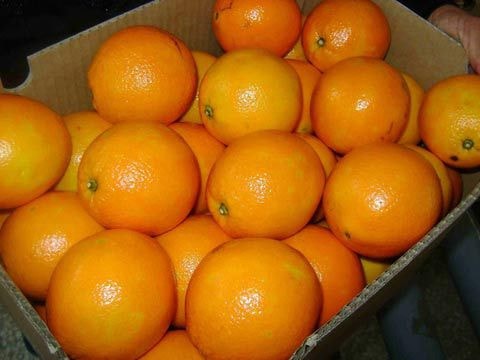 |
| Chinese oranges have a bright, shiny color and a smooth peel. |
Mr. Le Viet Minh, Deputy Director of Xuan Thanh Agricultural Company Limited, confirmed: "In May and June, you couldn't find a single orange in Quy Hop. The oranges sold by locals along the roadside are 100% Chinese oranges," and he lamented: "For a small profit, they use all sorts of tricks to deceive consumers. This is like 'throwing stones' at the Vinh orange brand!"
Faced with the problem of counterfeit and fake oranges, honest orange farmers like Ms. Phan Thi Tam in Pha village, Yen Khe commune (Con Cuong district), are extremely upset: "Every year, traders come to buy in very large quantities, but now they only choose to buy small amounts. They openly say they only buy a small amount from the orchard, and they will mix oranges from other places with the rest to sell, so they can make a profit."
For example, orange growers in Bai Phu, Dinh Son commune (Anh Son district), affirm that many low-quality oranges are sold along National Highway 7, especially at stalls displaying signs like "Bai Phu Clean Orange Orchard - Premium Quality". These vendors don't produce the oranges themselves but source them from other localities, using the signs simply to deceive consumers.
The risk of "losing" in brand competition.
While giving us a tour of his 0.7-hectare orange orchard laden with fruit, Mr. Kieu Quang Vinh from Minh Hop commune (Quy Hop district) expressed confidence in a bountiful harvest, noting that Cao Phong oranges from Hoa Binh province are a real competitor to Vinh oranges.
“What is certain is that after two consecutive years of Cao Phong oranges being promoted through district-level and then provincial-level festivals, the pride of Vinh oranges is threatened,” Mr. Vinh said, analyzing: “We can do well in planting, caring for, and protecting oranges thanks to accumulated experience over the years. However, promoting our orange products widely is something we haven’t been able to do yet. We urgently need the support of the Orange Growers Association as well as guidance from the government at all levels.”
According to Mr. Duong Minh Tan, head of Tan Thanh Cooperative, Vinh oranges excel in all aspects, from appearance to quality. However, the issue of promoting the product and brand in the market to ensure high and sustainable competitiveness for Vinh oranges is still too weak.
“This is also the reason why the nine orange-growing households in Minh Hop decided to establish an orange cooperative. By following the same production process and producing high-quality oranges, we have registered our own orange brand, “Tan Thanh,” to seek new and healthy competition in the market.”
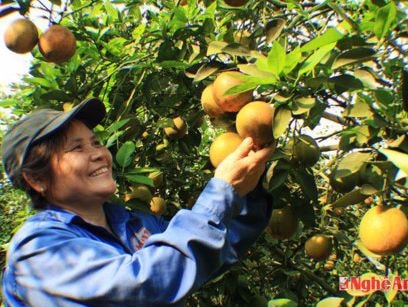 |
| Vinh oranges have become a unique brand of Nghe An province. |
Are associations and managers facing difficulties?
According to Mr. Hoang Minh, Director of Xuan Thanh Agricultural Company Limited and Chairman of the Vinh Orange Association, the concerns raised by producers stem from reality. The province has approximately 4,000 hectares of orange groves, supplying tens of thousands of tons to the market annually, but transactions are primarily decided by private traders. There are very few authorized Vinh orange dealers in the province and major centers nationwide. Furthermore, producers have not yet paid sufficient attention to labeling their oranges.
This limitation stems partly from consumers and producers, but also partly from the association's shortcomings in managing and operating its members.
One significant shortcoming worth considering is that the Vinh Orange Association, established in 2010, lacks specific regulations regarding its functions, duties, and operating mechanisms, and has not been updated annually.
According to Mr. Nguyen Dinh Tung, Chairman of the People's Committee of Quy Hop district: Recognizing the important role of orange trees in economic development, Quy Hop has developed resolutions and projects to implement them. However, protecting the market and preventing counterfeiting and mixing of Vinh oranges with other types of oranges is proving difficult for the district.
At a seminar on Vinh oranges in early September 2016, Mr. Nguyen Dinh Tung stated: "We have been informed by the people that many households in Quy Hop are bringing oranges from other places to sell, but we cannot yet hold them accountable for selling counterfeit oranges because they lack proper labels and registrations. Currently, many types of oranges are sold along the Ho Chi Minh Highway, all labeled as Quy Hop oranges, but it's impossible to find any violations based solely on the label!"
With 12 years of experience in growing oranges, Mr. Trinh Xuan Giao - owner of Thien Son orange farm (Dong Thanh, Yen Thanh) advises consumers: "Naturally ripened oranges usually have a yellow color at the bottom that spreads upwards. Avoid oranges with evenly distributed yellow spots all over the fruit, as these are oranges that have been artificially ripened." If the stem and leaves are wilted but the orange is still firmly attached to the branch, it means the orange has been treated with chemicals to keep it fresh and prevent leaf drop. This is often seen in oranges originating from China, transported to Vietnam over several days but "disguised" with leaves to deceive consumers into thinking they are freshly picked domestic oranges; Choose oranges with a natural, fresh color, turning yellow with a hint of green. Select oranges with more yellow than green, as this indicates they are ready to harvest and have the right amount of sweetness and flavor. Choose oranges that feel heavy in your hand. These are the ones with more juice. Oranges with thick, hard skin, that are large but light, are overripe and dry. If the seller allows you to gently scratch the peel of the orange with your fingernail and smell the characteristic orange aroma, it's highly likely that it's a Vinh orange…”. |
(to be continued)
NPV
| RELATED NEWS |
|---|


