
Who controls the volume of minerals extracted at the mines?
(Baonghean.vn) - Recently, in Nghe An province, inter-agency inspection teams have repeatedly discovered many businesses exploiting sand and gravel in excess of permitted levels for many years. Meanwhile, local authorities say it is very difficult to monitor this issue.
Common violations
For months now, severe erosion has been occurring along the Lam River in communes such as Long Xa and Hung Linh (Hung Nguyen district). Fertile alluvial plains, typically cultivated by locals for two harvests, are often swept away into the river just before harvest. As a result, many households are no longer willing to cultivate their land, leaving it fallow. The riverbank erosion in these two communes is so serious that Hung Nguyen district is considering spending over 100 billion VND to build and upgrade the riverbanks.
Not far upstream from the landslide area, a series of large barges are busily pumping sand from the riverbed. According to local residents, excessive sand mining is one of the main causes of the landslide. While previously people were concerned about illegal sand mining, recently they have another worry: licensed sand mining companies are exceeding the permitted levels. "This is essentially no different from illegal mining. It's even more dangerous because at a mining site, the relevant authorities have to assess it before allowing them to mine at a certain level. But now they're exceeding the limit, which will have a huge impact," said Mr. Nguyen Long Hanh (75 years old, Tan Thuong Loc commune, Nam Dan district) angrily.
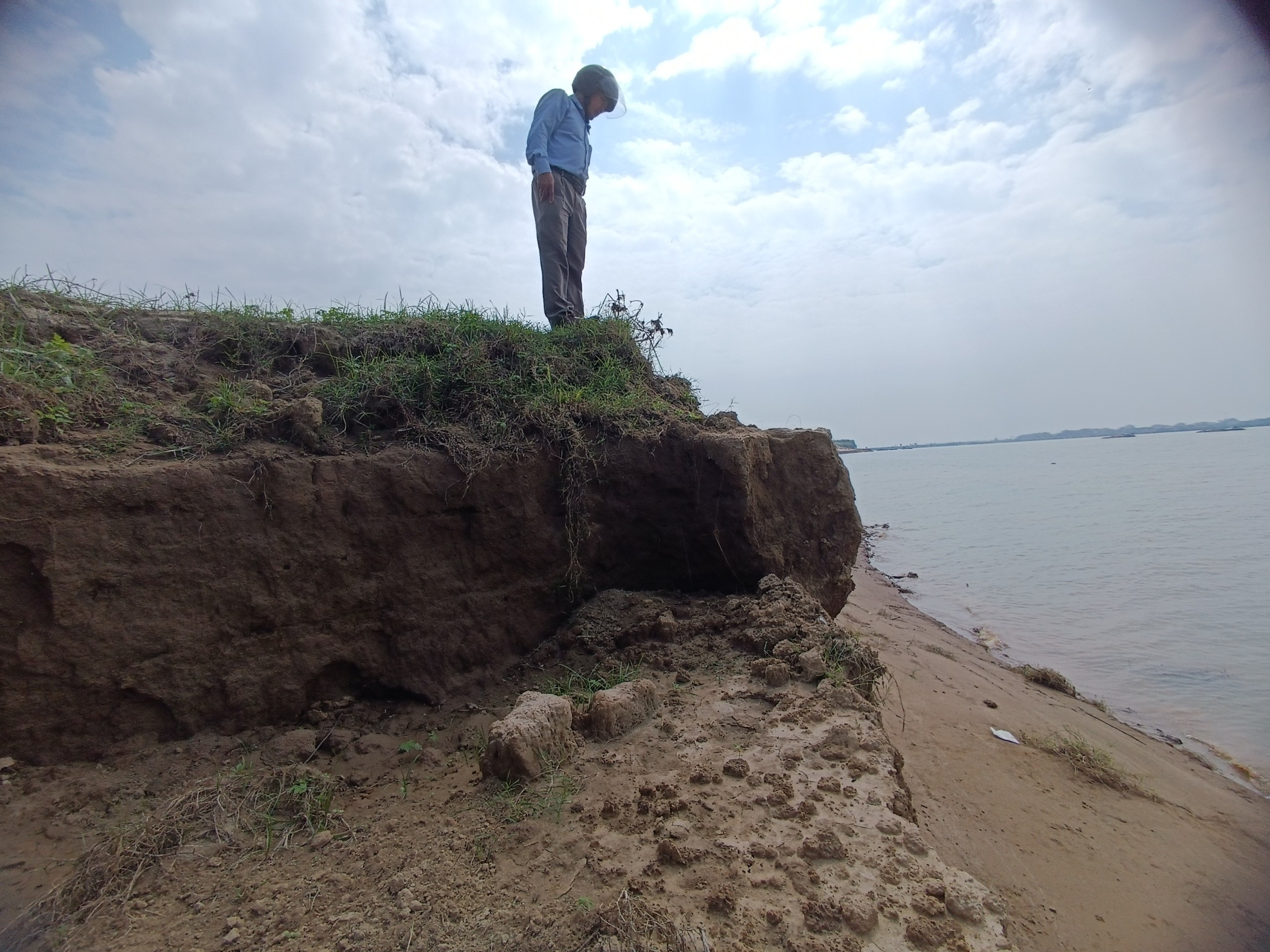 |
Severe erosion is occurring on both banks of the Lam River. This is partly due to excessive sand mining. (Photo: TH) |
In Nam Dan district, Nghe An province, the People's Committee recently fined Lam Son Dai Thanh Cooperative 900 million VND and suspended its mineral exploitation activities for 5.5 months for exceeding the permitted sand mining limit. This cooperative is one of the cooperatives with the most sand mining barges in Nghe An province. It currently owns 53 barges licensed to mine sand on the Lam River section passing through Khanh Son and Tan Thuong Loc communes. What is concerning is that the cooperative exceeded the permitted mining limit for two consecutive years without detection by local authorities and relevant agencies.
It was only recently, when a joint inter-agency inspection team from the province conducted an on-site inspection and compared it with tax invoices, that it was discovered that in 2020, Lam Son Dai Thanh Cooperative had exceeded its permitted mining capacity by 80.8%. In 2021, it exceeded its annual permitted mining capacity by 171.6%.
More seriously, in Thanh Chuong district, Thanh Chuong Sand, Gravel and Transportation Joint Stock Company exceeded its permitted sand mining capacity by 211.2% in 2020. In 2021, the company also exceeded its permitted annual mining capacity by 208.6%. The company was subsequently fined 900 million VND and had its mineral mining operations suspended for 5.5 months.
Similar to Lam Son Dai Thanh Cooperative, Thanh Chuong Sand, Gravel and Transportation Joint Stock Company is a major player in the sand mining sector. This company has been licensed to operate three mines on the Lam River section passing through Vo Liet, Thanh Chi, and Dong Van communes. Furthermore, all 15 sand and gravel collection and trading yards in Thanh Chuong district are owned by this company.
Not only in Nam Dan and Thanh Chuong districts, but also in Do Luong district, there has recently been a situation of sand mining exceeding the permitted limit. Specifically, in September 2022, the People's Committee of Nghe An province issued a decision to fine Hoang Nguyen Co., Ltd. 300 million VND for exceeding the permitted annual mining capacity stated in its mining license. This company was licensed to mine sand on the Lam River section from Luu Son commune, Do Luong district, to Cat Van commune, Thanh Chuong district. The permitted annual sand mining capacity of this company is 23,920 m³.3.
However, upon inspection, it was found that in 2021, this company had extracted 30,751.5 cubic meters of oil.3Exceeding capacity by 28.5%, with an excess volume of 6,831m³.3In addition to the fine, the Provincial People's Committee also ordered Hoang Nguyen Co., Ltd. to implement measures to improve environmental protection facilities, remedy environmental pollution, and repair damage to technical infrastructure caused by exceeding the permitted mining capacity.
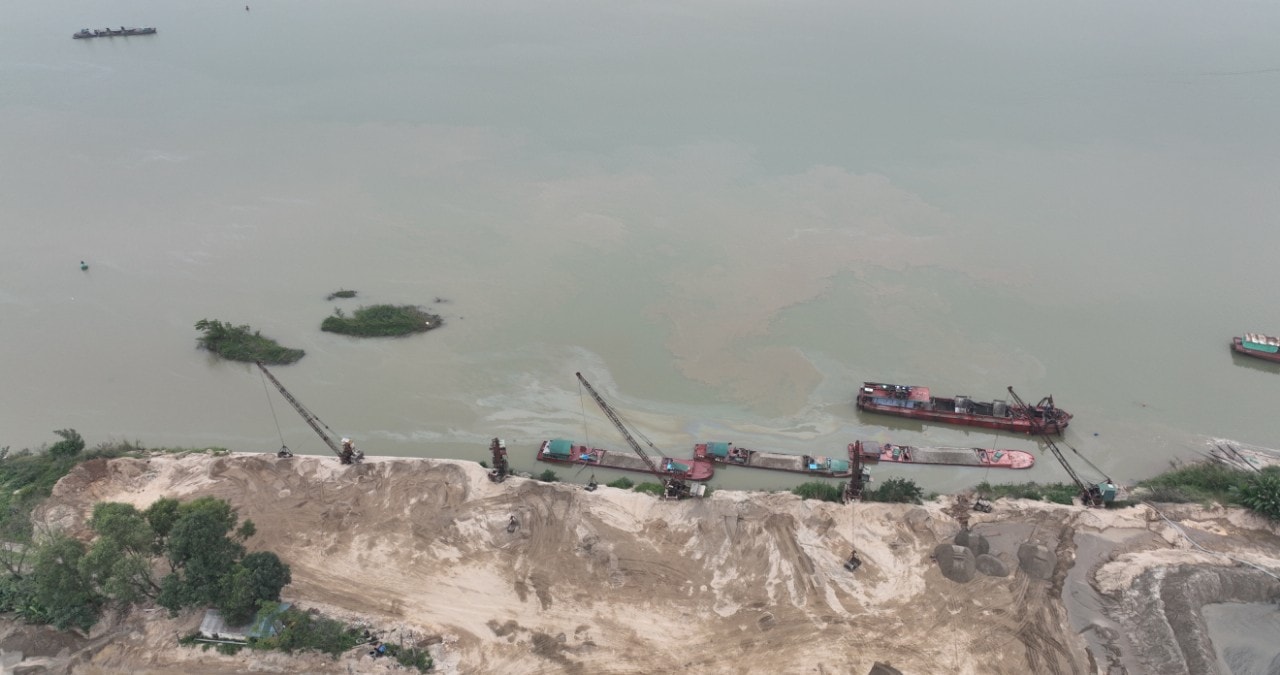 |
A sand storage area along the Lam River. Photo: TH |
Difficult to monitor?
According to Mr. Le Dinh Thanh, Vice Chairman of the Thanh Chuong District People's Committee, there are 8 licensed sand and gravel mining areas in the district. Of these, 4 mines belong to Hoang Nguyen Co., Ltd. and Thanh Chuong Sand, Gravel and Transportation Joint Stock Company. These two companies were recently fined for exceeding their permitted mining capacity.
The leaders of Thanh Chuong district also acknowledged the situation of illegal sand mining as well as sand mining outside the licensed mining areas. In recent years, the locality has fined an average of more than 1 billion VND annually for these violations. However, regarding mining exceeding capacity, Mr. Thanh said it is very difficult to monitor. "Illegal mining or mining outside the licensed area can be detected, but controlling the volume is very difficult," Mr. Thanh said.
Similarly, a leader from the Department of Natural Resources and Environment of Nam Dan district stated that the unit cannot manage this issue. “We cannot manage that. They mine at the mine, transport the materials to Hung Nguyen district for sale; who can supervise that? We only control whether mining takes place within the mine or not, as long as it doesn't leave the mine. As for the mining capacity, how can we manage that?” this official said, adding that controlling this situation requires the involvement of many units, especially the waterway traffic police.
"When the barge leaves the mine and transports the goods to the point of sale, this force will carefully check the documents, inspect the invoices, and then take action based on the tax invoices," this person added.
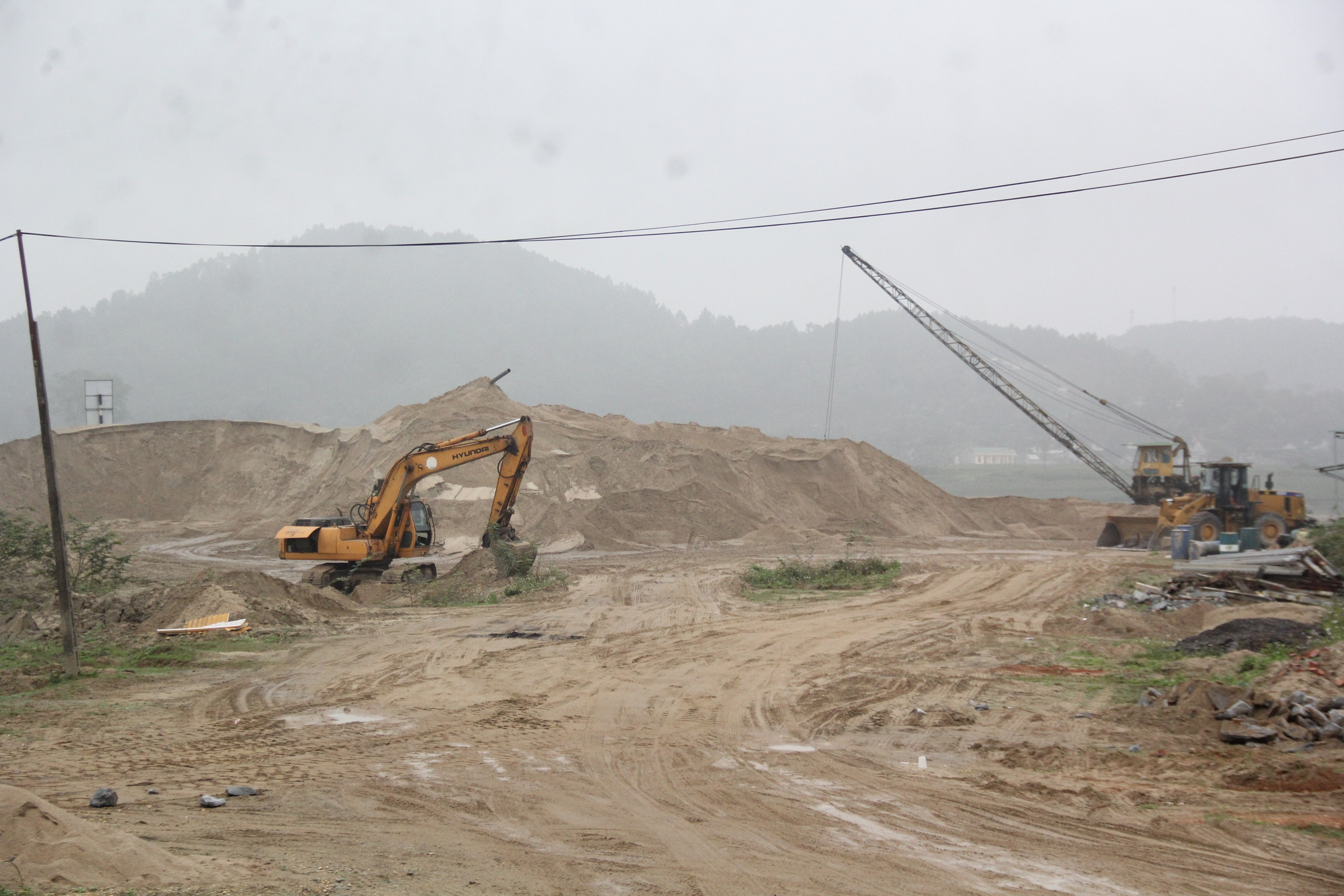 |
Local authorities claim it is difficult to monitor the actual volume of minerals extracted. Photo: TH |
Meanwhile, Major Nguyen Khanh Dung, Head of the Waterway Police Team (Traffic Police Department – Nghe An Provincial Police), said that the unit only manages vehicles, not wharves, docks, or mining sites, making control very difficult. “On land, we can use satellite imagery for monitoring, but underwater, it’s impossible. In principle, when selling goods, the point of sale must have a weighing scale, cameras, and daily entry and exit data. But currently, almost no place has these,” Major Dung said.
An official from the Department of Natural Resources and Environment of Do Luong district said that, in reality, some businesses have installed cameras and weighing scales, but only to deceive inspection teams. “When the inspection team leaves, they turn off the cameras, and many vehicles don't even pass through the weighing station. Therefore, it's very difficult to monitor. To effectively monitor, simply installing cameras and weighing scales isn't enough; the camera system also needs to be connected to the police and the Tax Department. However, this solution has not yet been implemented,” the official said.
Strengthening state management
Regarding this issue, the People's Committee of Nghe An province has just issued a plan to strengthen state management of mineral resources in the province. Accordingly, the Provincial People's Committee requires departments, agencies, units, and localities to clearly define their leading and coordinating responsibilities in state management of mineral resources, as a basis for implementing assigned tasks synchronously, promptly, and effectively. Furthermore, it aims to strengthen state management of mineral resources, ensure rational and economical exploitation and use of mineral resources, meet the requirements of sustainable development, increase economic efficiency, and generate revenue for the state budget…
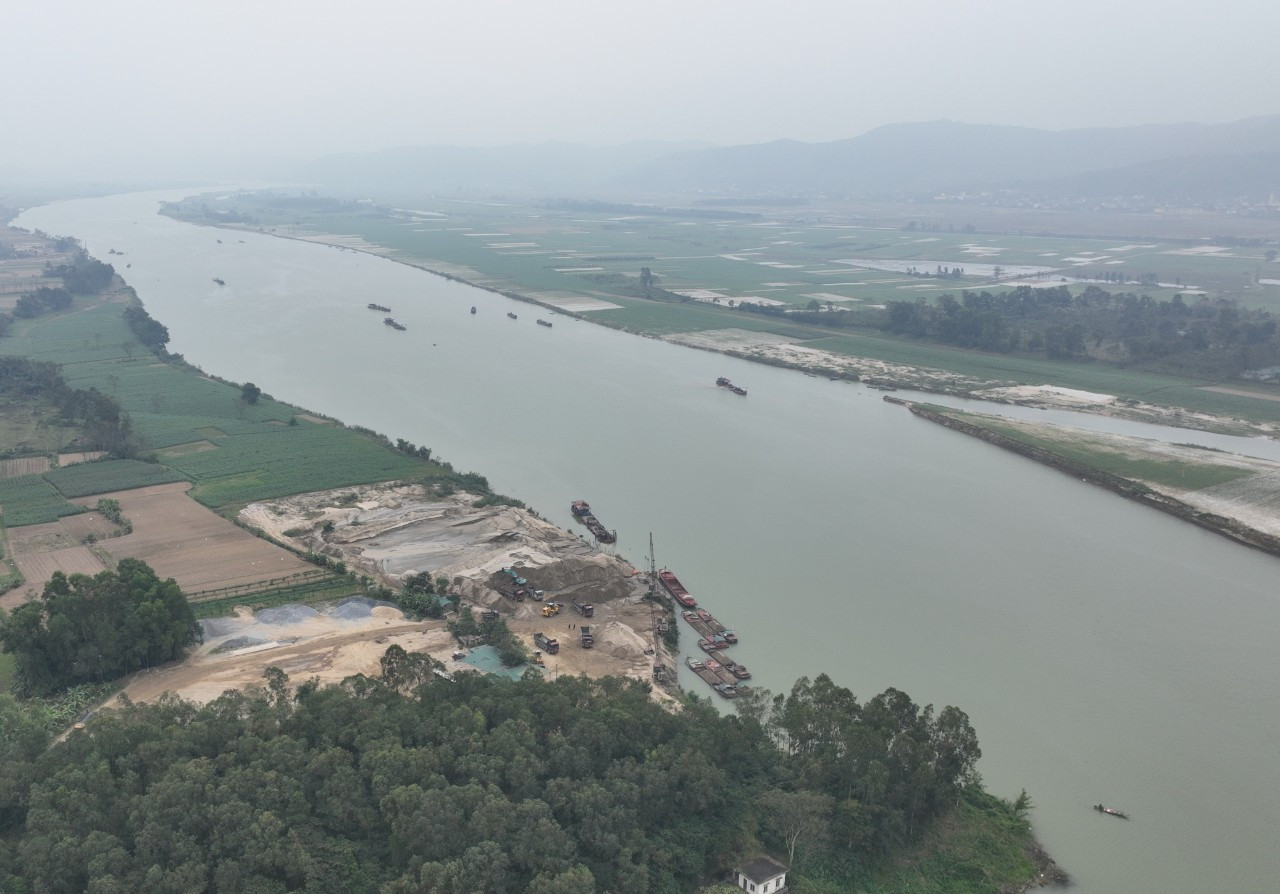 |
Barges extracting sand on the Lam River section passing through Nam Dan district. Photo: TH |
Furthermore, it is necessary to thoroughly inspect and address the installation of cameras and weighing stations by businesses and organizations/individuals exploiting and trading in sand and gravel mineral storage areas; to study regulations on connecting surveillance camera data at storage facilities to store information and data from mining units with the Tax authorities and resource management agencies to monitor mining output. Strictly control invoices, documents, and origin to prevent the legalization of illegal mineral exploitation and the operation of unlicensed mineral businesses. Establish a coordination mechanism between the Tax authorities, the Police, and the Market Management Department to handle cases of illegal mineral transportation and trading. Improve the quality of inspection, examination, and handling of violations in mineral activities; monitor and review the rectification and compliance with legal regulations after inspections and examinations. Research, develop, and improve the information system and database on minerals and mining enterprises in Nghe An province.


