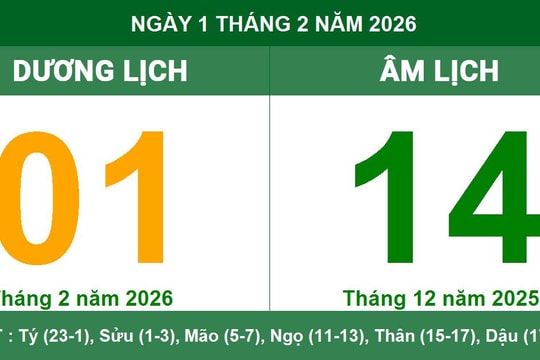
DayGregorian calendar:01-02-2026
DayLunar calendar:14-12-2025
Day of the week:Sunday
DayYear of the HorsemonthYear of the OxyearYear of the Snake (乙巳)
HourZodiac:Rat (23-1), Ox (1-3), Rabbit (5-7), Horse (11-13), Monkey (15-17), Rooster (17-19)
| Gregorian calendar | Lunar calendar |
|---|---|
| February 2026 | December 2025 (Year of the Snake) |
|
01
|
14
Day:Year of the Horse, Month:Year of the Ox Solar terms:South Korea |
| Auspicious Hours (Good Hours) | |
| Rat (23-1), Ox (1-3), Rabbit (5-7), Horse (11-13), Monkey (15-17), Rooster (17-19) | |
|
|
Rat (23:00-23:59); Ox (01:00-02:59); Rabbit (05:00-06:59); Horse (11:00-12:59); Monkey (15:00-16:59); Rooster (17:00-18:59) |
|
|
Tiger (03:00-04:59); Dragon (07:00-08:59); Snake (09:00-10:59); Goat (13:00-14:59); Dog (19:00-20:59); Pig (21:00-22:59) |
|
|
These days are considered inauspicious: ButLunar Taboo Day"The 5th, 14th, and 23rd of the month - Going out for fun is risky, let alone going out for business..." |
|
|
Day:Year of the Horse- meaning the Heavenly Stem and Earthly Branch are the same (both Fire), this day is an auspicious day. - Elemental influence: Day of the Heavenly River Water, unfavorable for those born in the year of Canh Ty. - This day belongs to the Water element, which clashes with the Fire element, except for the following zodiac signs: Mau Ty, Binh Than, and Mau Ngo, which belong to the Fire element and are not affected by Water. - The day of the Horse is in harmonious combination with the Goat, and in triple harmony with the Tiger and Dog, forming a Fire element. It clashes with the Rat, is in conflict with the Horse and Rooster, harms the Ox, destroys the Rabbit, and is in absolute opposition to the Pig. |
|
|
ButBing"If you don't repair your stove, you'll encounter a fire hazard." ButNoon"It is not advisable to re-roof a house because it will have to be re-roofed later." |
|
|
Day:Void- That is, Hung Day. Things are likely to fail. Work will come to a standstill, progress will be delayed, and obstacles will arise. Money and possessions will be lost, and reputation and prestige will decline. It's a bad day in every respect, so it's best to avoid undertaking any endeavors to minimize the chances of failure. "The Void encounters an urgent divination." |
|
|
Rabbit : Rooster (Mao Nhat Ke) - Wang Liang: Bad (Hung Tu) The ruling animal is the rooster, governing Sunday. Both construction and creation are good. Burial is strictly forbidden on this day. Marriage, opening a canal or waterway, opening a business, traveling, making or laying a bed, and constructing or building doors are also considered inauspicious. All other activities are also unfavorable. Therefore, absolutely no burials should be conducted on this day. : - When the Rooster and Rabbit stars are in the Goat sign, one loses ambition. In the Ất Mão or Đinh Mão signs, it is very auspicious. The Mão day is auspicious for marriage; on the Quý Mão day, undertaking any project will lead to financial loss. - Compatible with 8 days: Ất Mùi, Đinh Mùi, Tân Mùi, Ất Mão, Đinh Mão, Tân Mão, Ất Hợi, and Tân Hợi. Mão: Day of the Rooster (the chicken): Day star, bad star. Best for construction. Unfavorable for weddings, funerals, installing or repairing doors. "The star of the Rabbit creates the ox that advances into the field." |
|
|
Direct What should be doneDrawing up contracts, conducting transactions, breaking ground and leveling the land, seeking medical treatment, hunting animals and fish, searching for and apprehending thieves and robbers. Building foundations and walls. Do not:Moving house, traveling far away, opening a business, spending money. |
|
|
Good star: - Bright Star: Everything will go well - Star of the Mirror Heart: Auspicious for funerals - The God of Salvation Star: Auspicious for rituals, lawsuits, and clearing injustices (warding off evil influences). Bad star: - Moon Fire and Poison Fire: Unfavorable for roofing and building kitchens. - Desolate Star: Bad for everything - The Crying Ghost Star: Unfavorable for rituals and funerals. |
|
|
DayWhere is Thanh Long?It is auspicious to set out early in the morning. Pray for financial success and good fortune. May everything go as you wish. |
|
|
Departing in the Southwest direction to welcome the 'God of Joy'. Departing in the East direction to welcome the 'God of Wealth'. |
|
|
From 11:00 AM to 1:00 PM (Noon) and from 11:00 PM to 1:00 AM (Midnight)Arguments, quarrels, and disputes should be avoided; caution is advised. It is best to postpone departures. Guard against curses and avoid contracting illnesses. In general, activities such as meetings, debates, and official business should be avoided during this time. If it is absolutely necessary to engage in such activities during this time, it is advisable to keep quiet to minimize the risk of fights or arguments. From 13:00-15:00 (Goat) and from 01:00-03:00 (Ox)This is a very auspicious time; traveling often brings good fortune. Business and trade will be profitable. Travelers will soon return home. Women will receive good news. Everything in the household will be harmonious. If there is illness, prayers will bring recovery, and the whole family will be healthy. From 3 PM to 5 PM (Monkey) and from 3 AM to 5 AM (Tiger)Seeking wealth is not beneficial, or often leads to disappointment. Leaving home may result in loss or misfortune; important matters may be thwarted; encountering evil spirits requires offerings and rituals for peace. From 5 PM to 7 PM (Rooster) and from 5 AM to 7 AM (Rabbit)Everything will go well; it's best to seek wealth in the southwest direction – your home will be peaceful. Those who travel will be safe. From 7 PM to 9 PM (Tuất) and from 7 AM to 9 AM (Thìn)Plans are difficult to succeed; seeking fortune and wealth is uncertain. Lawsuits should best be postponed. No news yet from those who have traveled far. Lost money or belongings, if found in the South, can be recovered quickly. Beware of arguments, conflicts, or petty gossip. Work will be slow and protracted, but it's best to be thorough in everything you do. From 9 PM to 11 PM (Pig) and from 9 AM to 11 AM (Snake)Good news is coming soon. If you are seeking fortune and wealth, head south. Business trips and meetings will bring good luck. Those who travel will receive news. Livestock farming will be prosperous. |
February 1st, 2026 corresponds to the 14th day of the 12th lunar month. It is the day of Bính Ngọ, the month of Kỷ Sửu, and the year of Ất Tỵ.
February 1st, 2026 is a Sunday.
December 14th in the lunar calendar is an ordinary day.
December 14th in the lunar calendar is the dayWhere is the Dragon Fruit?.
Origin of the lunar calendar
The lunar calendar, also known as the perpetual calendar, is a type of calendar based on the cycles of the moon. It is a unique calendar. In fact, the lunar calendar is the Islamic calendar, in which each year contains exactly 12 lunar months. The characteristic of a purely lunar calendar, as in the case of the Islamic calendar, is that it is a continuous cycle of the full moon and is not tied to seasons. Therefore, the Islamic lunar year is about 11 or 12 days shorter than each solar year, and only returns to align with the solar year after every 33 or 34 Islamic years. The Islamic calendar is used primarily for religious purposes. In Saudi Arabia, the calendar is also used for commercial purposes.
Most other types of calendars, whether called "lunar calendars" or perpetual calendars, are in fact lunisolar calendars. This means that in these calendars, the months are maintained according to the cycle of the Moon, but sometimes leap months are added according to certain rules to adjust the lunar cycles to match the solar year. Currently, in Vietnamese, when people talk about the lunar calendar, they think of a calendar based on the principles of the Chinese calendar, but modified according to UTC+7 instead of UTC+8. It is a lunisolar calendar in the truest sense, not a purely lunar calendar. Because the calculation of the lunar calendar differs from that of China, the Vietnamese Lunar New Year sometimes does not completely coincide with the Spring Festival of China and other countries influenced by Chinese culture and the Sinocentric cultural sphere.
Because the purely lunar calendar has only 12 lunar months (corresponding months) in each year, this cycle (354.367 days) is sometimes also called a lunar year.
Lunar and Solar Calendar
The lunisolar calendar is a type of calendar used by many cultures, in which the dates indicate both the lunar phase (or lunar cycle) and the duration of the solar year (solar calendar). If the solar year is defined as the tropical year, the lunisolar calendar will provide indication of the seasons; if it is calculated according to the astronomical year, the calendar will predict the constellations near which a full moon (the "see-see") is likely to occur. There is usually an additional requirement that a year contains only a natural number of months, in most years 12 months, but every two (or three) years there is a year with 13 months.

Governing body: Nghe An Provincial Party Committee
Director: Tran Minh Ngoc
Electronic newspaper operating license number: 153/GP-BTTTT
Issued by the Ministry of Information and Communications on March 24, 2022






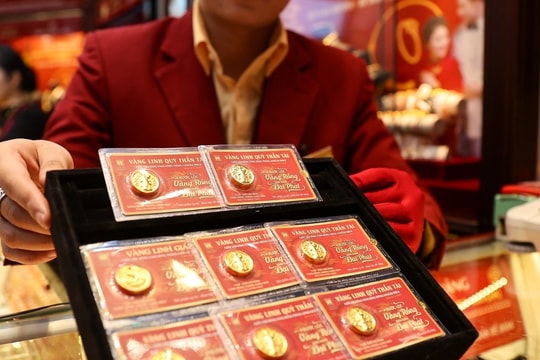

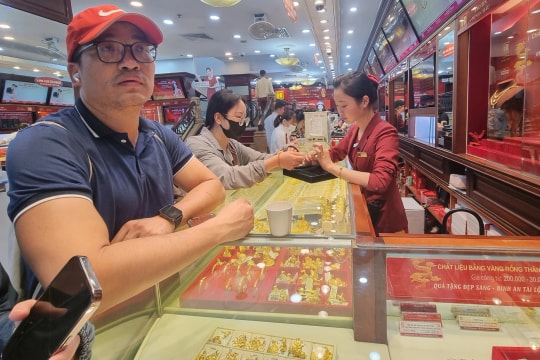
.jpg "Giá vàng hôm nay 1/2/2026: Chốt tháng 1 giá vàng SJC tăng hơn 19 triệu, vàng thế giới tăng hơn 500 USD")