
Music and the life of the Hmong people
The Hmong people need music not just for entertainment. For a long time, they have understood and appreciated the educational function of music. In the folklore of ethnic minorities in Vietnam: Gịt-Giàng of the Muong people, skilled in leading his people to kill ferocious beasts; Pú-Lương - the soldier of the Tay people, who once fought elephants, wrestled with tigers, and kicked tigers to death; but especially Nồ-Giao of the Hmong people, who subdued a tiger using only the sound of the Hmong flute. Part 1:
The Hmong people need music not just for entertainment. For a long time, they have understood and appreciated the educational function of music. In the folklore of ethnic minorities in Vietnam: Gịt-Giàng of the Muong people, skilled in leading his people to kill ferocious beasts; Pú-Lương - the soldier of the Tay people, who once fought elephants, wrestled with tigers, and kicked tigers to death; but especially Nồ-Giao of the Hmong people, who subdued a tiger using only the sound of the Hmong flute.
Part 1:
|
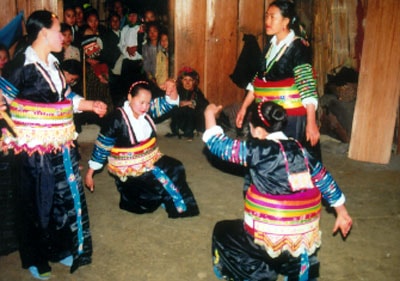
The sound of the lute and lips whispering to lovers in the quiet of the late night. The songs of the Hmong people inviting each other to eat meals together, inviting each other to smoke by the fire.
People challenge each other with the sound of the six-pipe mouth organ. They argue with the sound of the Xy-u horn. With a heavy basket on his back, his feet climbing steep slopes, his clothes soaked with sweat, the Hmong young man never stops playing his precious mouth organ. It can be said that no market in the highlands is complete without the rich sound of the mouth organ and the melodious flute. In spring, like the youth of many other ethnic groups, Hmong boys and girls dress up beautifully and go out in groups to play in the fields and mountains, under the shade of peach blossoms; many couples sing and confide in each other through a string used as a sound transmission device.
The Hmong people always need two matchmakers (one from outside the family, one from within the family) when asking for a wife. Bringing a paper umbrella and a floral scarf to the bride's house, upon entering, the matchmaker doesn't speak but sings a greeting to the host family: "On the mountain pass there is a tree, its flowers blooming as beautiful as the clouds. We heard that your family has a precious girl, so we have come to ask for her hand in marriage." Or: "We have come to the bride's house, bringing empty stomachs to eat the family's food. We have come to the bride's house, bringing bare backs to wear the family's clothes." When invited by the bride's family to wash their face and feet, or before going to bed, the matchmaker never forgets to sing a polite song: "This water is jade water... this mat is floral mat...". Halfway to the bride's house, after dinner, the Hmong also sing, and only after singing do they continue the journey to the groom's house. According to the usual custom of a Hmong wedding, after dinner, singing continues throughout the night until morning. It begins with songs congratulating the bride and groom. Next came the lyrical songs, exchanged between the Hmong men and women, celebrating the joyous occasion. (To be continued)
Hong Thao
Part II:


