
Echoes of Dien Bien Phu
(Baonghean) - During the resistance war against French colonialism and the Dien Bien Phu Campaign, Nghe An contributed significantly in terms of manpower and resources; achieving many outstanding victories, contributing to the historic victory that "shook the world and resonated across continents"... General Secretary Le Duan once assessed: "Without Thanh Hoa - Nghe An - Ha Tinh, there would have been no Dien Bien Phu victory."
From mid-1953 to early 1954, knowing that our army and people were preparing to launch major campaigns in Lai Chau, Northwest Vietnam, and Upper Laos, and intensely concentrating on the Dien Bien Phu Campaign, the French colonialists intensified their countermeasures against us in the Northwest battlefield while simultaneously launching fierce bombing and sweeping operations by aircraft and warships in the liberated areas of Military Region IV. In Nghe An province alone, French aircraft and artillery from warships at sea concentrated their fierce attacks on key transportation routes and resistance organizations such as Ben Thuy (Vinh City), Hoang Mai (Quynh Luu District), Cat Van (Thanh Chuong District), Cua Hoi, Cua Lo (Nghi Loc District), and Cua Van (Dien Chau District). Particularly, on April 29, 1953, French aircraft brutally dropped 126 bombs on Mau Lam village (now Nghi Lam commune, Nghi Loc district), killing 78 people, including 18 children, and injuring 45 others. The enemy's brutality fueled the people's patriotic spirit and hatred for the invaders to an intense level.
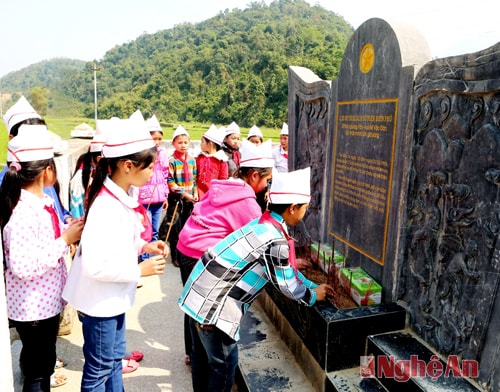 |
| Students from Muong Pon Primary School (Dien Bien district) offer incense and learn about the heroic sacrifice of martyr Be Van Dan. Photo: Tran Duy Ngoan |
Mr. Ha Van Tai, 83 years old, a retired official in Hung Loc commune (Vinh City), recalled: In mid-1953, he was appointed political commissar of a civilian labor company in Yen Thanh district, stationed in a village of the Tho ethnic minority in the Ben Lo area (now Nghia Quang commune, Nghia Dan district). The civilian laborers worked diligently with the spirit of "working day and night to make ends meet." Seeing this, people from neighboring villages also joined the civilian labor force, so his company always exceeded its assigned targets. At the same time, thousands of people from Yen Thanh, Nghi Loc, and Dien Chau districts also contributed to repairing Road 34 (Bao Nham - Quan Hanh), and the Nha Le canal running through the area was dredged to ensure that boats carrying tens of tons could pass through. The Lam River section from Ben Thuy (Vinh) to Cho Trang (Do Luong) also had its transport capacity increased.
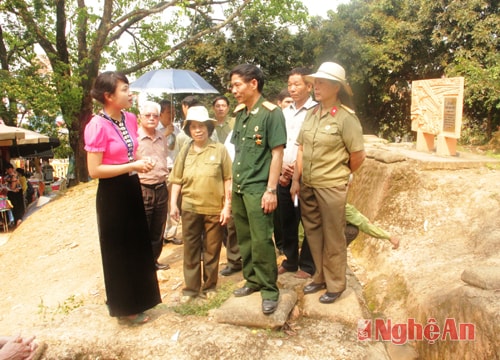 |
| Tourists listen to a presentation when visiting Hill A1. |
In a short time, the road and inland waterway transport system from the Thanh-Nghe-Tinh liberated zone to the provinces of Inter-Region III was connected to the Viet Bac and Tay Bac war zones. From here, the transportation of troops, weapons, food, and other supplies by motorized vehicles or boats to support the battlefields became faster and more efficient.
In late 1953 and early 1954, Nghe An province was ablaze with enthusiasm and determination, vowing "All for the front lines," "All for victory." While civilian laborers were busily building roads and clearing inland waterways, 20,000 civilian laborers, 1,500 bicycle drivers, and 33,000 civilian laborers from Ha Tinh province, divided into two columns, advanced to the front lines. One column was tasked with transporting over 4,600 tons of rice and other necessities to support the troops in the Central Laos Campaign. The other column followed National Highway 1A into Ky Anh district, crossing the Ngang Pass to serve the war-torn Binh Tri Thien battlefield.
Mr. Ho Sac, 85 years old, currently residing in Quynh Bang commune, recalled: During the third phase of the campaign, the Quynh Luu Company crossed the La Boi and Ca Rong passes to open a new route to transport rice and weapons to the 66th Regiment pursuing the enemy in Tha Khet town. At that time, rice was scarce, and there were many wounded soldiers. The civilian laborers discussed reducing their rations to only 400 grams of rice per day and voluntarily ate porridge for two days to save rice for the soldiers. At the end of December 1953, the Central Laos Campaign was victorious, and the civilian laborers completed their first course. Mr. Ho Sac and many others responded to the call from their superiors and enthusiastically volunteered to register for another course to serve the Dien Bien Phu Campaign. For this course, the province mobilized 33,000 civilian laborers and 2,000 bicycles with the task of transporting 3,000 tons of rice from Quynh Luu through Thanh Hoa up to Suoi Rut (Hoa Binh province). As they approached the handover location, he was informed that the Nghe An delegation would continue transporting the rice to Moc Chau (Son La). Although the journey was an additional 100 kilometers, the food and other necessities transported by the Nghe An civilian labor force arrived on schedule, promptly serving the troops participating in the Dien Bien Phu Campaign.
Mr. Mai Ất, currently the Chairman of the Nghe An Former Youth Volunteers Association and former Chairman of the Vinh City People's Committee, who was once a Youth Volunteer stationed at Pha Đin Pass, recounted that at that time, Nghe An had 13,000 Youth Volunteers participating in the Dien Bien Phu Campaign. From mid-1953 until the end of the Dien Bien Phu Campaign, Nghe An's Youth Volunteers worked alongside the engineering corps to open an additional 82 km of new road from Suoi Rut to Moc Chau, repair Highway 13 from Yen Bai to Co Noi intersection (Son La); and open branch roads, artillery hauling roads, and underground tunnels across the Ta Vai and Hat Lot streams in Hoa Binh, Son La, and Lai Chau. In addition, the Youth Volunteers also defused unexploded bombs, filled bomb craters, prevented mudslides, and transported goods. Famous winding passes like Pha Đin and Lung Lo became battle zones where Nghe An's Youth Volunteers were present. And, 100 Youth Volunteer Team members from Nghe An province bravely fell on those roads.
Mrs. Tran Thi Anh, 84 years old, currently residing in Phong Dinh Hamlet, Hung Dung Ward (Vinh City), recounted: In February 1952, she and 10 young people from her village, including 6 female volunteers, joined the Nghe An Youth Volunteer Brigade and were assigned to build a road from Suoi Rut (Hoa Binh) to Moc Chau (Son La). There, she was assigned as the platoon leader of a platoon of women from the two districts of Nam Dan and Hung Nguyen. Digging rocks, cutting trees, and paving roads, she and her comrades worked tirelessly. Many women suffered from fever but refused to rest. Despite the hardships and bombings, they remained cheerful. Songs like "Through the Northwest" and "Oh, Army Soldier!" echoed throughout the mountains and forests, especially when soldiers marched through.
On May 7, 1954, after "56 days and nights of digging tunnels in the mountains and sleeping in bunkers, enduring torrential rain and eating meager rations, blood mixed with mud, unwavering courage and determination," our troops completely crushed the Dien Bien Phu stronghold of the French colonialists; killing and capturing 16,200 enemy soldiers, shooting down 62 aircraft, and seizing 64 vehicles and all of the enemy's weapons, ammunition, military equipment, and supplies.
During the nine years of resistance against French colonialism, Nghe An province mobilized over 80,000 young people to join the army, over 105,000 militia and guerrillas, and over 1 million people to serve as civilian laborers in the resistance. In the Dien Bien Phu Campaign alone, Nghe An mobilized over 60,000 civilian laborers. At the end of the nine years of resistance against French colonialism, Nghe An had 96 collectives and individuals awarded by the Government, and 8 comrades were awarded the title of Hero of the People's Armed Forces. Typical examples include Heroic Martyr Tran Can (from Son Thanh, Yen Thanh), famous for his close-quarters combat with the enemy on Hill 507; Hero Dang Dinh Ho (Phong Thinh commune, Thanh Chuong district), as brave as a tiger with his deep penetration and cutting tactics, striking fear into the French army on many occasions; and Hero Phan Tu (from Tho Thanh, Yen Thanh district), renowned for his courage and resourcefulness in clearing rapids on the Nam Na River to open supply routes to the Dien Bien Phu front.
The great victory at Dien Bien Phu and the immortal spirit of Dien Bien Phu continue to provide immense strength to the army and people of the whole country in general, and Nghe An in particular, to continue to defeat the invading American imperialists and move forward steadily in the cause of building and defending the Fatherland today.
Viet Long


