
India and Bangladesh exchanged land and people.
On June 6th, during a two-day visit to Bangladesh, the Indian Prime Minister signed a historic agreement with his counterpart to resolve a territorial dispute that had existed for over 300 years.
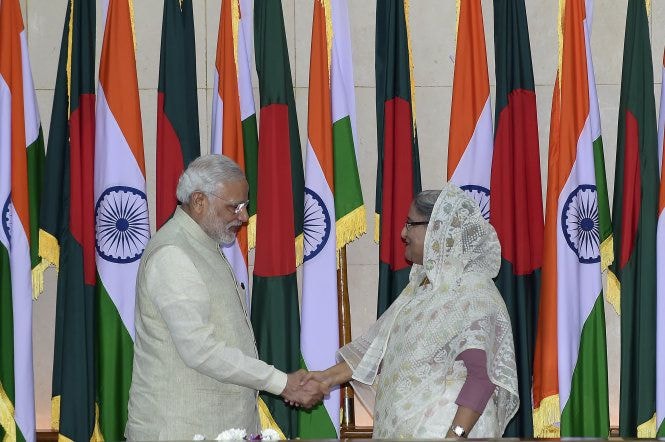 |
| Indian Prime Minister Narendra Modi (left) shakes hands with Bangladeshi Prime Minister Sheikh Hasina Wajid after talks in Dhaka on June 6 - Photo: AFP. |
Indian Prime Minister Narendra Modi (left) shakes hands with Bangladeshi Prime Minister Sheikh Hasina Wajid after talks in Dhaka on June 6 - Photo: AFP
It is no surprise that Bangladesh's Foreign Minister Abul Hassan Mahmood called the agreement a "historic milestone in relations between the two neighboring South Asian nations." The agreement has put an end to territorial disputes that had lasted since 1713.
The nature of the aforementioned agreement is even more remarkable when considering the complex and unique relationship in the world regarding the sovereignty of border territories between India and Bangladesh in the North Bengal region.
The agreement to exchange land parcels under one country's sovereignty but located within the territory of another country simplifies the issue of sovereignty along the 4,000km border and clarifies the nationality of approximately 52,000 residents living there.
Sovereignty in the style of... "Russian dolls"
According to the signed agreement, Indian Prime Minister Narendra Modi and Bangladeshi Prime Minister Sheikh Hasina Wajid agreed to exchange 200 land parcels, with each country taking over the other's land currently located within its territory.
Residents in those areas have the option of either staying or moving across the border, depending on their needs.
This is a historical consequence from 300 years ago, when the Moghul emperors tried to seize control of the Cooch Behar region in North Bengal. Today, the northern border between India and Bangladesh is a jagged, leopard-skin-like landscape with hundreds of land parcels.
Accordingly, India owns 106 land parcels within Bangladeshi territory, and conversely, Bangladesh owns 92 land parcels within its neighbor's territory.
Most of these plots of land are very small, with a total area of just over 100 square kilometers. The smallest plot is Upan Chowki Bhaini, measuring only 53 square meters, which is roughly the size of an average apartment in Mumbai.
But the situation is even more complicated when there are 24 such land parcels nested within each other, interlocking like Russian matryoshka dolls, where within Bangladesh there is Indian land, then within that Indian land there is a smaller Bangladeshi land parcel, and so on...
This "integration" problem creates difficulties not only for government management but also for the lives of residents living in those areas. In many cases, they become stateless citizens, losing their right to social benefits.
With such land-exchange agreements, both India and Bangladesh hope to end the complexities of border sovereignty issues, opening a new chapter in the history of relations between the two countries.
Prior to signing the agreement, on May 13th, the Indian government approved the 119th constitutional amendment draft, which specifically addresses the redrawing of the border between India and Bangladesh.
India promotes investment projects.
Along with an agreement to exchange land parcels in the area surrounding the official border, India and Bangladesh also signed a series of investment agreements worth $4.5 billion in the power generation sector and a $2 billion loan agreement for Bangladesh.
Additionally, the two prime ministers, along with the Chief Minister of West Bengal, Mamata Banerjee, attended the inauguration ceremony of a bus service in the border area between the two countries.
In addition to strengthening trade cooperation, the two countries are also aiming to enhance cooperation in border security and combating human trafficking. Along with the $1 billion aid provided to Pakistan in 2011, India has announced an additional $2 billion loan to its neighbor for investment in infrastructure development projects.
Along with numerous other investment projects, two Indian power companies, Adani and Reliance, have also signed contracts worth over $4.5 billion with the Bangladesh Power Development Board (BPDB) to build six power plants with a capacity of 4,600 MW.
On that basis, Mr. Modi affirmed: "Bangladesh will purchase 1,100 MW of electricity from India, more than double its current electricity output (500 MW)."
The total value of trade between India and Bangladesh in the 2014-2015 fiscal year reached $6.9 billion, but it was still heavily skewed towards India, with exports to Bangladesh accounting for $6.2 billion of that amount.
However, according to Prime Minister Narendra Modi, India will prioritize investing more in Bangladesh as the country prepares to become India's exclusive economic zone, and the current investment packages will help gradually narrow the trade deficit between the two countries.
It began to emerge 40 years ago.
In fact, the agreement to exchange these lands was first reached in 1974 between Indian Prime Minister Indira Gandhi and Bangladeshi Prime Minister Sheikh Mujibur Rahman.
However, after Prime Minister Mujibur was assassinated in 1975, further progress on the agreement stalled for a long period and was subsequently rejected by the succeeding government.
(According to TTO)
| RELATED NEWS |
|---|


