
Maritime security: Impact on regional peace in Asia
(Baonghean) - It can be said that the Asia-Pacific region experiences far more territorial and maritime disputes than any other region in the world. The Diaoyu/Senkaku Islands dispute is a prominent issue in Sino-Japanese relations, causing tension between the two countries. The South China Sea dispute is seen as a measure of the level of tension or harmony in China-ASEAN relations. Countries involved in territorial disputes in Asia, including China, ASEAN, etc., are all key members of the region; therefore, the relationship between these countries has a significant impact, determining the existence, peace, and stability of the entire region.
Disputes over maritime sovereignty in Asia have also increased recently. The recent deployment of the Haiyang 981 oil rig by China in waters under Vietnamese sovereignty has raised international concerns about the potential for increased instability in the South China Sea. This concern is entirely justified. Geographically, the South China Sea is a semi-enclosed body of water, covering approximately 3.5 million square kilometers, located on the western edge of the Pacific Ocean, within Southeast Asia. It borders several Southeast Asian countries (Vietnam, the Philippines, Indonesia, Brunei, Malaysia, Singapore, Thailand, and Cambodia) and China. Therefore, the South China Sea directly impacts the lives of hundreds of millions of people in these countries.
From an economic perspective, the South China Sea also contains important marine natural resources essential for the lives and economic development of surrounding countries, especially biological resources (fisheries), minerals (oil and gas), and tourism. The South China Sea lies on a vital maritime transport route connecting the Pacific and Indian Oceans, Europe and Asia, and the Middle East and Asia. It is considered the world's second busiest international shipping route, with approximately 150-200 ships of various types passing through it daily, of which about 50% are ships with a tonnage of over 5,000 tons, and more than 10% are ships with a tonnage of 30,000 tons or more. Furthermore, many East Asian countries have economies that depend vitally on this sea route, such as Japan, South Korea, Taiwan, Singapore, and China. This is a crucial artery for transporting oil and other commercial resources. Over 90% of the world's commercial shipping is conducted by sea, and 45% of that passes through the South China Sea. This demonstrates the immense importance of this sea region to all countries in terms of geostrategy, security, maritime transport, and economy. Therefore, instability in this sea region would seriously impact the security, political, and economic interests of the countries in the region.
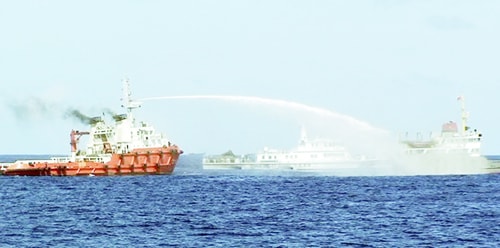 |
| Chinese ships sprayed water cannons at Vietnamese fisheries patrol and coast guard vessels. |
According to analysts, some regional sovereignty disputes in Asia are not only related to economics but also cause conflicts in relations between major powers. For example, some major powers, although not directly involved in the disputes, have vital interests in the disputed region. Therefore, the developments in regional sovereignty disputes indirectly affect the relations between those countries and the countries involved in the disputes, causing instability in the region.
Developments in regional sovereignty disputes, whether positively or negatively impacting any bilateral relationship, inevitably trigger a "chain reaction" in other relationships, thereby affecting the political and security landscape of the entire region. Furthermore, the emergence of major powers – which play a dominant role globally – will extend their influence beyond Asia, profoundly impacting the global landscape and world peace and security.
Thanh Hien


