
Affection for the sea
(Baonghean) - With the Central Vietnamese coast stretching so far, it's hard to choose a place for a short trip. "Let's go visit the fishing villages in Son Hai; this year, Son Hai is one of the communes with the highest revenue from fishing in the entire district," my friend whispered over. So, let's go…
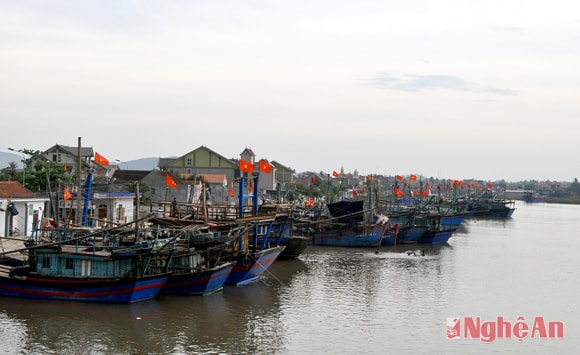 |
| Fishing boats belonging to fishermen from Son Hai commune in Lach Thoi. |
“This year is a success!” – Mr. Tran Van Thay, Chairman of the Son Hai Commune Fisheries Association (Quynh Luu District), said confidently, then smiled brightly. He added that this year the whole commune will have a big Tet (Lunar New Year) celebration; in the last month of 2014 alone, the commune is estimated to have earned over 20 billion VND in total income from fishing. They just go out to sea, anchor their boats, and turn on their lights; whatever the sea offers, they eat it, regardless! They don't complain, they don't haggle, and they don't get discouraged by a bad fishing trip. However, they still consider squid and tuna fishing to be the most traditional and skillful methods, so for fishing, hundreds of boats in Son Hai only carry large-mesh nets, avoiding overfishing small fish. This principle of going out to sea has followed the fishermen of this coastal region for generations, as a way of showing gratitude to the salty sea…
Perhaps it's because of that kindness, but for many years now, the sea has been incredibly generous to the fishermen of Son Hai. Walking through the villages, one sees well-maintained roads and alleyways paved with concrete, gleaming modern multi-story houses, and expensive cars and motorbikes are no longer uncommon. On paper, the summary report shows an average per capita income of over 21 million dong per year, and "public opinion" jokingly suggests it's probably even higher, as a comfortable life is clearly evident in each family. This prosperity is solely based on fishing… Seeing my curiosity about the "secret," the fishermen shared that, of course, the spiritual aspect of "relying on heaven" is indispensable, but to put it bluntly, their great success is due to many factors.
In recent years, starting from 2010, when the State issued a series of preferential policies to support fishermen, Son Hai commune in Quynh Luu district has been one of the first to boldly build large, powerful fishing vessels to venture further offshore. Currently, the commune has 269 vessels, including 19 newly built ones, with a total capacity of over 51,000 horsepower, and notably, 215 vessels with a capacity of over 90 horsepower. This is partly because they understand that investing in the profession is never a waste, and partly because the characteristics of Son Hai's fishing require venturing far offshore, scouring the entire Gulf of Tonkin, even the shared fishing grounds between Vietnam and China… Far offshore, in the deep sea, the fishing profession is so renowned that the squid and grouper caught by Son Hai fishermen are, "confidently, the best in the North," concluded Mr. Tran Van Thay, Chairman of the Son Hai Commune Fisheries Association.
Mr. Tran Van Thay is known as the "leader" of the seafaring profession in Son Hai, and also a "treasure trove" of stories, both past and present, in this nearly thousand-year-old coastal region. At 58 years old, this leader is short, stocky, strong, and resolute. I've met many fishermen, and their common characteristic is their weathered, "stormy" demeanor, even in their speech. But in Mr. Thay, that "stormy" demeanor is the "stormy" demeanor of a confident man, daring to think and act. Mr. Thay's family has been involved in the seafaring profession for generations. In his generation, at the age of 17, he joined his father's boat as an apprentice. In those decades, "apprentice" was a title for a worker, specializing in cooking, cleaning, and assisting the ship's crew and the "old helmsman."
After years of apprenticeship and over 30 years as a skilled fisherman and then a captain, he knows every channel and wind pattern in the familiar fishing grounds of Son Hai like the lines on his palm. For many years, he served as the Chairman of the Fisheries Association of the commune, advising on development projects and actively working with various departments and agencies in the district and province to ensure that the fishermen of his commune received their rightful benefits. Listening to him tell stories about the sea and his trade is captivating! Just the stories about the traditional squid and tuna fishing of Son Hai alone are countless, both long and short…
He said that fishing has been associated with the fishermen of Son Hai for hundreds of years, but then, as if to be sure, he added: "Who can remember exactly when? Saying 'hundreds of years' is just an approximation. Because it's been passed down through generations, in the old days, when people first settled and established their villages, our ancestors used to sail out to sea to catch squid. The squid fishing techniques back then were rudimentary; fishing was only within a radius of 40 nautical miles. Small boats pulled by sails relied solely on the wind, how could they go far? There were no lights either, just flickering torches or dim oil lamps... Yet, squid and tuna fishing sustained the people of Son Hai through many difficult times." Then he enthusiastically recounted stories of fishing, as if it were his lifeblood, regardless of the fact that for the past ten years or so, due to health reasons, he had completely stopped his voyages and stayed home to focus on developing his family's seafood collection and processing business.
He said that many fishing villages across the country have squid fishing, even in Nghe An province, many places are thriving in this industry, but the fishing techniques of the fishermen in Son Hai are rarely matched. “It’s offshore fishing, not inshore fishing, that’s one. The fishing line has a span of 15-20 meters, that’s two. The fishermen are highly experienced, having battled in various fishing grounds, familiar with the currents and knowing when to cast and reel in the line, that’s three. The bait is four. That’s a rough estimate, isn’t it?” – The leader of the sea laughed heartily, candidly presenting his “secrets,” yet his pride was undeniable. After a few more leisurely cups of tea, the story of the trade became even more profound. “For catching barracuda, the best bait is using small barracudas, sliced fresh and mixed with the hook. As for squid fishing, I dare say that using artificial bait is more effective than real bait. The artificial bait is made of wood or plastic wrapped with eye-catching red and green rubber bands. Turn on a few dozen 'super' lights (super high-pressure lamps, each 1000KW - PV) and cast your line out during calm seas. Guaranteed to catch a squid,” Mr. Thấy revealed.
To reassure the newcomer about the fishing profession in Son Hai, Mr. Thay led me to meet the young captain, Tran Van Manh (1980). At 34 years old, Manh has nearly a decade of experience as a captain. He's burly, speaks clearly and concisely, and if Mr. Thay hadn't been with me, I might have felt hesitant to interact with this young fisherman. Manh had just finished an 18-day fishing trip and returned to port for a "moonlight rest," his face still showing signs of fatigue after days of sleep deprivation and wind. Yet, when asked about the sea, he openly boasted about earning several hundred million dong. "Several hundred million dong is good enough. A 200 HP boat with 10 crew members, after calculating fuel, lamps, food, ice... each person still has fifteen or twenty million dong left," Manh enthusiastically shared. Then, turning to Mr. Thay, he told him that the squid and grouper catch this time was very successful. "The 'Son Hai style' fishing ensures that the squid and barracuda are still wriggling, their scales glistening and shimmering, without a single scratch or tear. After an 18-day trip, all the seafood is packed into three ice holds. Upon arrival at Lach Thoi Port, traders come to buy the catch on the spot, assessing its freshness and determining the price. 'Today, the wholesale price at the dock is 180,000 VND/kg for fresh squid, and nearly 100,000 VND for barracuda, sir!' – Captain Tran Van Manh calculated. Because of its freshness and reputation, the squid and barracuda from Son Hai's boats have traveled to provinces throughout Vietnam, both North and South. For several years now, they have also been favored by many exporters to South Korea and China, increasing the economic value of the product and providing a stable market for fishermen, allowing them to confidently continue fishing at sea."
The story of the fishing profession in Son Hai is also a story of deep affection for the sea, for Mother Nature, and for the guardian spirits of the waterways, whom the fishermen here deeply respect. Following Captain Tran Van Manh and the "leader" of the sea, Tran Van Thay, I arrived at the Thoi Temple, nestled precariously at the entrance to the windy Lach Thoi estuary. The Thoi Temple, once a grand structure in history, has, through the vicissitudes of time, now only has its gate pillars and a few moss-covered stones remaining. The two men, seasoned veterans of the sea, knelt down, arranging offerings. The heavy incense smoke, carried by the salty sea breeze, stung my eyes. I couldn't know what Manh and Mr. Thay were thinking that afternoon. Perhaps it was about the sea. Perhaps it was about their livelihood. Or perhaps it was a prayer for peace and tranquility in the new year? As for me, I think I will definitely return to this coastal village many more times, driven by my longing to embark on a fishing trip to admire the traditional fishing methods, and also by my hope to see Son Hai achieve even more bountiful harvests and undergo further transformation in its economic, social, and cultural landscape, perhaps starting with the restoration of this sacred Thoi Temple…
Phuong Chi


