
Ensuring safety for villages in landslide-prone areas.
(Baonghean)Unable to hide his joy, Mr. Vi Van Nghe, Deputy Head of Pung village, Luu Kien commune, Tuong Duong district, said that if the Party and the State had not had the policy of relocating the village to a new place, Pung village might have been swept away by the floodwaters.
It is known that 132 households in Pủng village live along the Tân Xà stream, an area with weak geological conditions and a high risk of landslides during each rainy season. Given this situation, in 2011, the Ethnic Affairs Department of the Tương Dương District People's Committee surveyed, developed a project, and proceeded with planning and construction of a resettlement area for the villagers. Of the 132 households, 52 households with 246 people have been relocated to a new settlement. The new settlement site is about 2 km from the old area. The terrain is flat, and infrastructure such as electricity, roads, and schools are all in place. The total cost of the project is over 14 billion VND. According to the plan, the 52 households will soon separate from the old Pủng village to form a new village called Lưu Sơn. Currently, the newly built kindergarten in the village has also been named after this new village.
In reality, the resettlement of people in the mountainous district of Tuong Duong has been implemented through two programs. The first is the program to support the resettlement of people for permanent residence and livelihood, as stipulated in Decision 33/2007/QD-TTg of the Prime Minister, implemented by the Ethnic Affairs Department. The second is the program for the relocation of people in disaster-stricken areas, areas with special difficulties, border regions, islands, and areas with spontaneous migration, as stipulated in Decision 193/2006 (later supplemented by Decision 1776/QD-TTg dated November 21, 2012, of the Prime Minister), implemented by the Rural and Mountainous Development Board. From 2009 to the present, six villages with nearly 340 households have been relocated to new residences with adequate infrastructure and living conditions.
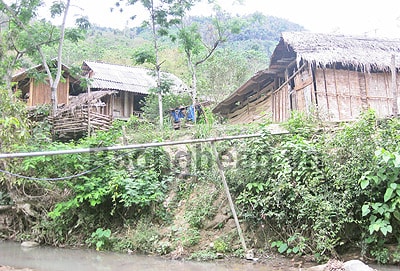
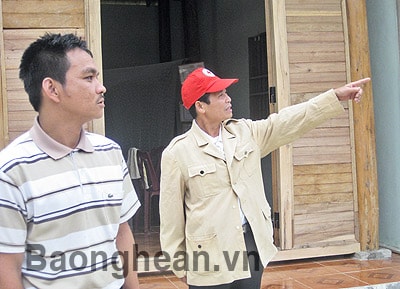
Deputy village head of Pủng Vi Văn Nghệ hamlet, Lưu Kiền commune (Tương Dương district), spoke with reporters about the landslide-prone area.
The resettlement project for villages at high risk of landslides was first implemented by the People's Committee of Tuong Duong District in 2009. Prior to that, in 2007, relevant agencies conducted surveys and technical measurements. 49 households from Huoi Son village – Tam Hop commune were the first to be relocated from the buffer zone of Pu Mat National Park to their new homes. The survey and relocation process was supported by Border Guard Post 551 (Provincial Border Guard).
This was a pilot project with a modest budget, but thanks to the coordination between the State and the Border Guard's "Borderland Shelter" program of the province, it yielded positive results. Following the success of the program, in 2010, Tuong Duong district continued to implement the project to relocate Huoi To 1 village, Mai Son commune. The total cost of the project was over 12.3 billion VND, with the District's Rural and Mountainous Development Board as the investor. At the end of 2010, just as the relocation was completed, a devastating flash flood struck the village in early 2011. "The 63 households in the village were overjoyed; they had absolute faith in the policies of the Party and the State," said Mr. Nguyen Vuong Luyen, Head of the Rural and Mountainous Development Board of Tuong Duong district, happily.
In accordance with the Prime Minister's directives through Decisions 193, 1776, and 33, and under the guidance and supervision of the Provincial People's Committee, all resettlement projects are implemented according to the principle that the new settlement area is not far from the old residences and traditional production areas, has relatively flat terrain, and suitable geological conditions. Infrastructure such as roads, water supply systems, electricity, and environmental sanitation are planned and invested in comprehensively to meet the requirements for stable and long-term living for the people. For villages that relocate to new settlements but lack social welfare facilities such as community centers and schools, the State will gradually invest in building new ones. This helps ethnic minority children receive education right in their local area, thus reducing illiteracy in particularly disadvantaged areas. According to regulations, each household receives 20 million VND in support from the State upon moving to a new residence. Households located in border areas receive 30 million VND in support, with an additional 5 million VND for impoverished households.
Mr. Lo Duc Thuan, a resident of Pung village, Luu Kien commune, said: “Previously, relocating people was not easy, but now, aware of the dangers posed by natural disasters, most people agree and seriously comply with the government's resettlement program. We may have lived in our old place for 10 years without any problems, but just one unusual flood could wipe everything out.” Mr. Nguyen Vuong Luyen affirmed: In Tuong Duong district, there are currently hundreds of households in need of resettlement to avoid landslides, but the district has only been able to implement a few projects due to a lack of funding.
It can be said that the implementation of resettlement projects for villages located in particularly difficult mountainous areas, frequently affected by natural factors in Tuong Duong, has solved many pressing problems for the lives of the local people. However, in reality, the State needs to have more policies that better meet the requirements, aiming for sustainable development in mountainous areas.
Text and photos: Tuan Dat


