
Impressions of Korean agriculture
(Baonghean)South Korea is an industrialized country, but agriculture has always been given high priority. Therefore, South Korea now has many unique agricultural products that generate significant economic benefits. However, the South Korean agricultural sector is currently facing the challenge of freezing winter weather. Linking and cooperating to boost agricultural production presents a promising opportunity for both Vietnam and South Korea…
Development through the application of technological advancements and collaboration.
Stepping off the plane, bundled up in layers of warm clothing, the biting cold truly gave a strong sense of the harsh winter in South Korea. Ms. Hanh, a Vietnamese tour guide (from Quang Ninh province), a quick-witted woman in a gray military uniform, who is married to a Korean man, explained: South Korea has a temperate climate, with winter lasting six months, from October to April. The peak of winter is from January to March, when the weather is dry and the outdoor temperature often drops low. Daytime temperatures are 1-2°C, while nighttime temperatures can reach -4-5°C, and in some places as low as -10°C. This is also the period when snow falls, scorching the vegetation. From the international airport to the city center, and then from the city center to Everland Park, both sides of the road are mostly covered in a thick layer of white snow. The freezing temperatures pose a significant threat to agricultural production on the Korean peninsula. One might expect that with such harsh weather conditions, agricultural production would be disrupted, making it difficult for Koreans to enjoy fresh vegetables during the cold winter. However, surprisingly, the meal consisted of more vegetables than meat or fish. Alongside the traditional kimchi were vibrant purple lettuces and ripe yellow citrus fruits, as if they had just been picked from the garden. The restaurant owner explained that all the fresh ingredients were produced in South Korea.
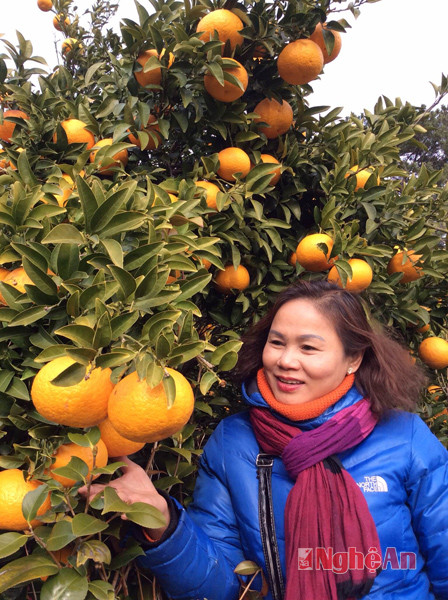 |
| Oranges in Jeju Island, South Korea. Photo: V.D. |
On the way to the Sunrise Peak, a UNESCO World Heritage site, you'll see orchards laden with oranges and high-tech agricultural farms stretching as far as the eye can see. It's hard to imagine that the land here isn't fertile, as the Vietnamese would say, "dogs eat rocks, chickens eat pebbles." The terrain is 70-80% mountainous, and the weather is dry and cold, below 0°C, making it unsuitable for production. Yet, in this season, the crops on the farms are still sprouting, blooming, and bearing fruit. Jeju Island, once known for having the most of everything – rocks and wind – is now known for having the most tangerines in the region. Tangerines grow everywhere: along the roadsides, in household gardens, and on farms in the hills. Therefore, Koreans often call Jeju Island the "Tanger Island."
Even though it's the end of the sweet fruit season, the tangerine orchards are still laden with ripe, golden-yellow fruit. Having traveled to many countries in Asia and tasted many varieties of oranges and tangerines, perhaps the tangerines from South Korea are still special in terms of quality, flavor, and appearance. In the orchards, every tree is heavily laden with fruit, all identical, with smooth, taut skins that are completely yellow, making them very appealing. Not only are they beautiful, but the tangerines here also have a unique flavor – fragrant and subtly sweet, making you want to eat more and more. The price is also affordable. At tourist spots, 1 kg of tangerines costs 3 won (10 fruits), equivalent to about 60,000 Vietnamese dong. According to locals, the price at the orchard is even cheaper, and there are discounts for bulk purchases. However, due to high yields, each hectare typically generates an income of 10-15 million won (200-300 million Vietnamese dong).
Not only tangerines, but many agricultural products here have also gained brand recognition thanks to the early implementation of the green revolution and bio-revolution in the fields. In particular, South Korea has achieved significant success in agricultural breeding. Through hybridization and tissue culture methods, South Korea has created many varieties of vegetables and fruits with high yields, quality, and economic efficiency. Typical examples include high-yield vegetable varieties such as Song Jeong radish, Summukking Chinese cabbage, and Huk Keun Jang green onion. Production in many localities has seen a breakthrough in radish and Chinese cabbage yields. While the average yield of radish and Chinese cabbage in Vietnam is currently only 20-25 tons/hectare/season, South Korea has achieved 50-70 tons/hectare/season. Besides focusing on varieties, South Korean farmers also invest in intensive cultivation using drip irrigation systems and plastic mulch to protect against frost and insect damage. Some farms producing high-value crops invest in snow shelters equipped with heating lamps to ensure the crops thrive.
Thanks to advancements in research and technological application, South Korea has been able to produce many unique agricultural products for domestic consumption and export, bringing high economic value, such as reishi mushrooms and red ginseng.
It is noteworthy that the production, processing, and consumption of agricultural products are being linked together in a nearly closed chain. In this chain, businesses play a key role, supporting farmers with capital, seeds, technical guidance, and especially product consumption; farmers commit to loyalty to the businesses, selling their products to them at the agreed price and absolutely not selling them elsewhere. This linkage has helped the agricultural sector grow stronger, forming production conglomerates that not only focus on investing in agricultural production but also in building processing lines and distribution networks, creating sustainable agricultural development. For example, South Korea currently has conglomerates investing in the production and consumption of ginseng; conglomerates producing and consuming reishi mushrooms, etc.
Agricultural corporations not only invest in intensive farming but also research and process raw agricultural products into high-value refined goods to meet the needs of domestic and international markets. In this way, not only raw products, but also red ginseng and reishi mushrooms are refined into many products with various functions, both nourishing health and supporting disease treatment. Red ginseng alone has been processed into hundreds of different products, not only meeting health needs but also supporting disease treatment and beauty. In supermarkets selling ginseng products, many tourists are overwhelmed by the sheer number of products on display and the high prices: 300g of dried ginseng costs over $400, ginseng extract capsules $225, honey-coated ginseng $215, red ginseng skin cream $175… Reishi mushrooms have dozens of different products: honey-coated reishi extract, reishi capsules, reishi tea, reishi drinks, red ginseng and reishi extract…
These steps and methods have contributed to both exploiting the potential of the land and advantages, improving the lives of farmers, and creating jobs for many people. Currently, the income of Korean farmers is over 32 million won per year, equivalent to 23,000 USD. In some places, such as Shindo village in Gyong Sangbuk province, which specializes in growing apples, peppers, vegetables, and beans, the average income reaches 70 million won per person per year. This increase in farmers' income has contributed to the rapid growth of South Korea's GDP. From a backward country, South Korea is now among the top developed countries in the G20 and the fourth largest economy in Asia, with an average per capita income of approximately 20,000 USD in 2010.
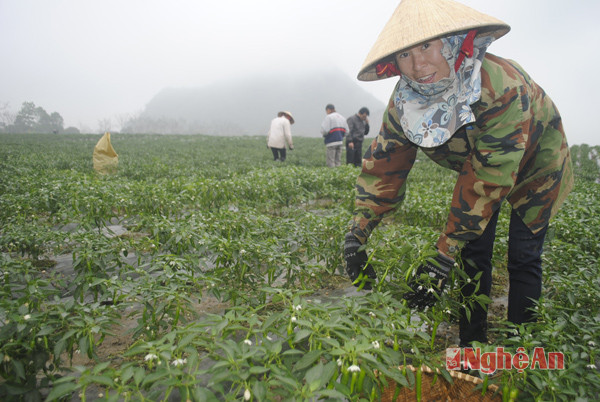 |
| A joint venture model for growing Korean chili peppers for export in Tan Ky district. Photo: Xuan Hoang. |
Our opportunity
Despite its significant achievements, South Korea's agricultural production faces challenges due to cold weather, which increases production costs and negatively impacts both quality and quantity. Producing vegetables in winter costs four to five times more than in summer. Furthermore, in many years, prolonged snowfall for months makes it impossible to produce fresh vegetables, while demand remains high, necessitating the import of fruits and vegetables from abroad. However, this creates difficulties in controlling the levels of harmful chemicals in imported products, and they are also expensive.
Therefore, recently, some Korean organizations and businesses have been trying to find partners to collaborate with Vietnamese businesses to soon implement pilot projects for the production of fresh vegetables and fruits in several localities. The model involves businesses investing in seeds, providing technical guidance on planting, caring for, and harvesting, and guaranteeing product purchase. Farmers then cultivate intensively and sell the products back at an agreed price. In Yen Lac commune, Lac Thuy district, Hoa Binh province, during the 2013-2014 winter-spring season, a pilot project was implemented to plant five types of vegetables (Chinese cabbage, radish, chili peppers, onions, and potatoes) using Korean varieties, yielding promising results. The yield of Chinese cabbage and radish reached 53-54 tons/ha, with an estimated income of over 220 million VND/ha, more than double that of the control models.
In Nghe An province, according to the head of the Agriculture Department of Tan Ky district, the 2013-2014 winter-spring crop is being piloted as a model for integrated production of clean chili peppers (110 hectares) using the Trang Nong-138 variety, implemented by Vintechco Vietnam-Germany Investment Joint Stock Company (Hanoi) in cooperation with a Korean company. Initial results show that the production model is very promising, with an average yield of over 7 tons/ha, a total production of 800 tons, and importantly, the quality and appearance meet the prescribed standards. All products are packaged for export and sold in the Korean market at 50,000 VND/kg. However, currently, the investor is buying directly from the field at a lower price (5,000 VND/kg), but the income still reaches over 1.5 million VND/sao/crop.
These results are still limited in scope and somewhat spontaneous, but they have opened up good opportunities for agricultural development cooperation between the two countries in general, and between Nghe An and South Korea in particular, in the future. This will help exploit potential advantages, create jobs, and especially improve the lives of the people.
Literary Group


