
Heroic Martyr Ho Thi Cuc
Ho Thi Cuc was born into a poor peasant family. At seven months old, her father died in the 1945 famine. When she was two, her mother remarried, and due to extreme poverty, they had to find a new home. Unable to follow her mother, Cuc lived under the loving care of her grandfather and aunt Loan. Then her grandfather passed away. From then on, the aunt and niece supported each other, and the orphaned girl grew up doing all the chores of a farmer: tending cattle, cutting grass, gathering firewood... Until her uncle Ho Dung returned from the army and remarried, Ho Thi Cuc went to live with her uncle and aunt, who treated her like their eldest daughter.
Cúc's hometown is in Sơn Bằng commune, Hương Sơn district, Hà Tĩnh province, a village rich in fruit trees, especially the long rows of palm trees and chạc chìu trees along the village lanes, giving off a fragrance similar to that of milkweed flowers. Night after night, especially on summer nights, the intoxicating scent of chạc chìu flowers permeates even her dreams. The Ngàn Phố River, clear and blue all year round, flows like a silken ribbon through Cúc's hometown – the river of her childhood. Cúc's hometown also has the Nầm Bridge, a short distance from her house. Further down is Choi Market, selling green tea, red sugarcane, and most abundantly, jackfruit and black olives. Aunt Loan has taken Cúc to the market a couple of times during Tet (Lunar New Year).
Cúc's childhood was like that; although she was loved and cared for by her aunt and uncle, she still lived a hard life and didn't get much education. By the age of eighteen, Cúc was a charming young woman, small in stature but hardworking and careful. Seeing that Cúc was of marriageable age, an aunt on her mother's side arranged for her to marry Cứ, a man from Sơn Tây in the district. The wedding was very simple.
Then Cúc went to her husband's house on a small boat, upstream on the Ngàn Phố River, one afternoon when the leaves on both banks of the river were dyed golden. Cúc's husband was also an orphan, having lost both parents, and suffered from mental illness. The newlyweds' house was a thatched hut nestled at the foot of the hill. Cúc shed tears when she saw her husband's family's circumstances, but she thought that since fate had decreed it this way, she had to love and live with them. Unexpectedly, Cúc's husband had episodes every day, and each time he had an episode, he would smash things and beat Cúc.
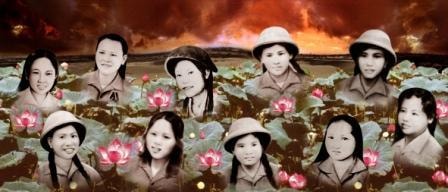 |
The Ten Girls of Dong Loc. |
Their married life was far from happy and very short-lived. One day, while transporting lime for the cooperative, Mr. Cu's boat capsized in Hoi Dong, and he perished. Cuc was left alone in a secluded hut at the foot of a desolate hill, unsure how she would survive the next day. Her uncle, feeling sorry for Cuc, went to Son Tay to bring her home.
When the war against the Americans broke out, the youth of the entire village went to the front. In July 1965, Cúc volunteered to join the "Three Ready" youth movement. Cúc's comrades were young men and women from the province. Cúc was in Squad 4, all girls, Company 552, P18. Initially, Cúc's squad was tasked with ensuring traffic flow and loading/unloading goods at the Địa Lợi ferry terminal, south of Hương Khê district. The Địa Lợi ferry, crossing the Ngàn Sâu River on Highway 15, was a gateway to the Trường Sơn Trail, subjected to relentless and brutal American attacks day and night.
For two years amidst bombing, Cúc and her comrades in Squad 4-C552 bravely held their ground, ensuring the smooth flow of traffic and maintaining the supply lines. In 1967, Cúc's squad moved to Phú Lộc. Then, in early 1968, Cúc and her comrades marched to Đồng Lộc – the "bottleneck" of the transportation route connecting the North with the South. Ideally, in early 1968, Cúc and Võ Thị Tần should have completed their Youth Volunteer service and been transferred to other jobs or further education, but their superiors requested them to stay for another term. Cúc always put others before herself. For example, one day in Hương Trạch, on Highway 15, while arranging equipment for troop movement, she noticed a shovel was missing. Knowing her comrades had dropped it into a ditch, Cúc searched tirelessly to find it. By the time she got back, everyone had already left in vehicles, leaving Cúc to walk dozens of kilometers alone in the night.
Upon arriving at Mai Long village, My Loc commune, the villagers had all evacuated, leaving the houses eerily deserted. Squad leader Vo Thi Tan took a piece of charcoal and wrote on the crumbling wall the date the squad returned to the Dong Loc death zone: 12-7-1968 A4 - C552 - P18. For some reason, Ho Thi Cuc then used the same piece of charcoal to add the number 15 below that inscription. 15 is not the squad's troop number.
Squad 4, led by Vo Thi Tan, had 17 members. On July 24, 1968, the squad was assigned the task of building a tunnel in the middle of Dong Loc Crossroads during the day. On that fateful day, six members were away on other assignments: Lan, Nhi, and Nguyen Thi Huong went to collect tools in Nga Loc commune; Tinh and Xuan (Duc Hong) worked in the mess hall; and Hong went to cut wood in Quang Binh. That's what the rest said. So what does the mysterious number 15 that Cuc wrote below mean? If you add the number 12 to Cuc's number 15, you get 27, which is the day the members of Unit 552 held a memorial service for Cuc alone! And why did the unit hold a memorial service for Cuc alone last? Cuc was always the same person, always thinking of and worrying about others.
As the squad deputy, Cúc had to check if everyone had gone down to the bunker. When the bombs fell, Cúc only had time to hide in a small alcove. Only nine girls were found in the bunker. It was three days later that Hồ Thị Cúc's body was found in a small foxhole a few dozen meters away from where the nine girls were. Hồ Thị Cúc had a cousin, Thanh, who was a few years younger than Cúc. They had been close friends since childhood. When Thanh grew up, she joined the army and fought at the Quảng Trị Citadel. During difficult times, she often dreamed of Cúc, feeling as if Cúc was always following her, and hearing a distant voice that sounded like Cúc's, "Thanh, I'm here." Thanh escaped danger many times, even when she was close to death!
Now, there are no chạc chìu trees at the resting place of the heroine, but the fragrance of chạc chìu flowers will waft from Hương Sơn, Cúc's hometown, to Cúc night after night...
Duc Ban


