
Mr. Son, that autumn...
(Baonghean)Anh Son District is one of the "red addresses" of the revolutionary movement. It was the place where a Soviet government was established during the revolutionary upsurge of 1930-1931, and also the place that seized power early in the General Uprising (1945) with the victory of attacking the Kim Nhan fort and besieging and capturing the district headquarters. Sixty-seven years have passed since that historic autumn, and this land has undergone many changes.
Recently, we had the opportunity to return to our hometown hoping to meet and interact with historical witnesses to learn about the revolutionary struggle. However, we learned that in the entire Anh Son district, only two veteran cadres and eleven pre-revolutionary cadres are still alive. These historical witnesses are all around 90 years old; some are ill due to old age, some are no longer mentally sharp, and others have moved elsewhere with their children and grandchildren. Fortunately, a retired teacher introduced us to Mr. Nguyen Huu Von, saying that "we might be able to glean some information about the history of the revolutionary struggle in Anh Son." Excited, we traveled to Long Son commune, only to find out that he and his wife had moved to Vinh City to live with their eldest son and his wife. Finally, we had a conversation with Mr. Nguyen Huu Von in Vinh.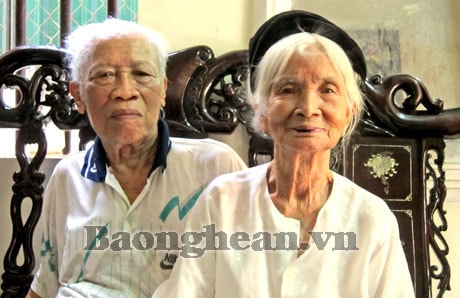
Mr. and Mrs. Nguyen Huu Von.
Upon hearing that a journalist, a fellow villager, had come to visit, Mr. Von was very happy. When asked about the atmosphere of the revolutionary struggle in his hometown of Anh Son, his eyes seemed to brighten, and the wrinkles on his face faded, giving way to a radiant expression on the face of the 87-year-old man. For him, the memories of those days remain vivid and fresh.
From what we learned, he was born and raised in Long Son commune, in a family with many members who were early enlightened and participated in the revolutionary struggle. As a teenager, Mr. Von was encouraged by senior Party members to join a traditional theater troupe to instill patriotism and revolutionary spirit in the people. His troupe traveled to various villages and hamlets, performing plays praising the indomitable and resilient fighting spirit of the Vietnamese nation through heroes such as Trung Trac and Trung Nhi, Mai Thuc Loan, and Nguyen Trai... Wherever the troupe went, the people warmly welcomed them. Later, he was appointed the leader of the National Salvation Youth Team, and then the Secretary of the National Salvation Youth Union.
When the August Revolution broke out, Nguyen Huu Von was assigned to the Self-Defense Force tasked with suppressing the enemy, protecting revolutionary masses during demonstrations, and fighting to seize the Kim Nhan fort and the district headquarters. After the country gained independence, Mr. Von continued his revolutionary activities before transferring to work in the postal service until his retirement. His participation in the revolution was recognized by the Party and the State through prestigious titles, including the First Class Anti-French Resistance Medal, the First Class Anti-American Resistance Medal, the Third Class Military Merit Medal, and most recently, the 60-Year Party Membership Badge. And now, his greatest joy and pride is seeing the country at peace, his homeland transformed, his children and grandchildren successful and making significant contributions to the development of society.
Regarding the events of the 1945 General Uprising to seize power in Anh Son, Mr. Nguyen Huu Von still remembers them clearly. He said that on August 15, 1945, upon receiving news of Japan's surrender to the Allies, the inter-provincial Viet Minh issued the order for a general uprising to seize power. The following day, the Viet Minh Provincial Committee immediately organized a planning meeting and established an uprising committee of seven people, headed by comrades Phan Hoang Tiem and Nguyen Trung Luc.
Next, on August 18th, the Anh Son Viet Minh organized a demonstration aimed at gathering revolutionary masses and gauging the attitude of the Japanese army. From dawn, from all directions, people from various districts marched in orderly ranks towards the central stadium (in what is now Do Luong town) carrying countless red flags with yellow stars and various banners. Self-defense units, swords in hand, were ready to suppress the enemy if they acted rashly. Comrade Pham Nhu Cuong, representing the Viet Minh, stepped onto the platform and delivered a speech. Tens of thousands of people looked up and listened intently to every call to arms, urging everyone to rise up, break all chains and oppression, and win independence and freedom.
Then everyone shouted, "Long live independence!" A group of Japanese soldiers arrived, demanding to meet the commander for negotiations. Comrade Pham Nhu Cuong replied, "Our people have risen up to overthrow French colonialism and the feudal regime of the Southern Dynasty. Japan has surrendered to the Allies, so you should not interfere." Faced with the fervent fighting spirit of the revolutionary masses, the Japanese soldiers had to withdraw. The people returned, cheering in joy at the victory, and at the same time, urgently prepared for the upcoming general uprising. During these days, the entire Anh Son countryside was ablaze with flags and banners. Every day, Viet Minh cars drove along Highway 7 to announce the good news from all over the country about the seizure of power and to read the order for the general uprising to encourage the revolutionary struggle.
During this time, the Dang Thuong area, where the Kim Nhan outpost was located, was heavily fortified with Japanese soldiers. The Anh Son Viet Minh Committee directly directed the attack to neutralize the Japanese troops and simultaneously undermine the morale of the local gentry. On the night of August 22, 1945, the Self-Defense units, divided into four directions, advanced to capture the outpost. The fort's officers and soldiers immediately laid down their weapons and surrendered. At this moment, tens of thousands of people from Quan Lang, Tri Le, Dai Dien, and from Lang Dien and Hoi Tien poured in to witness the unconditional surrender of the enemy and to see the red flag with a yellow star flying atop the outpost gate, a place that had long been considered "impregnable".
Then the masses immediately returned to their rural areas, continuing the struggle to overthrow the local landlords and seize power for the people. The entire enemy administrative system, from the district to the village level in the Dang Thuong region, fell into the hands of the Viet Minh, and the Provisional Revolutionary Committee was established. Enemy outposts in Anh Son district successively fell into the hands of the revolutionaries. On the morning of August 23rd, people from all over flocked to the Anh Son district headquarters to witness this glorious moment in the history of the revolutionary struggle and to mark a major turning point in their lives, from the status of slaves to citizens masters of their own country. The Provisional Revolutionary Government officially introduced itself to the people. Joy filled the air, everyone sharing the exhilaration of becoming citizens of a free and independent nation...
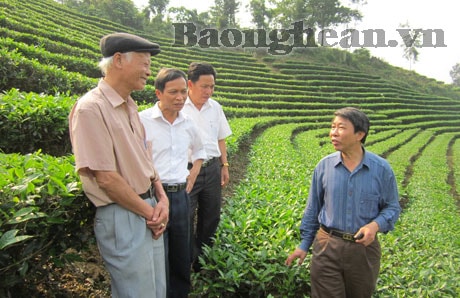
Model for developing industrial tea cultivation in Hung Son commune (Anh Son district).Photo: Diep Anh.
After a brief pause, Mr. Von asked us about the situation in his hometown, as he hadn't visited the villages in Anh Son due to health reasons. We told him about the vast tea hills in Bai Phu (Dinh Son) and Hung Son, the expansive sugarcane fields in Thanh-Binh-Tho, the year-round fertile fields and alluvial plains, and the bridges connecting the Lam River. Recently, in the university and college entrance exams, many students from Anh Son district achieved high scores, ranking among the top in the province. Mr. Von was overjoyed; his face brightened, his eyes filled with confidence, and we could read in them the thought: The struggles and sacrifices of those who came before were not in vain!
Cong Kien


