
Mr. Son: Expanding highly effective farming models.
(Baonghean) - In the process of economic development, Anh Son district integrates programs and builds agricultural extension models, contributing to the transformation of crop structure to suit the land and actual conditions of each locality, helping farmers access new methods and achieve high efficiency.
In the 2014 summer-autumn crop season, with funding support from the New Rural Development program, Mr. Lo Van Thuy's family, Secretary of the Party Branch of Nhan Tai hamlet, Cam Son commune (Anh Son district), converted 4 sao (approximately 0.4 hectares) of unproductive land previously used for growing corn and peanuts to growing green pumpkins using the HN999 variety. The model was guided by the District Agricultural Extension Station, which provided detailed instructions on applying nano-technology fertilizers (imported from the US and approved by the Ministry of Agriculture for nationwide use) to the soil preparation, branching, and fruit development processes of the pumpkin plants. As a result, the pumpkins grew quickly, were free from pests and diseases, and yielded 1 ton per sao. With a selling price of 5,000 VND/kg, after deducting expenses, the net profit was over 13 million VND within 3 months, a 50% increase compared to the previous crop. Mr. Nguyen Van Thang, Vice Chairman of the People's Committee of Cam Son commune, said: "Currently, 32 hectares of converted green pumpkins on the commune's alluvial land generate nearly 4 billion VND per crop. Pumpkin growers have been able to secure their own seed sources. Seeing the effectiveness, many villages in the commune have switched to a cropping pattern of two rice crops and one winter pumpkin crop on rice land. In the spring of 2015, people in Cam Loi and Ha Du villages expanded the area of green pumpkin cultivation on alluvial land to more than 5 hectares."
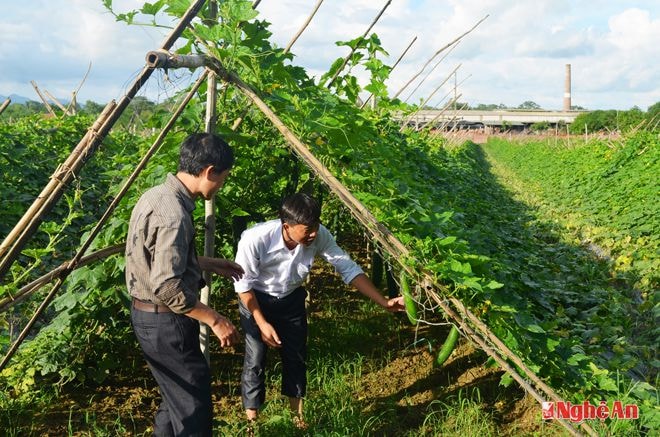 |
| Intensive cultivation of green squash yields high productivity in Cam Son commune (Anh Son district). |
Following land consolidation and reallocation, in the spring of 2014, Tuong Son commune implemented a model of high-density corn cultivation using the C919 variety on 40 hectares. The amount of seed used for this model increased by 0.5 kg/sao compared to conventional corn cultivation. The province provided 33% of the funding for this model, including seeds, fertilizer, phosphorus, potassium, etc. As a result, the yield of the model corn reached 4 quintals/sao, an increase of 1.8 quintals/sao compared to the old cultivation method. With a selling price of 700,000 VND/quintal, farmers earned a net profit of 22-25 million VND/ha, three times higher than corn grown using the previous method. Based on the practical results, the commune continued to build two model fields of high-density corn cultivation, including 30 hectares of DK 6919 variety and 60 hectares of C919 corn... From the effectiveness of the high-density corn cultivation model in Tuong Son commune, the entire district has now replicated hundreds of hectares of high-density corn cultivation in Tam Son commune (300 ha) and Hung Son commune (40 ha).
Densely planted corn is arranged on land previously used for two rice crops, buffer land, and as a third corn crop in many communes, increasing yields by 15-20% compared to traditional farming methods. Along with corn, a model for planting and intensively cultivating green squash using nanotechnology (150 million VND/model) has been implemented on nearly 100 hectares in Cam Son, Tao Son, and Linh Son, achieving yields of 30-40 tons/ha and generating billions of VND in revenue annually from squash cultivation. A model for planting and intensively cultivating the new Roc 16 sugarcane variety, on a 2-hectare scale in Phuc Son commune, achieved a yield of 82 tons/ha, generating an income of 62 million VND/ha and a net profit of 37 million VND/ha, a 30% increase compared to the old investment process. A large-scale model of 40 hectares of high-quality rice in Tao Son and Linh Son communes increased value by 20% compared to conventional rice cultivation...
Anh Son district has vast land but faces many difficulties in terms of natural conditions for agricultural production. There is no irrigation system for the cultivated areas, and people are often worried about the market for their products, so they are hesitant to invest in production. Based on this reality, in recent years the district has focused on introducing scientific and technological advancements and developing high-economic-efficiency production models to farmers in the area. Mr. Nguyen Cong The, Head of the Agriculture Department of Anh Son district, said: "To achieve the goal of increasing people's income, the most important thing is to start with specific, practical actions and models." Along with the accelerated land consolidation and exchange process to create large plots of land suitable for concentrated commodity production, in 2012, the District People's Committee issued Decision No. 2318/UBND approving the Project "Building a model for agricultural and rural economic development in the period 2012 - 2015" to select key crops and livestock, and build large-scale commodity production areas to serve the processing industry and export. In the spirit of the annual production projects, the district has effectively utilized state support funds, integrating them through the New Rural Development program to implement effective and timely models.
During the exchange, Mr. Tran Van Ha, Head of the Anh Son District Agricultural Extension Station, said: To build and implement successful crop models, the station carefully surveys the land, selects participating households with the motto "hands-on guidance". On average, the station coordinates over 50 training courses on scientific and technical transfer annually, attracting over 4,000 members. This activity contributes to improving the efficiency of agricultural crops and opening up new ways of doing business for farmers in the district. In many communes such as Cam Son, Tuong Son, Hung Son, and Phuc Son, people proactively produce hundreds of tons of organic microbial fertilizer from agricultural by-products to intensively cultivate sugarcane, pumpkins, corn, tea, and rice. Anh Son district is continuing to mobilize state capital and people's efforts in conjunction with the New Rural Development program to invest in and upgrade transportation infrastructure and the power grid to serve the planning of concentrated commodity production areas; The goal is to have 1,000 hectares of densely planted corn on alluvial land and double-cropped rice land in potential communes, and 200-350 hectares of high-yield intensive cultivation of green squash. In the spring of 2015, the entire district aims for each commune to have one large-scale model rice field…
Luong Mai
| RELATED NEWS |
|---|
According to the Department of Agriculture and Rural Development, as of January 30, 2015, the entire province had sown and planted over 38,000 hectares of rice out of a total planned 86,000 hectares. This included 27,200 hectares of transplanted rice and 10,579 hectares of direct-seeded rice. Overall, farmers have been quite diligent in adhering to production processes from sowing to seedling care, and favorable weather conditions have contributed to the good growth and development of the rice plants. However, according to Mr. Nguyen Van Lap, Deputy Director of the Department of Agriculture and Rural Development, the worrying aspect of this year's spring crop production is that despite prior warnings, many people in some localities still sowed seedlings and planted earlier than scheduled. Currently, it is raining and cold, with temperatures averaging only 15-16°C at night and nearly 20°C during the day, hindering the development of rice plants. In the coming time, if the weather becomes sunny and warm, the early-planted rice fields risk premature flowering, coinciding with the late-season cold spell, potentially leading to crop failure. Therefore, for these areas, farmers need to focus on caring for the rice plants to ensure strong growth and prevent stunted growth, which would cause them to flower even earlier. Along with focusing on planting and covering the spring rice crop before the Lunar New Year, farmers need to regularly inspect their fields to monitor the development of pests and diseases, especially rice blast disease in susceptible rice varieties such as AC5 and BC15. Currently, rice blast disease has appeared in some early-planted rice fields in Hung Nguyen and Vinh City. “In this year's spring crop production, the first stage of intensive care for the rice plants (15-17 days after transplanting) coincides with the Tet holiday and lasts until the 15th day of the first lunar month. Therefore, besides celebrating Tet and welcoming the spring, farmers need to take advantage of the time to go to the fields to care for the rice plants according to technical requirements. On the part of the specialized agencies, we have also requested that plant protection agencies from the Sub-department to the stations regularly assign staff to inspect the fields from the second day of Tet to detect and promptly handle any pests or diseases,” Mr. Lap said. Phu Huong |


