
Applying "best practices" in the party newspaper.
(Baonghean) - Over the years, the Party Committee of Dien Hanh commune (Dien Chau district) has paid great attention to disseminating information and propaganda through the Party newspaper to Party branches and the people. With effective implementation and utilization, the Party newspaper has become a useful tool, contributing to development movements in the locality.
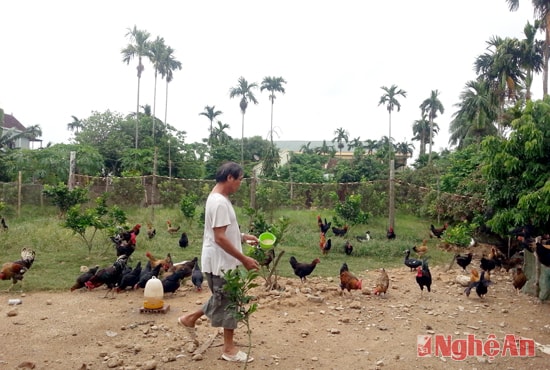 |
| Mr. Tang Van Dam's farm is located in Hamlet 3, Dien Hanh Commune. |
The Dien Hanh commune Party Committee has 8 rural Party branches, 3 school Party branches, and the commune has 1,727 households and nearly 6,800 inhabitants. As a purely agricultural commune, income mainly comes from rice cultivation and supplementary construction work. In 2013, income from crop cultivation and livestock farming was 26,746 million VND, and income from service industries was 154,582 million VND. The average per capita income reached approximately 24 million VND/year. One of the reasons for this achievement is the commune's effective propaganda and ideological work, which has motivated households to strive to escape poverty; in particular, the Party newspaper plays a very important role. Every year, the Dien Hanh commune Party Committee, in addition to fully utilizing allocated funds, also allocates 30-40 million VND to purchase newspapers and magazines, ensuring that all Party branches and organizations have regular access to them.
In Dien Hanh commune, in addition to newspapers provided and subscribed to by individual organizations and associations, there are also 8 newspapers and magazines that are subscribed to and delivered to the commune Party Committee daily. Therefore, the commune Party Committee has emphasized the effective and wasteful use of these publications. Every day, the Party Committee's Propaganda Department and Culture Department take turns highlighting and disseminating high-quality, selected information to the people through various means. Newspapers from the Party branches are intended for Party members to read at the village cultural centers and before monthly branch meetings. The commune has also established reading clubs such as the Senior Citizens' Reading Club and the Reading Club in Hamlet 2.
The clubs have nearly a dozen different newspapers, providing diverse information for various age groups. Every Sunday afternoon, the reading room is opened for the public to read newspapers. For nearly 15 years, Hamlet 2, Dien Hanh Commune, has maintained this regular newspaper reading practice. "We usually read current events on all fronts, consult traditional remedies to share with each other and take care of our health. We also check security information and remind our children and grandchildren to live healthy lives and stay away from social vices," shared Ms. Truong Thi Ty, Head of the Elderly Association in Hamlet 2.
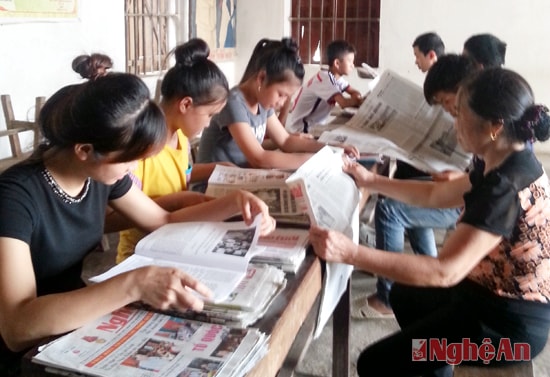 |
| Newspaper reading club in Hamlet 2, Dien Hanh commune (Dien Chau). |
Drawing on experience gained from the press, cadres, Party members, and the people of Dien Hanh commune have implemented many successful economic models that are suitable to the local characteristics and situation. A prime example is the family of Mr. Tang Van Dam in Hamlet 3 – one of the families excelling in economic activities. On a 2,500m2 garden, Mr. Dam's family has built a closed-loop garden, pond, and livestock model, combining broiler chickens, egg-laying chickens, geese, ducks, etc., with fish farming; and cultivating longan, bananas, dragon fruit, etc. Also drawing on knowledge from the press, Mr. Dam's farm has focused on applying clean production methods in every stage and for every type of product. Mr. Dam said: "The criterion is to bring to the market clean, high-quality products in limited quantities to ensure easy sales and better prices…" By applying scientific and technical methods combined with practical experience, the food products provided by the family are very popular with consumers and bring in a decent income for the family.
In addition to developing the economy through the family farm model, Dien Hanh commune has expanded and promoted the construction industry through the formation of construction teams. Currently, the commune has nearly 400 people working abroad and nearly 1,300 skilled workers, mainly in construction. These activities are well-organized and regularly employ a large number of construction workers, especially the construction company of Mr. Nguyen Dang Hoa in Hamlet 8, which employs nearly 70 workers; and the construction company of Mr. Tang Huong in Hamlet 7, which employs nearly 100 workers. The construction industry here has created stable jobs and high incomes for many people, contributing to raising the average income of the entire commune to its current level. Comrade Phan Quoc Bao, Deputy Secretary of the Party Committee of Dien Hanh commune, shared: “Daily newspapers have provided a lot of useful and timely information to the people and Party members. From the newspapers, especially the provincial Party Committee's newspaper, which publishes good models and practices, the Party Committee and its branches have directed the people to learn from and apply them to the reality of the commune and each household. In addition, through press information, negative phenomena and social evils have been reduced, contributing to socio-economic development and building a 'Clean and Strong' Party Committee last year.”
Currently, the commune is focusing on land consolidation and exchange, with each household receiving 1 to 2 plots; planning for the construction of concentrated livestock farming models away from residential areas; developing craft villages, and improving infrastructure, etc., in order to build a more developed locality and improve the lives of its people. To achieve these goals effectively, Dien Hanh commune recognizes the significant contribution of information and communication work, especially through the press.
Text and photos:Nam Thu


