
President Ho Chi Minh instructed: We must protect the sea!
In his system of views and ideology, President Ho Chi Minh recognized early on the particularly important position and significance of the sea and islands. He clearly pointed out the urgent need to protect and exploit the resources from the sea to serve the cause of national construction and development, while also always emphasizing the requirement to firmly protect the sacred sovereignty of the Fatherland's sea and islands.
In his system of views and ideology, President Ho Chi Minh recognized early on the particularly important position and significance of the sea and islands. He clearly pointed out the urgent need to protect and exploit the resources from the sea to serve the cause of national construction and development, while also always emphasizing the requirement to firmly protect the sacred sovereignty of the Fatherland's sea and islands.
"Our silver sea belongs to our people."
From 1910, when Uncle Ho taught at Duc Thanh School (Binh Thuan province), near Thuong Chanh beach, he already had a profound observation: Our sea is rich and beautiful, but why must our people suffer such misery and hardship? He criticized: France claims to be "bringing civilization to Vietnam," but what lies behind those flowery words of the French and the West?
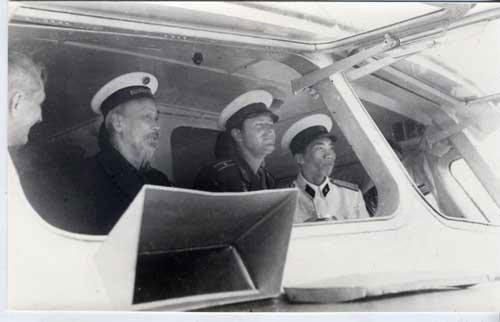 |
| President Ho Chi Minh during a visit to Titop Island, Ha Long Bay, Quang Ninh province. (Archival photo) |
Perhaps, from that thought, he decided to embark on a journey to save the country by sea, on a French merchant ship. Having traveled across five continents and four oceans, upon becoming the head of the Party and State, Ho Chi Minh highly valued the importance of the sea and islands to the nation, considering them an integral part of the country's prosperity. He affirmed: "Our country is located in a tropical region with a favorable climate. It has golden forests, silver seas, and fertile land." Today, as we live in what is considered the "century of the ocean," President Ho Chi Minh's affirmation holds even greater significance.
On October 18, 1946, after returning to Vietnam from a visit to the French Republic aboard the ship Dumont d'Érville in Cam Ranh Bay (Khanh Hoa province), President Ho Chi Minh met with the French High Commissioner D'Argenlieu. When the French High Commissioner said, "The President is truly familiar with the sea; perhaps we should bestow upon him the title 'Little Sailor,' as the French army affectionately gave Napoleon the name 'Little Captain,'" President Ho Chi Minh replied, "Yes, the little sailor of the Vietnamese Navy." With his witty and quick-witted yet profoundly serious response, he affirmed Vietnam's national sovereignty over its seas and islands.
Once, during a visit to Quang Ninh, President Ho Chi Minh asked the provincial chairman: "Do you want to get rich and earn a lot of dollars?" Before the provincial leader could understand his meaning, he continued: "Use a helicopter to take tourists to the islands in the morning and bring them back in the evening, and you'll rake in the money." This story demonstrates that he had already clearly recognized the economic role of Ha Long Bay's seas and islands. He also visited Co To Island many times.
After 1954, when the whole country was carrying out two strategic tasks, President Ho Chi Minh paid great attention to the exploitation and protection of the sea. On March 31, 1959, when visiting Cat Ba fishing village, he taught: "Our silver sea is owned by our people." His ideology was to master the potential of the sea, protect the sea, and exploit its resources to serve the development of the country and the lives of the people. January 4th each year has become the traditional day of the Vietnamese fisheries industry.
"...Our coastline is long and beautiful; we must know how to preserve it."
In 1961, when President Ho Chi Minh visited and spoke with naval officers and soldiers, he instructed: "In the past, we only had night and forests; today we have day, sky, and sea. Our coastline is long and beautiful; we must know how to protect it." President Ho Chi Minh's words were a command to firmly protect the sovereignty of the sea and islands for the entire nation.
To achieve that goal, on May 7, 1955, he directed the establishment of the Coastal Defense Department, the predecessor of the Vietnam People's Navy today, because he foresaw the danger of hostile forces infringing upon our maritime and island sovereignty. On April 10, 1956, speaking at the Conference of Cadres for Coastal Region Reform, he affirmed: “The plains are the house, and the sea is the gate. Can we protect the house without protecting the gate? Where will the intruders enter first? They will enter through the gate first. Therefore, we must educate our people to protect the coast... If we do not take care to protect the coastal region, then fishing and salt production will not be safe. Therefore, an important task of the people in the coastal region is to protect the coast. The people in the coastal region are the gatekeepers for the Fatherland.”
Assigning tasks to the naval forces, President Ho Chi Minh instructed: “Our coastline holds a very important strategic position. Therefore, the tasks of the Navy, both in the short and long term, are very arduous, but also very glorious.” He demanded: “We must find ways of fighting that are suitable to the conditions of our people, the terrain of our coastline, and the weapons and equipment we possess. Our Navy must learn from modern combat experience, but must not forget the ancient traditions of fighting invaders passed down from our ancestors.” These ideas provided a wise strategic direction for the naval forces before the US imperialist air and naval bombing campaign against North Vietnam. They also laid the groundwork for the art of naval warfare of the Vietnam People's Navy.
To protect the sea, President Ho Chi Minh paid great attention to and cared for the lives of officers and soldiers operating at sea and on the islands. When meeting with naval soldiers, he always showed concern for the results of force building, and assessed the situation regarding the protection of the coast and islands, especially the remote islands. In March 1959, while boarding the T.524 ship to inspect the island area in Ha Long Bay, he proactively poured water and distributed candy to each officer and soldier on board, reminding the sailors to love the sea and, having a ship, to diligently study the techniques to use the ship well and fight effectively.
On March 31, 1959, while visiting the artillery position of Company 34 on Hon Rong Island, President Ho Chi Minh instructed the soldiers to strive to overcome difficulties, endure hardships, remain committed to their duties, actively study military, political, and cultural matters, and increase production to improve their living conditions. Knowing that the soldiers on the island lacked fresh water and books, he requested that the General Logistics Department's officer research and ensure that each soldier could bathe twice a week with fresh water. He asked the soldiers, "You don't have a radio to listen to the news, do you? I will send you one." A few days later, the unit received a telegram from the Presidential Palace inviting them to receive the radio that President Ho Chi Minh had gifted them.
Deeply imbued with President Ho Chi Minh's ideology, today, in the process of national construction, the Party has formulated Resolution No. 4 of the Central Committee (10th Congress) on the "Vietnam Maritime Strategy to 2020," setting the goal of striving to "make our country a strong maritime economic nation, prospering from the sea, and firmly ensuring national sovereignty and sovereign rights over the sea and islands." In the face of China's blatant violations of Vietnam's maritime sovereignty in recent times, we are even more deeply imbued with Ho Chi Minh's ideology, so that the entire Party, army, and people are united in firmly defending the sacred sovereignty of our Fatherland's sea and islands.
According to the People's Army Newspaper


