
Lesson 1: It's crucial to recognize the dangerous nature of the plan!
(Baonghean) - Recently, domestic and international public opinion has been very concerned about China's construction of military bases on Gac Ma Island and Chu Thap Island, which China seized from Vietnam on March 19, 1988. A reporter from Baonghean Newspaper had an interview with Major General, Associate Professor – Doctor Le Van Cuong, former Director of the Institute of Strategic Science of the Ministry of Public Security, on this issue. Below is the content of the interview.
| RELATED NEWS |
|---|
PV:General Le Van Cuong, recently public opinion has suggested that China is taking dangerous escalatory actions aimed at monopolizing the South China Sea. Could you please elaborate on China's actions in the Spratly Islands?
Major General Le Van Cuong:It is true that in recent months, specifically since May 2014, domestic and international public opinion has been abuzz with the news that China has been building and reclaiming several submerged islands in the Spratly Islands, which it has seized from Vietnam, namely Gac Ma Island and Chu Thap Island, with the intention of establishing military bases right in the center of the Spratly archipelago. This is a serious violation of international law, the 1982 United Nations Convention on the Law of the Sea, and the Declaration on the Conduct of Parties in the South China Sea (DOC) that China signed with ASEAN countries in 2002. And to cover up this violation, from May 1st to July 15th, 2014, China moved the Haiyang 981 oil rig into waters under Vietnam's sovereignty and jurisdiction. China's scheme is to draw the attention of Vietnam and the international community to this action, diverting public attention from the Haiyang 981 oil rig construction and the illegal construction of military bases, so that they can confidently continue building illegally in the Spratly Islands.
At Gac Ma Island, China has pumped sand and nearly completed the construction of a military base with an airport featuring a 1,800m long runway, capable of taking off and landing Chinese J8 and J10 fighter jets. Below Gac Ma harbor, Chinese ships of 5,000 tons can dock. Simultaneously with Gac Ma Island, since April 2014, China has been reclaiming Cross Island, part of the six islands that China seized from Vietnam on March 14, 1983. Cross Island is a submerged island, with only the southern tip visible at low tide. In terms of size, Cross Island is three times larger than Gac Ma Island. China has also been pumping sand and reclaiming the submerged island to create an artificial island, a second military base for China in the Spratly Islands. When completed, Cross Island will have a runway nearly 2,000m long, capable of accommodating 5,000-ton ships. If completed this year, China's military bases on Fiery Cross and Gac Ma islands would be larger than the US military bases in the Indian Ocean.
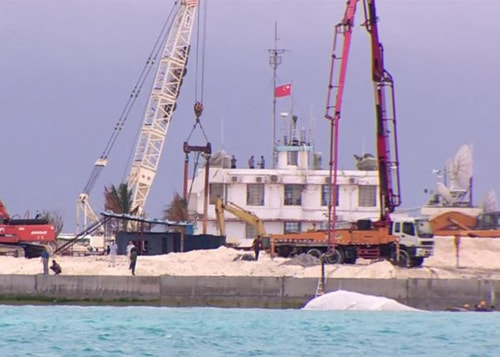 |
| China is carrying out large-scale construction on Gạc Ma. (Photo: BBC) |
This is an extremely dangerous plot and scheme by China. In the South China Sea, Fiery Cross Island and Gac Ma Island hold incredibly important strategic positions for China in terms of both offensive and defensive capabilities. It is known that the Hainan Fleet, located south of Hainan Island (China), is China's strongest naval fleet. From the Paracel Islands, which China has seized from Vietnam, circling around Fiery Cross Island to Gac Ma Island, these four island groups form a strategic defensive perimeter. It is difficult for any aircraft carrier from the South China Sea to approach China. This system also creates a three-pronged attack capability that makes it difficult for any warship to encircle and attack China. Therefore, the positions of Fiery Cross Island and Gac Ma Island are crucial, creating a strategic defensive and offensive belt. Most of the Spratly Islands currently under Vietnam's control, comprising 21 islands, both above and below sea level, are located outside Fiery Cross Island and Gac Ma Island.
This means that, once the military bases on Gac Ma Island and Chu Thap Island are completed, the risk of Vietnam's islands being completely isolated is very high. And who knows, at some point China might establish an air defense identification zone in the South China Sea, making our supply, transportation, and logistics from the central and southern coasts to the islands in the Spratly archipelago extremely difficult. We would be in an isolated and passive position; if China were to take other measures, it might be able to seize the entire Spratly archipelago without even fighting. Therefore, this is an extremely dangerous scheme.
Therefore, this is the time for the international community and Vietnam to speak out strongly against China's intentions and schemes. This is an extremely dangerous tactic in China's process of monopolizing the South China Sea.
PV:How have China's actions in the South China Sea in general, and the Spratly Islands in particular, violated international law and its commitments? I request that the Major General provide a clear analysis.
Major General Le Van Cuong:China's aggressive actions are not a recent development. Historically, the Geneva Accords, signed on July 20, 1954, between the Democratic Republic of Vietnam and the French Republic, stipulated in Article 4 that the Democratic Republic of Vietnam (Hanoi) administered the sea and islands north of the 17th parallel, while the Republic of Vietnam (Saigon) administered the sea and islands south of the 17th parallel, including the Paracel and Spratly Islands. China signed this 1954 agreement. Historically, China also helped Vietnam draft the first agreement for negotiations with France and the United States between May 8 and June 22, 1954. On July 20, 1954, Vietnam signed the 1954 Agreement with France, which stated that the Paracel and Spratly Islands belonged to Vietnam. On July 21, 1954, the international community also held an international meeting in Geneva, attended by countries such as the Soviet Union, the United States, Great Britain, France, China, Canada, India, and Southeast Asian nations. The meeting stated that the international community respected the independence, sovereignty, and territorial integrity of Vietnam.
This means that China signed the Geneva Accords twice. Vietnam's Hoang Sa and Truong Sa islands were confirmed by an international treaty with the highest legal value. This refutes all of China's claims. China has no legal basis whatsoever regarding Hoang Sa and Truong Sa. After the Geneva Accords, China concentrated its forces to occupy a region of the Hoang Sa archipelago, which was then under the control of the Republic of Vietnam (Saigon). The first time China used military means to occupy a cluster of islands was in 1956. The second time, in January 1974, China occupied the entire Hoang Sa archipelago, which was then under the control of the Republic of Vietnam (Saigon). The third time, on March 14, 1988, China used force to occupy six islands of Vietnam in the Truong Sa archipelago, and at the end of 1988, China occupied another island. Thus, in 1988, from March 14th to the end of the year, China used military means to seize 7 submerged islands belonging to Vietnam in the Spratly Islands. This means that since 1954, China has used military means three times to seize the entire Paracel Islands and parts of the Spratly Islands belonging to Vietnam.
China's military actions violated Article 1, Paragraph 1 of the UN Charter, which states that the purpose of the United Nations is to maintain international peace and security. China is a permanent member of the Security Council. China also violated Article 2, Paragraph 3 of the UN Charter, which states that all members must settle their international disputes by peaceful means, in a manner that does not endanger international peace, security and justice. Article 2, Paragraph 4 of the UN Charter also stipulates that all members of the United Nations refrain from the threat or use of force in international relations against the territorial integrity or independence of any State.
Regarding the 1982 United Nations Convention, they violated Article 516 and Article 76, which stipulate the sovereign rights and jurisdiction of coastal states over their maritime zones, exclusive economic zones, and continental shelves, including those of Vietnam. Article 81 states that any drilling or exploration activities, for any reason whatsoever, must be authorized by the coastal states. The reclamation and construction of military bases on Gac Ma Island and Chu Thap Island are completely contrary to Article 81. Article 279 states that member states have an obligation to settle all disputes between themselves and other countries by peaceful means in accordance with Article 2, Paragraph 3 of the UN Charter, and this purpose requires finding peaceful solutions as set out in Article 33, Paragraph 1 of the Charter.
Article 33 states that states involved in disputes should use peaceful means and not prejudice international peace and security. Therefore, China's reclamation of Gac Ma and Chu Thap islands from the beginning of 2014 to the present violates the United Nations Charter, Articles 1, 2, Paragraph 3, 3, Paragraph 4, Article 33, Article 56, Article 76, and Article 279 of the 1982 United Nations Convention on the Law of the Sea, and possibly Article 81. These are all the actions China has violated. In terms of commitments, the reclamation of Gac Ma and Chu Thap islands, as well as their conduct in the Spratly Islands, seriously violates the commitments that Chinese leaders have signed and declared to other countries. First, there is the Convention on the Law of the Sea (DOC), which China signed with ASEAN in 2002. The DOC contains a clause stating that: Until disputes are resolved, the parties concerned should not take actions that alter the status quo and further complicate the issue. China has violated the DOC. In terms of declarations, China has violated four declarations:
The first statement, from 2011, when General Secretary Nguyen Phu Trong visited China and signed a joint statement with Xi Jinping, outlined five principles for resolving disputes in the South China Sea. One of these principles stated that, during the dispute resolution process, neither side should infringe upon or alter the status quo, thereby destabilizing the South China Sea and undermining regional security. China, however, contradicted its own statement.
Second statement: In June 2013, when President Truong Tan Sang visited China, President Xi Jinping also signed a joint statement with President Truong Tan Sang, in which President Xi Jinping pledged that Vietnam and China would find a satisfactory solution to the South China Sea dispute, ensuring the interests of all parties. While a solution had not yet been found, neither side would further complicate the situation or alter the status quo. And they betrayed the commitment they had signed.
In mid-2013, during the ASEAN +1 Summit, at a meeting with heads of state, President Xi Jinping stated that China and ASEAN share a common destiny, experiencing both joy and hardship together. Therefore, China and ASEAN need to move quickly towards a friendly cooperation agreement for regional development. They had committed to regional peace and stability, yet they broke their own commitment.
Another commitment was made in October 2013, when Chinese Premier Li Keqiang visited Hanoi and signed a joint statement with Vietnamese Prime Minister Nguyen Tan Dung. Regarding the South China Sea, Premier Li Keqiang stated that both sides would seek peaceful means to resolve the South China Sea dispute. China and Vietnam also established a permanent working group on the South China Sea to ensure stability there.
Thus, within three years, they made four commitments but then repeatedly reneged on them. China's actions from the beginning of 2014 to the present in reclaiming Gac Ma Island and Cross Island are violations of the United Nations Charter, the 1982 United Nations Convention on the Law of the Sea, the Declaration on the Conduct of Parties in the South China Sea (DOC), and the four commitments that President Xi Jinping and Li Keqiang made to ASEAN countries and Vietnam. From this, I recall an occasion in the early 1960s when a foreign journalist asked then-General Secretary of the Communist Party of the Soviet Union: "What do you think of the Chinese leadership?" Kholosov replied: "Only fools believe what the Chinese leadership says." I believe that statement is absolutely correct. They have trampled on international law, disregarded international law, and China has turned its back on its commitments to the international community in general, and Vietnam in particular.
Many international scholars argue that when faced with political difficulties and social instability, Chinese leaders often accuse foreign countries of threatening China to divert public opinion outwards, even creating military conflicts with neighbors to quell domestic unrest. I completely agree with these foreign scholars' opinions. Let's look back at Chinese history; from 1949 to the present, whenever China experiences political, economic, or social instability, they often shift the issue outwards to urge domestic forces to temporarily set aside internal conflicts and focus on the external enemy. We recall the period from 1958 to 1962, during which Chairman Mao Zedong implemented the Three Red Banners policy and a leap forward in the economy.
This was a misguided left-wing policy. Subsequently, every household engaged in iron and steel production, with thousands of counties producing hundreds of millions of tons of unusable, rusty iron. The Three Red Banners policy and the Great Leap Forward economic policy of 1958-1962 led to the starvation of 37 million Chinese people and the destruction of society. To salvage the situation, the Chinese leadership launched an invasion of India. That was the first lesson. During the 10 years of the Cultural Revolution (1966-1976), Chairman Mao Zedong launched the Cultural Revolution to eliminate his rivals. During this 10-year Cultural Revolution, Mao Zedong used the Red Guards to kill 20 million party members and outstanding Chinese citizens. This time, the entire Chinese Communist Party was shattered. To salvage the domestic situation, Mao Zedong launched a war against the Soviet Union and falsely accused the Soviet Union of aggression. We should remember that in 1969, the Soviet Union did not threaten China in any way. Chairman Mao lied to the 650 million Chinese people, telling them they were facing a threat from the Soviet Union, and therefore, domestic issues were temporarily put aside before launching the war on the Syamour River against the Soviet Union in 1969.
For the third time in 1976, Mao Zedong died, and the "Gang of Four" also disintegrated and collapsed. Among those sentenced was Mao Zedong's concubine, Jiang Qing, who was later sentenced to death but had her sentence commuted to life imprisonment. Deng Xiaoping came to power amidst such a shattered Party, State, and society. Therefore, on February 17, 1979, Deng Xiaoping launched a war of aggression against Vietnam along the entire border. Afterward, he allied himself with the United States and the international community to encircle and embargo Vietnam.
History tells us that in all three instances where China faced major domestic problems, they pushed the issues outward. I believe that public opinion and scholars have a basis for saying this. All of China's actions in the South China Sea stem from its internal affairs. Therefore, in the process of finding ways to respond to China's actions in the South China Sea, it is extremely important that we closely monitor China's internal affairs, especially its political and social situation. The day before yesterday, the Third Plenary Session of the 18th Central Committee of the Communist Party of China concluded. This was a particularly important session because, from 1949 until now, for the first time, an 18th Central Committee meeting focused solely on the rule of law and party rule, meaning that by all means, power in China must abide by the law and ensure the role of the party, overcoming degeneration, corruption, and decay.
China's fight against corruption has reached an extremely difficult and complex stage. After centuries of accumulation, this festering wound has now become a festering sore within the state apparatus, affecting the political situation and threatening the Chinese Communist Party. Beneath the dazzling facade of development, the socio-political situation is extremely complex. In 1998, Zhu Rongji was a determined prime minister fighting corruption. He said, "Prepare 100 coffins and reserve one for me. I am willing to die in this fight if it brings the country long-term economic stability and the people's trust in the government and the Party." On June 26, 2014, Xi Jinping stated at a Politburo meeting: "I am not afraid of death, I am not afraid of losing honor, and I am ready to plunge into the fight against corruption."
In the past 18 months, 50 high-ranking Chinese officials, including vice ministers and above at the central level, provincial governors and vice governors, and three Politburo members, have been arrested. The arrests of Zhou Yongkang, a member of the Politburo Standing Committee, along with Xu Caihou and Guo Boxiong, two vice chairmen of the Central Military Commission, and numerous other high-ranking officials, are unprecedented in Chinese history. Their political and social situation is extremely complex; after a long period of growth at 9-11%, their economy has now stagnated at 7-7.5%. This is a bubble economy with enormous public debt and many problems. Therefore, when studying countermeasures, we must pay attention to internal issues and closely monitor China's internal affairs to predict their behavior in the South China Sea. This is something we must closely monitor going forward.
PV:Thank you, Major General!
(To be continued)
Ngo Kien(Perform)


