
Lesson 1: What opportunities are available for graduates?
(Baonghean) - Recently, public opinion nationwide has been genuinely concerned about the information that over 72,000 graduates and master's degree holders are unemployed. Opportunities will become even more difficult because the economy has not yet recovered from the crisis, while the quality of training at many universities and colleges does not meet development requirements, and students lack soft skills and the skills needed by society.
Six months ago, the family of Mr. Nguyen Van Hoa in Thanh Ha commune, Thanh Chuong district, was overjoyed when their second son graduated from university with a good grade in Business Administration. They were happy because, until then, only one person in the family had achieved a university degree. However, this joy was mixed with worry about finding a job. For the past six months, seeing his son traveling back and forth from the district to Vinh City every day seeking employment without success, Mr. Hoa sadly shared: “When he got into university, the whole family was so happy. We worked hard to support his education, hoping he would find a stable job to ease the hardship of working in the countryside. But after graduating, it’s difficult to find work, and the whole family is worried, not knowing what will happen to him!?” Similarly, Dang Thi Hoa in Ben Thuy ward, Vinh City, graduated from high school but didn’t get into university. She then studied accounting at a vocational school. After two years of studying without finding a job, her family tried to invest in her further education to pursue a university degree. One might think that would make it easier to find a job, but after graduating, they're still just "sitting around doing nothing."
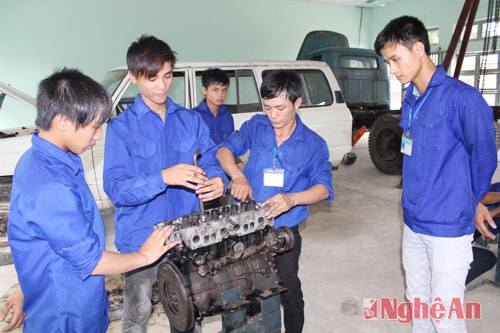 |
| Automotive repair class at Yen Thanh Vocational College of Agriculture and Industry. Photo: ns |
Recently, the Ministry of Labour, Invalids and Social Affairs announced that approximately 72,000 graduates and master's degree holders are unemployed, and in reality, that number could be much higher. In Nghe An province alone, according to statistics from the Department of Education and Training, there are about 12,000 people with vocational school diplomas or higher who have not yet found employment, including over 4,000 with college degrees and more than 3,000 with bachelor's or master's degrees.
Faced with the pressing issue of unemployment, we attempted to find job opportunities for graduates waiting for work. With a business administration degree in hand, we approached several businesses in the province. Some companies immediately rejected our applications, citing "no need"; others, when we spoke to their administrative staff, didn't even bother reviewing our resumes, only asking about our field of study. When we explained our major, they said, "This field has the most oversupply; even master's degrees are hard to come by, let alone bachelor's degrees." In some exceptional cases, a few businesses (mainly in the textile and toy assembly sectors) hired workers without requiring a degree, offering only seasonal contracts for production line work with salaries ranging from 1.8 million to 2.5 million VND, but with a probationary period of 1 to 3 months "for free." Of course, these places aren't keen on hiring university graduates because they know that "those who have a university degree will only see this as a temporary job, not something they'll commit to long-term." To make it easier to get a job, many people reluctantly put away their engineering degrees... and accept apprenticeships as unskilled laborers.
 |
| English class at Vinh University. Photo: Huu Nghia |
Regarding recruitment into agencies, departments, or civil service positions at the district and commune levels, are there opportunities? After inquiring about this area at the Department of Internal Affairs, Mr. Dau Dinh Duong, Deputy Head of the Civil Servant and Public Employee Department, stated: “Each year, based on the needs of departments, agencies, and districts, the province will organize open civil servant recruitment exams. However, the number is not large; for example, in 2012, the entire province only recruited over 150 people; in 2013, 147 people; and in 2014, the recruitment target was also only about 150 people. Meanwhile, the competition ratio is very high; in some fields, there are 70 to 90 applications for just one position...”
At the commune level, the entire province only recruits around 100 people each year to replace those reaching retirement age. Therefore, opportunities for graduates and master's degree holders to work in communes are not easy. Mr. Nguyen Thang Long, Head of the Government Building Department of the Department of Internal Affairs, said: “A few years ago, encouraging college and university graduates to work in communes was very difficult. But now, many people want to return but don't have the opportunity. The reason is that the commune's civil servant workforce is already stable, and in recent years, younger people have been added, so recruitment exams are only organized to replace those who retire…” Opportunities will not be easy because, according to the Law on Cadres, Civil Servants, and Public Employees, anyone in the country who meets the requirements regarding professional field, age, etc., has the right to participate in the examination for positions in departments, agencies, districts, and communes in Nghe An. In reality, based on the recruitment needs of departments, agencies, and localities, on average, only about 3-5% of university and master's degree holders from within the province have the opportunity to find employment each year. Even more worrying, the Ministry of Interior recently drafted and is seeking feedback on a decree to streamline the civil service by 100,000 over the next six years…
To "earn" a university degree, a student from out of town needs at least 2.5 million VND per month. This means that over four years of study, the cost is approximately 120 million VND. However, after graduation, they often cannot find jobs. This represents a huge waste of both time and money for the students. Even more worrying is that many families in poor rural areas struggle to send their children to university, hoping they will find more stable employment than farming. Many families have sold their buffaloes and cows, and borrowed from the Policy Bank to fund their children's education, but after graduation, they cannot find jobs while their debts are due. According to statistics from the provincial Policy Bank, the outstanding debt for students from rural areas is nearly 2,700 billion VND, with 112,575 borrowing households; of which, nearly 6 billion VND is overdue (with over 2,500 borrowing households). According to Mr. Hoang Son Lam, Head of the Planning and Operations Department of the Policy Bank: “The amount of overdue debt compared to the total outstanding debt is not large and is within our control. However, there are many loan packages that have matured and been extended. This is also a matter of concern, especially since many customers are farmers in poor rural areas, and some families even borrowed money for 2-3 children's education. The bank is closely coordinating with working groups at the commune level to both inform families and encourage them to repay their debts…”
During our research for this article, we met Mr. Nguyen Van Cuong, a skilled automotive electrical repair technician working at a large repair shop on Nguyen Trai Street in Vinh City. With a salary of over 7,000,000 VND per month, Mr. Cuong considers it suitable. More importantly, he believes his chosen profession is the right one, as automotive repair is currently and will continue to be a field with many job opportunities. Mr. Cuong recounted his journey as a technician, starting after graduating from high school. Finding higher education unsuitable, he studied motorcycle repair. After three years, he realized the need for a change and decided to go to Ho Chi Minh City to study automotive repair. After two years of training and acquiring solid skills, he returned to Vinh and worked in automotive electrical repair.
To date, after nearly 10 years in the repair business, by recognizing career opportunities and continuously improving his skills, Mr. Cuong is considered one of the most skilled mechanics, sought after by many auto repair shops. However, he remains loyal to his starting point because of the foundations that have bound him to it. Mr. Cuong shared: “In any profession, attention to detail and strengthening relationships with colleagues and the organization are essential for success. I have the idea of only branching out when I have sufficient management skills and capital to open my own repair shop. At that point, I can recruit other skilled mechanics to work alongside me, both serving society and providing employment and income…”
The reality shows that the path to success and career advancement for each individual does not necessarily require attending university. The key issue is that students need to correctly identify the needs of the professions that society requires in order to seize learning opportunities and advance. As for colleges and universities, if they do a good job of forecasting the next 4-5 years, focusing on training according to societal needs, they can avoid the current dire situation of graduates being left unemployed. (To be continued)
Nguyen Son - My Ha


