
Lesson 1: There's still a lot of work to be done.
Resettlement work for the Hua Na Hydropower Plant Project (Que Phong) has been largely completed, with 1,406 households eligible for resettlement having moved to their new homes. This has enabled the key hydropower project to proceed as planned, closing the tunnel and impounding water on July 4th. However, nearly two months after the Hua Na Hydropower Plant began impounding water, many aspects of stabilizing life in the resettlement areas remain unfinished.
(Baonghean)Resettlement work for the Hua Na Hydropower Plant Project (Que Phong) has been largely completed, with 1,406 households eligible for resettlement having moved to their new homes. This has enabled the key hydropower project to proceed as planned, closing the tunnel and impounding water on July 4th. However, nearly two months after the Hua Na Hydropower Plant began impounding water, many aspects of stabilizing life in the resettlement areas remain unfinished.
The current situation in Pieng Cu
In the first resettlement area of Piêng Cu, Tiền Phong commune (implemented two years ago), the lives of the people are still very difficult; some households even lack housing, electricity, and the damaged water supply system has yet to be repaired…
After several days of torrential rain due to the influence of the remnants of Typhoon No. 5, we made our way up the road to the Piêng Cu Resettlement Area in Tiền Phong commune (this is the earliest of the 13 resettlement areas for the Hủa Na Hydropower Plant). The first thing we saw was a dilapidated, muddy, pothole-filled asphalt road connecting the main Phú Phương road to the center of the Piêng Cu Resettlement Area. Mr. Ha Van Phong, head of Pieng Cu 1 village, said: “Previously, this area was called Pieng Cu village, but it has recently been divided into Pieng Cu 1 and Pieng Cu 2. Pieng Cu 1 village has 72 households and 290 people, all of whom are of the Thai ethnic group. When the Hua Na Hydropower Plant Project was implemented, the people of Nong Danh village, Dong Van commune, relocated to this new resettlement area in October 2010. Two years have passed since they moved to their new homes, but they still haven't settled down. Their food depends on government-provided rice (30 kg per person per month), and they also borrow hillside land to grow cassava, gather bamboo shoots from the forest, dig up yams, or work as laborers to earn extra income. Not only do they lack land for production, but they also face a severe shortage of clean water. In the early days, the people had access to naturally flowing water from six communal water tanks, but since May 2011, the water pipeline, approximately seven meters long, has been cut off.” The kilometer gauge was damaged in many places, so all six tanks were completely dry.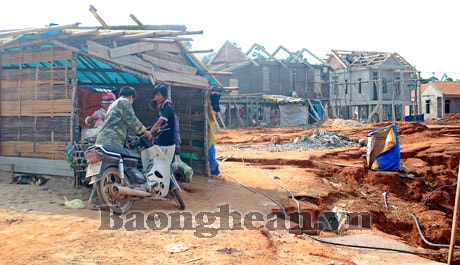
In the Huồi Siu and Huồi Lạn resettlement areas (Đồng Văn commune), most houses have not yet been completed.
Currently, the main source of water for the local people is from wells dug by the Hua Na Hydropower Project Management Board, and during the dry season, there is a shortage of water. It is known that, according to the project management board's commitment, after the houses are completed, they will support the people in installing electric fans. However, after two years of living there, many houses still lack electricity and electric fans. In Pieng Cu 1 village, there are 10 houses without electricity or fans, such as the families of Lang Van Chien, Lo Van Thieu, Luong Van Xo, Luong Thi Nhung, Ha Van Hoat… These families have had to rely on electricity from neighboring families. At the house of the village head of Pieng Cu 1, the house was just completed and they only moved in a few days ago. Because it hasn't been connected to the power grid, the family asked to connect electricity from a neighboring family, but they only have one light bulb hanging in the middle of the house.
A similar situation is occurring in Pieng Cu 2 village. Specifically, out of 61 households that moved to the resettlement area two years ago, one household still lacks a home. This is the case of Mr. Lang Van Hoai's family. Ha Hong Son, the Party Secretary of Pieng Cu 2 village, led us to their unfinished house, with only minor finishing touches on the roof (a section still untiled), and the livestock sheds and toilets. Currently, there are no workers on the construction site. Upon investigation, we learned that the construction crew has been on strike for nearly a week.
Meeting with Mr. Ton The Lung, the construction team leader, he complained: “My team is working on several resettlement houses for Anh Duc Co., Ltd. (Hung Nguyen). The last house we’re working on is for Mr. Hoai’s family. That house is still missing 1,000 roof tiles and the outbuildings are not yet finished. Currently, we are on strike because the company hasn’t paid us. I’ve worked 137.5 days, worth 22 million dong, but so far the company has only paid me 3,365,000 dong. We will only continue working when the company pays us for the work we did before July. When the team calls to inquire, the company’s leaders keep postponing payment.” In Pieng Cu 2 village, the self-flowing water supply system has been broken since May 2011, and the concrete internal village road system is also damaged in many places. Local residents also reported that Tien Phong 4 Primary School, where their children attend, is currently lacking many desks and chairs, forcing students to sit in cramped and crowded conditions.
Upon further investigation into the issue of land allocation for agriculture, we learned that the Hua Na Hydropower Project Management Board recently planned and organized a lottery for local people to receive garden land, hillside land, and arable land. According to the standard, land is allocated per household. A household of two members will receive 2 hectares of arable land, 2 hectares of hillside land, and 2 hectares of garden land; a household of 3-5 members will receive 3 hectares of hillside land, 3 hectares of arable land, and 3 hectares of garden land. If the government provides support with seedlings, livestock, and the transfer of scientific and technical knowledge in animal husbandry and production, the people will be able to temporarily stabilize their lives on that land.
Even the earliest relocated residents to the Hủa Na Hydropower Resettlement Area are facing numerous difficulties and challenges. To ensure that the people can settle down and live in peace, the local authorities, and especially the Hủa Na Hydropower Project Management Board, need to promptly address these issues.
Shortcomings... and a lack of synchronization!
Investigations reveal that although the resettlement work for the Hua Na Hydropower Project started early, many problems and obstacles arose during the process, leading to delays in relocation and affecting the project's overall progress. Among the many reasons for this situation, the most prominent issues are land leveling and compensation policies. Residents demanded to be allocated land plots by lottery before accepting compensation. This was due to the contractor's fault. Furthermore, the compensation policy was hampered by regulations concerning built houses, stilt houses, reclaimed land, orchards, and land already covered by land titles… even within a single commune, it required numerous adjustments before a consensus was reached.
A pressing issue for resettled residents is the low capacity and responsibility of contractors, failing to meet practical requirements. This has resulted in many households moving to new locations without housing, forced to live in temporary shelters. According to Mr. Tran Quoc Thanh, Secretary of the Que Phong District Party Committee, the cause is the difficult terrain and limited capacity and equipment of some contractors. This slows down land leveling, affecting many project components and failing to meet the residents' living needs in a timely manner. According to the government's policy, there are two ways to build houses for resettled households: residents voluntarily build their own houses, or they receive resettlement housing. This means that households with building materials or existing wooden stilt houses voluntarily move to the new location to build their own houses, or register for the government to build houses for them. Statistics show that approximately 25% of households voluntarily build their own houses; these households naturally have to build temporary shelters. However, the district still requested the Hua Na Hydropower Project Management Board to provide living allowances for the residents. These households also have access to electricity and running water. However, among those who voluntarily built their own houses, due to the poor quality of their materials, they only registered for resettlement housing at the last minute. Therefore, at this time, some houses are still in the foundation excavation stage. These households may have to accept living in temporary housing while waiting for their new homes for a considerable period, as the rainy season significantly impacts construction progress.
It is known that some contractors received an advance payment of 40% of the project value after signing the contract. However, due to the recent refusal of construction material suppliers to offer credit and the increase in construction material prices, many contractors are facing difficulties. This is a "last resort" for the contractors, but some contractors are also experiencing delays in receiving funds from the project owner, the Hua Na Hydropower Project Management Board. Furthermore, contractors lacking professional workers have to mobilize seasonal workers from Tan Ky, Nam Dan, Thanh Chuong, Yen Thanh, etc., who return to farming during the harvest season, significantly impacting the construction progress.
In reality, there is still much work to be done in the resettlement process for the Hua Na Hydropower Plant.
(To be continued)
X.Hoang – H.Vinh


