
Lesson 1: When the "public" side complains, the "private" side also complains!
Editor's Note: On September 14th, at the consultation meeting on the draft decree on financial mechanisms for public hospitals, Minister of Health Nguyen Thi Kim Tien expressed her determination to change hospital fees. Following the Ministry of Health's announcement of the draft increase in hospital fees, various opinions have been generated. Reporters from Nghe An Newspaper have investigated this issue.
(Baonghean.vn)Editor's Note: On September 14th, at the consultation meeting on the draft decree on financial mechanisms for public hospitals, Minister of Health Nguyen Thi Kim Tien expressed her determination to change hospital fees. Following the Ministry of Health's announcement of the draft increase in hospital fees, various opinions have been generated. Reporters from Nghe An Newspaper have investigated this issue.
On September 30, 1995, Joint Circular No. 14 of the Ministry of Health, the Ministry of Finance, the Ministry of Labor, Invalids and Social Affairs, and the Government Price Committee was issued, guiding the implementation of partial hospital fee collection. Since then, the hospital fee framework has been implemented according to this Circular, although it was later supplemented with prices for some other technical procedures according to Circular 03 dated January 26, 2006 (but without changing the original framework). Thus, for 16 years, hospital fees have remained unchanged, and from the perspective of those working in the health sector, this is a major inadequacy.
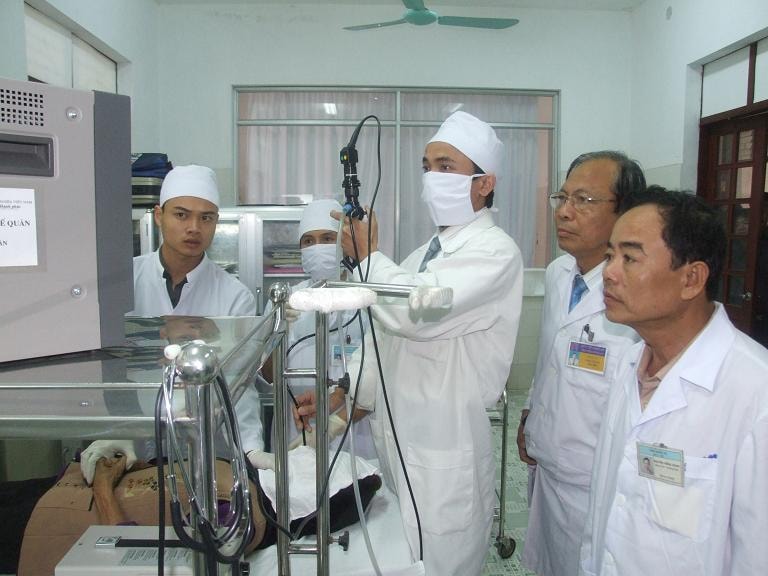
Using endotracheal endoscopy in the treatment of patients at the Provincial Tuberculosis and Lung Disease Hospital.Photo: Tu Thanh
Nghe An Friendship General Hospital is a Grade I hospital with the highest number of patients in the province. On average, the hospital's Outpatient Department receives about 500 patients daily. It has 13 doctors and 29 nurses and orderlies (including those in the specimen transport and billing departments). With such a large number of patients, the medical staff here have to work overtime to meet the needs of the patients. However, with the regulated consultation fee of 3000 VND per visit, according to Mr. Tran Ba Dinh, Head Nurse of the Outpatient Department: "We have to accept this price to serve the patients, because at this price, it only covers the cost of stationery, not to mention the intellectual effort of the doctors, electricity, water, and consumable supplies."
At this hospital, the daily cost of a hospital bed ranges from 8,000 to 18,000 VND, depending on the department. According to the doctors, this price only covers a small portion of the costs, such as electricity, water, and sanitation, and the government's subsidies for each bed are insufficient (while a bed on demand can cost several hundred thousand VND per day). A number of other technical services are also reported to be operating at a loss, such as certain procedures, surgical interventions, and obstetrics.
According to statistics, in the first nine months of the year, the hospital performed 1,423 cesarean sections, each reimbursed only 450,000 VND, while three sutures alone cost 180,000 VND (if the patient wanted high-quality sutures). Adding other costs, the total cost of a cesarean section reached at least 500,000 VND. (Some private hospitals in the area charge 5,000,000 VND for a cesarean section). Even a simple procedure like catheterization, which costs 6,000 VND, resulted in a deficit of over 30,000 VND.
To perform this procedure, two pairs of gloves, a catheter, a sterile autoclave, 20 ml of farafil oil, a 10 ml urinary catheter, and a vial of distilled water are required, with an estimated cost of approximately 42,500 VND (the hospital performed this procedure 5,700 times in the past nine months). Similarly, to insert a gastric tube, one pair of sterile gloves, a 50cc large-tipped syringe, a connecting tube, a rubber tubing connector, farafil oil, bandages, and other accompanying equipment are needed, with an estimated cost of 36,700 VND, but only 3,000 VND is reimbursed.
Dr. Le Van Tiec, Director of Vinh Transport Hospital, stated that the hospital's fee structure is based on the level 3 hospital fee framework, with a price of 2000 VND per consultation, which is "not even enough to cover the cost of stationery." The hospital has to find many ways to increase revenue to offset these expenses. For many years, the hospital has had to "self-save" by investing in equipment through socialized funding to perform advanced diagnostic and testing techniques. The hospital collects approximately 20 billion VND in hospital fees annually. After deducting nearly 17 billion VND for medication costs, the hospital has about 3 billion VND left to supplement salaries, benefits, and equipment purchases. The hospital has also expanded its services, but "the difficulty compared to private hospitals is that even if they offer services, they must adhere to the state-regulated prices." Regarding Decree 43, which allows hospitals to manage their own revenue and expenses, Dr. Tiec also noted that the state only allows self-determination, not autonomy, so "anything we want to do is hampered."
According to the leadership of Nghi Loc District General Hospital, the hospital has up to 120 services operating at a loss, such as cesarean sections, normal deliveries, difficult deliveries, insertion and removal of IUDs, dressing changes, cast removal, incision and drainage of abscesses, tonsillectomy, etc. Our investigation reveals that the situation at Nghi Loc General Hospital is also common among district-level hospitals, which are considered to be most affected by the inadequate hospital fees. At this level, unlike provincial-level hospitals, they cannot rely on other sources of funding to offset losses by increasing revenue from profitable services such as CT scans, MRI scans, and color ultrasounds. As a result, doctors often feel like they are "working for free," and these already struggling hospitals are further declining.
While public hospitals tend to "watch private hospitals collect fees and... hope for the same," private hospitals also have their own "concerns." Although regulations allow private hospitals to set their own fees, "raising prices means driving patients elsewhere."
According to Mr. Nguyen Phuong Kien, Chairman of the Board of Directors of Cua Dong General Hospital, the hospital currently charges 10 times higher fees for examinations and hospital beds compared to public hospitals. While this is still lower than many other facilities and areas, it is acceptable to people in Nghe An province. He also stated that the hospital cannot increase fees further because doing so would lead to a loss of patients, so for the past seven years, the hospital has not dared to raise the fees. Regarding providing medical services to 20,000 insured patients in Vinh City, Mr. Kien believes that the hospital is essentially "helping the government" because it has to invest in facilities, while the fees covered by insurance are regulated by the government.
But this is also a channel for the hospital to promote its brand, and from this source, many insured patients have accepted some services outside the covered list. Another drawback that Mr. Kien mentioned is the unreasonable reimbursement by the State for some services, with the current "equal" calculation method for ultrasound, X-ray, and laboratory tests. Patients diagnosed with color ultrasound are only reimbursed as if they were using black and white ultrasound, and a 5 billion VND X-ray machine with a 7-second film output is reimbursed as if it were a 50 million VND machine. However, in private hospitals, hospital fees don't increase, but quality must still improve because "patients are the ones who pay the salaries." And while public hospitals receive state investment in equipment, private hospitals are essentially "investing capital and gradually reaping the benefits." This is also the reality at Hospital 115, which we investigated.
(To be continued)
Thuy Vinh


