
Lesson 1: Counterfeit and pirated goods are rampant.
(Baonghean)With increasingly sophisticated counterfeiting techniques, fake and pirated goods, or intellectual property infringements, are appearing on the market in ever greater numbers and being openly sold. This problem not only harms consumers and legitimate manufacturers but also acts as a barrier for businesses in their efforts to find markets, develop, and protect their brands.
Ms. Nguyen Thi Hong, from Hamlet 4, Nam Anh Commune (Nam Dan District), is still deeply disappointed as she recounts her experience of being a victim of counterfeit goods. Ms. Hong's son passed the entrance exam to Hanoi University of Transport. To encourage his academic achievement, she bought him a laptop to help with his studies. The two went to Vinh City to buy the laptop, and after consulting with a salesperson, her son chose a Dell laptop because, according to the salesperson, it was small, compact, and durable. Without hesitation, Ms. Hong decided to buy it for 8.6 million VND. However, less than two months after her son started university, he called to report problems with the computer. First, it frequently shut down while in use, and then the battery drained very quickly.
"I took the receipt to the store to ask about warranty service, and the employee nonchalantly said I had to wait for a new warranty period and that I would have to bear 50% of the cost. As if that wasn't enough to get me angry about the store's irresponsible information, my child then informed me that this laptop was just a counterfeit Dell product. I saved up for a whole year to buy this laptop for my child, only to buy a fake one. Now I don't know who to complain to..." - Ms. Hong expressed her frustration!
After a period of calm, counterfeit sanitary pads have reappeared on the market with even more sophisticated imitations. They are identical to genuine products, from the brand name to the shape and color. Showing two packs of counterfeit sanitary pads as evidence, Ms. Nguyen Thu Ha (residing in Hoa Tien hamlet, Hung Loc commune, Vinh City) said: "I'm quite careful, so I bought sanitary pads at a mini-supermarket on Phung Chi Kien street instead of at retail grocery stores. I checked very carefully before paying, confirming it was indeed Kotex-Style at 11,000 VND per pack. I even asked the staff if the product was genuine. They said they had someone from the company who supplied the goods, so I felt reassured. But when I got home and opened the pack, I saw that each pad had the word 'Kalex' on it instead of the usual 'Kotex'."
At first glance, Ms. Ha, like many other consumers, would find it difficult to recognize this as a counterfeit product. The packaging still bears the words "Kotex - Style," along with an image of a girl wearing a rosary and with her hair in a bun. At the bottom is a label with the name of the manufacturing company, Kimberly-Clark Co., Ltd., located in Phu Nhuan District, Ho Chi Minh City. However, upon closer inspection and comparison with the genuine product, several differences become apparent. First, the lines on the packaging are not sharp, the colors don't match, and some are smudged; the address at the bottom is illegible and blurry; and the opening for cutting the packaging is wrinkled and looks very bad. The most obvious difference is that this product lacks the fragrance of the genuine product; it smells of recycled plastic, which is quite unpleasant.
Like many other consumer goods, milk of unknown origin, poor quality, and even counterfeit milk are quite common in the market. In most stores, consumers can easily find and buy boxes of "imported" powdered milk. Due to a preference for foreign products, many people believe that foreign-language labels, even if they don't understand them or know the ingredients, are genuine. Taking advantage of this, many domestic and international counterfeit manufacturers produce fake products, labeling them with famous brand names to deceive consumers under the guise of "imported goods" for profit.
Clearly, using "imported" goods carries many risks and dangers because they lack certificates of origin and are not inspected for quality by any agency or organization. The recent scandal involving fake Danlait goat milk, which failed to meet protein standards, serves as a lesson for consumers. Danlait is actually a dietary supplement, but when it arrived in the Vietnamese market, it was advertised as "goat milk" imported from France. According to the company's import documents, the product was priced at only 3 euros per box (approximately 81,000 VND per box), but the retail price on the market reached 415,000 VND per box. Clearly, those who used Danlait for a long time were not only cheated out of a large amount of money but also negatively impacted their children's nutrition and development because this milk did not contain enough protein to meet their developmental needs.
According to the assessment of the Market Management Department's leadership, counterfeit and imitation goods are circulating and being traded openly in the market, from urban to rural areas. Counterfeit goods appear in almost all product categories, from common consumer products to high-end items. Common violations currently affecting three key product categories—fertilizers, pesticides, and alcoholic beverages—include deficiencies in nutrient content compared to declared standards or quality levels that do not meet declared standards; mixing fillers and colorings into products, then distributing them directly to retail stores and agents at low prices without invoices or documentation; counterfeiting the trademarks of reputable brands to circulate fake products on the market; and using misleading pronunciation or terminology regarding nutrient content to sell at higher prices. Particularly in recent times, there has been an increasing number of small-scale production facilities, with many new types of low-quality products circulating on the market...
For example, on January 9, 2013, Market Management Team No. 3, in coordination with the Traffic Police Team of Hung Nguyen District Police, inspected a car with license plate 34L-2096 owned by Mr. Cao Minh Hoang. They discovered 216 bottles of BLACK liquor (700ml, 40% Vol) of foreign origin without invoices or documents proving their legality; 12 whole slaughtered goats weighing 180kg of unknown origin and without quarantine procedures; and 299 packages of SUFER-CLO chemical of foreign origin without invoices or documents proving their legality. The estimated value of the shipment was 150 million VND. On January 16, 2013, Market Management Team No. 1 inspected the production facility of Ms. Pham Thi Tam, residing in Dien Kim commune (Dien Chau district). During the inspection, the team confiscated 4,000 empty sanitary napkin packaging of various types, and 1,530 packages of counterfeit Diana and Kotex sanitary napkins.
On December 20, 2012, Market Management Team No. 1 seized 1,032 counterfeit Rang Dong compact fluorescent light bulbs at a household electrical goods business in Block 1, Yen Thanh Town, owned by Mr. Phan Doan Thanh. Previously, on September 17, 2012, Market Management Team No. 3 inspected a passenger bus with license plate 81L - 3899 traveling northbound through Hung Tay commune, Hung Nguyen district. During the inspection, the team discovered a shipment of 610 packages of counterfeit OMO soap, 26,550 packages of counterfeit shampoo of various brands, and 1,600 packages of various types of sanitary pads, all violating trademark regulations. The estimated value of the seized goods was approximately 54 million VND...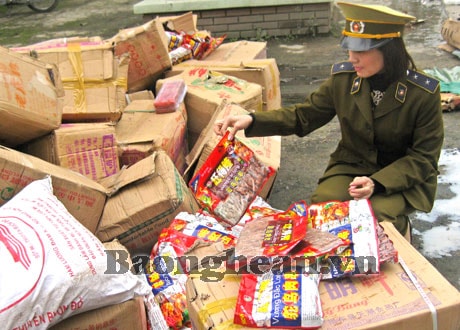
Counterfeit and fake goods seized by the Nghe An Market Management Department.
In 2012, the Provincial Market Management Department, in coordination with relevant agencies, inspected and handled 125 cases of violations related to counterfeit goods and intellectual property infringement, collecting fines totaling 777 million VND; and handled 1,579 cases of violations of regulations on product labeling, imposing administrative fines of 1.731 billion VND. Regarding food safety and hygiene related to counterfeit and substandard food products circulating in the market, the Market Management Department detected and handled 24 cases of food safety violations. The violating items included: orange juice, counterfeit animal feed, poultry eggs, and meat and animal fat of unknown origin or without quarantine certificates.
After discovering and seizing the aforementioned goods, the Market Management Force transferred them to relevant agencies for further inspection of violations and organized the destruction of all goods violating food safety regulations; the total value of confiscated and destroyed goods was 476 million VND... These are outstanding efforts by the entire force. However, the results of inspection and handling are only the tip of the iceberg, and the fight against counterfeit and fake goods remains very challenging.
(To be continued)
Ngoc Anh


