
Lesson 1: The Effectiveness of Consensus
In the current period, mobilizing social resources to build school infrastructure is absolutely essential. However, the question is how to ensure that society and parents wholeheartedly support this initiative without any dissent or criticism.
(Baonghean)In the current period, mobilizing social resources to build school infrastructure is absolutely essential. However, the question is how to ensure that society and parents wholeheartedly support this initiative without any dissent or criticism.
Leading us on a tour of the school's facilities, Mr. Ha Van Ton, Principal of Dien Ky Primary School (Dien Chau), enthusiastically boasted: “At the beginning of this school year, the school re-tiled the restrooms, laid tiles on all the walkways in the schoolyard, renovated the sports field, and invested in building a waste sorting pit. The whole thing cost about 100 million VND, all from social mobilization funds…” During the summer, the school surveys the condition of its facilities, identifies items needing investment and repair, prepares a budget, and discusses it with the Parents' Representative Board before submitting it to the Commune People's Committee for approval. After receiving approval and authorization from the authorities, the school mobilizes parents to contribute. This mobilization is entirely voluntary on the part of parents; it is not mandatory and the contribution is not divided equally among everyone. Parents participate in all stages, from surveying and selecting the construction unit to project acceptance and final settlement.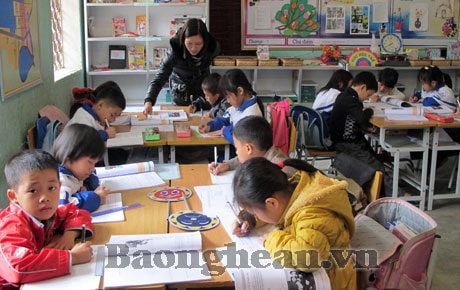
Thanks to social contributions, Dien Ky Primary School (Dien Chau) has built a spacious classroom with complete teaching equipment.
Mr. Nguyen Dang Long, Head of the Parents' Association of the school, said: "The amount of contributions from parents is not large. However, the important thing is the transparency in revenue and expenditure, the rational use of socialized funds, and the investment in practical things that serve the children's learning, which has received the parents' approval and support. This school year, the school has completed the above projects with funds contributed by parents and there have been no complaints."
Giang Son Tay Primary School (Do Luong District), located in a mountainous commune and recently separated from the main school, faces numerous challenges. Understanding that social mobilization isn't just about soliciting monetary contributions, the school has actively engaged various organizations and associations through labor and in-kind donations. The Veterans Association undertook tree planting and electrical installation; the Youth Union leveled the sports field; and the Women's Association cleaned the school grounds. Notably, the commune government mobilized each commune official and civil servant to contribute two days' salary, each resident to donate 10,000 VND, and school staff to contribute two days' salary to upgrade the school's facilities; they also appealed to businesses to donate chairs. Throughout the fundraising process, the Parents' Association participated in discussions regarding revenue and expenditure, and also supervised the project. Upon completion, a clear and transparent financial settlement was conducted for the parents' information.
Immediately after the State decided to stop collecting construction fees from the Parents' Association, the Anh Son District Department of Education and Training quickly advised the District People's Committee to issue Decision No. 929/QD-UBND.VX dated July 18, 2008, approving the day of action for the socialization of education; and simultaneously directed pilot programs at 3 schools in 3 communes: Tuong Son, Phuc Son, and Khai Son. On the very first day of the campaign, 188 million VND was collected. Since then, this model has been replicated throughout the district with adjustments to suit the practical situation and requirements of each school year.
In 2008, the education sector adopted the policy: "Self-reliance, voluntariness, no imposition, ensuring the principles of grassroots democracy and the socialization of education." In 2009, the sector expanded the model of direct democracy by engaging in direct dialogue with communes and towns through the sector's online network. In 2010, the sector adopted the motto: "Good advice, broad linkages, strong internal strength, high harmony, and great consensus"... Therefore, each year, approximately 4 billion VND is mobilized from contributions by parents, teachers, philanthropists, organizations, and associations inside and outside the district to build infrastructure and purchase equipment for teaching and learning. To date, 58 out of 63 schools are well-equipped, accounting for 92%. The basic educational environment is green, clean, and beautiful. 31 out of 63 schools meet national standards.
For example, Thach Son commune, a unique commune with many Catholic households, raised nearly 55 million VND in just 30 minutes. Thanh Son commune raised 95 million VND, which was used to build and donate 45-50 different projects of varying sizes to the school. In addition, the people contributed artifacts such as gongs, looms for weaving brocade, and pestles for pounding rice... to educate students about the traditional culture of their homeland and village. Mr. Nguyen Duc Vinh, Head of the District Education and Training Department, shared: “Calling for support from parents and guardians is not difficult; the main thing is to create consensus. This requires the principal to prioritize integrity, not be tempted by personal gain, and to use the donated money transparently and openly so that parents and guardians will trust and wholeheartedly support them. And especially, the fundraising must be appropriate and within the people's means.” For social projects, parents and guardians must be the supervisors. Social contributions must be recorded and managed uniformly through the school's accounting and record-keeping system. All income and expenditure must be publicly disclosed and transparent in accordance with the law. After the project is completed and accepted, a public financial settlement report must be submitted to all parents and guardians. When benefactors see the practical benefits for their children, they will feel comfortable, confident, and place more trust in the school where their children study.
While Anh Son district has its annual "Social Action for Education" on September 12th, Thanh Chuong district has its "For Preschool Education" day, which has been maintained for nearly five years. During the annual Month of Action for Children, Thanh Chuong has called upon organizations, businesses, and philanthropists to contribute in kind, money, gifts, and purchase equipment, supplies, and toys for preschools. Similarly, in Quynh Luu district, the policy of socializing education was enacted by the District Party Committee in Resolution 09 of 2008 (a thematic resolution on "Promoting the Socialization of Education"). Since then, Quynh Luu has mobilized over 60 billion VND for education investment, with 13.528 billion VND invested in education during the 2011-2012 school year alone...
When the State decided to stop collecting construction fees from parents, the socialization of education became a solution to achieve the goal of investing in and building school facilities, constructing schools that meet national standards, and improving the quality of education and training. In various localities, each school, through different forms, has successfully mobilized the participation of all levels and sectors, and the consensus of parents, creating a combined resource to invest in and care for education. In the 2011-2012 school year alone, the entire province mobilized over 105 billion VND. Although the amount collected from social contributions is not yet substantial, it is many times greater than the revenue from construction as before (According to regulations, construction fees are: 80,000 VND/child/year for preschool; 100,000 VND/student/year for primary school; 120,000 VND/student/year for secondary school; and 150,000 VND/student/year for high school, while social contributions average 300-400,000 VND/student/year). This shows that relying solely on regulated revenue will not mobilize the combined strength or harness the internal resources of parents and the generosity of benefactors to build a better learning environment for future generations.
However, alongside its advantages, the socialization of education still faces shortcomings such as: some schools "use" the Parent-Teacher Association to solicit unreasonable contributions; setting a general minimum contribution amount for each student instead of voluntary contributions; schools "negotiating" contribution levels with parents... the problem of excessive fees in schools is uncontrollable. But the most important issue, and the one that parents are most concerned about, is whether the spending of funds from educational socialization in schools is reasonable? Have schools spent correctly and sufficiently? Who supervises the collection and expenditure, and is that collection and expenditure transparent and public?
(To be continued)
Thanh Phuc


