
Lesson 1: Huoi Tho - A joyful village nestled in the mountains
The process of socio-economic development and cultural exchange is raising many important issues in the lives of ethnic minorities, especially the preservation and promotion of the cultural identity of each ethnic group, avoiding the risk of "assimilation". One of the solutions being applied by localities is the construction of models of purely ethnic cultural villages. Nghe An Newspaper would like to introduce some models that have been and are being implemented in mountainous districts.
(Baonghean)The process of socio-economic development and cultural exchange is raising many important issues in the lives of ethnic minorities, especially the preservation and promotion of the cultural identity of each ethnic group, avoiding the risk of "assimilation". One of the solutions being applied by localities is the construction of models of purely ethnic cultural villages. Nghe An Newspaper would like to introduce some models that have been and are being implemented in mountainous districts.
Traveling along National Highway 7A, upon reaching Huu Kiem commune (Ky Son district), looking up at the Pu Nha Thau mountain range, travelers will encounter houses nestled halfway up the mountain, hidden among ancient trees and shrouded in clouds. These houses belong to Huoi Tho village, home to nearly 120 households of the Khmu ethnic minority, and have been selected by the Ky Son District Department of Culture as a site for preserving cultural identity.
The road from National Highway 7A to Huoi Tho village used to be steep and winding, clinging precariously to the mountainside, making it only accessible on foot, with only experienced long-distance drivers daring enough to attempt a motorbike climb. With the new rural development program, this road is now being paved with concrete, making travel much easier. In less than 10 minutes, our motorbike reached the center of the village. From Huoi Tho, you can admire the Nam Mo River winding through the mountains and National Highway 7A running along the foothills. The first impression upon arriving was the clean and well-maintained roads, and the rows of stilt houses suggesting order and neatness.
Fortunately, we arrived in Huoi Tho during the Khmu people's harvest festival. After a firm handshake, the village head, Xeo Van Dung, warmly said, "This year's harvest festival has changed a little; we won't be holding it at each house like before. That was both costly and time-consuming. This year, the village has decided that after the ceremony at each individual house, everyone will come together to celebrate at the community center. This is more economical and much more enjoyable." At this moment, five jars of rice wine had been placed in the courtyard, and everyone was sitting around them. Enjoying the rice wine, we could feel the flavor of the upland rice, the forest leaves, and the meticulous work of the Khmu women. Two sets of gongs and drums, already set out under the eaves of the community center, began to resound with a lively, captivating sound and rhythm.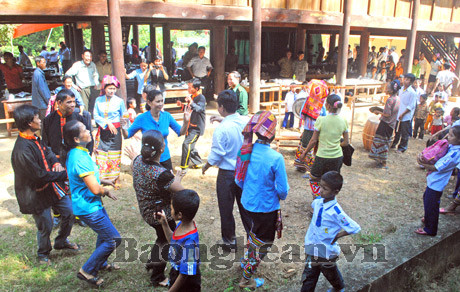
A joyful day in Huoi Tho village (Huu Kiem commune - Ky Son district).
While drinking and chatting boisterously, the sound of gongs suddenly rang out, and old and young, men and women, began to join in the rhythmic and graceful lam toi dance. Sitting next to us, sipping more rice wine, the village elder Luong Van Binh leaned close and whispered in our ear: “The lam toi dance is characteristic of the Khmu people; it mimics the movements of climbing mountains, wading through streams, clearing fields, harvesting rice, and tending corn. Everyone here dances beautifully, because not knowing the lam toi dance means you're not a Khmu person.” Whether it was because of the visitors from the lowlands or not, the elders in Huoi Tho all went home and brought out various flutes, pipes, and other musical instruments to harmonize with the two sets of gongs and drums. Elder Binh pointed out and introduced each instrument to the guests: the horizontal flute, the pi tom, the tot tong, the dao dao, and then the mouth organ and leaf mouth organ.
It's worth noting that most of these musical instruments are crafted quite simply. From bamboo, reeds, and even leaves, the skillful hands and passionate, life-loving souls of the Khmu men create melodies that are sometimes lively, sometimes profound. This harmony sounds like the babbling of streams, the rustling of the forest wind, the calls of forest birds, and even the hesitant footsteps of footsteps. This is the "soulful melody," the voice of the Khmu people, an ethnic group still facing many difficulties on its path to development, yet whose spirits remain joyful and full of hope.
Here, we met again with Mrs. Moong Thi Loi, a Tơm folk singer and a prominent figure of the Ky Son District Folk Art Troupe at cultural and artistic festivals in recent years. At over 70 years old, Mrs. Loi's voice remains smooth and she can sing Tơm continuously for 30 minutes. She explained that Tơm is a traditional folk song of the Khmu ethnic group, recounting the daily life of families and villages. On this occasion, she sang the song "Huoi Tho on a Joyful Day" for the guests.
Listening to Mrs. Loi sing the "tom" song, the whole village paused their festivities and listened intently. When she finished the song, everyone applauded and raised their glasses to toast the village's artist. It is known that Mrs. Loi is the best "tom" singer in Huoi Tho, and whenever she has free time, she often teaches her children and grandchildren in the village. Her eldest daughter, Cut Thi Nhung, has inherited her mother's voice and vocal stamina.
We took the opportunity to visit several families in Huoi Tho. Here, the craft of weaving is still maintained. For a long time, the Khmu people have been recognized for their skill in traditional weaving, and products such as rattan chairs, rattan trays, and rice presses from Huoi Tho are proof of that. These items are now quite popular; according to Mr. Cut Van Kham, "every item we make sells out as soon as it's finished." This is an opportunity for the people of Huoi Tho to preserve their traditional craft, while also increasing their income, improving their lives, and providing employment for the elderly.
During the meal, Village Head Xeo Van Dung said: “Our village was chosen by the district as a pilot site for building a Khmu ethnic cultural village, so we have been given many opportunities. We have been allocated funds to open classes to teach folk songs and traditional musical instruments; and we have received investment to build a cultural house worth over 1 billion VND to preserve characteristic artifacts of our ethnic group.”
Continuing our conversation, we learned that the implementation of cultural preservation and promotion efforts in Huồi Thợ still faces many difficulties. For example, there are now few people who are knowledgeable about folk songs, how to make and use musical instruments, and most are elderly. Meanwhile, the younger generation is influenced by many other cultural factors, and many are not yet aware of the importance of traditional culture.
Tuong Anh


