
Lesson 1: The sun shines on the thatched roof.
(Baonghean) - During our trip to explore the unique aspects of the Mong community in Nghe An, one village caught our attention. It was Buoc Mu village (Na Ngoi commune - Ky Son district), an ancient Mong village with a history spanning hundreds of years. Under the sunlight, the thatched roofs of the houses appeared ancient and mystical…
(Baonghean) - During our trip to explore the unique aspects of the Mong community in Nghe An, one village caught our attention. It was Buoc Mu village (Na Ngoi commune - Ky Son district), an ancient Mong village with a history spanning hundreds of years. Under the sunlight, the thatched roofs of the houses appeared ancient and mystical…
On our journey to discover the unique aspects of the Hmong community in Ky Son district, a small village at the foot of Pu Xai Lai Leng mountain captivated us. Not only was it peaceful, but its living environment differed from other Hmong communities. While the Hmong traditionally reside in high mountains, the village of Buoc Mu in Na Ngoi commune is clustered at a lower elevation, at the foot of the mountain. Terraced rice paddies surround the village, creating a living space reminiscent of a low-lying Thai village. In the late afternoon, petite Hmong women, carrying baskets called "lu co" on their backs, silently lead their herds of cattle back to the village. They only smile when greeted. The women here grow up, marry, work in the fields, and herd cattle. They are not fluent in Vietnamese or Thai. They only respond with smiles. Meanwhile, the children diligently work with hoes in the fields near their houses.
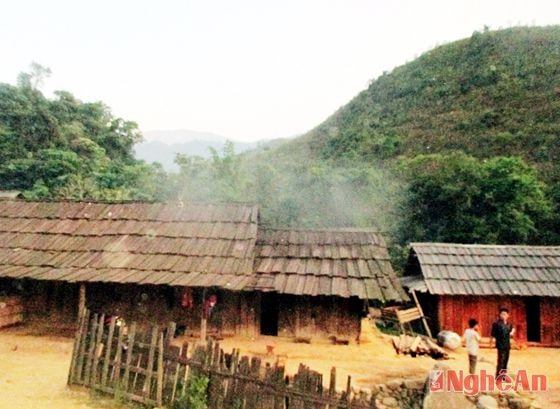 |
| The houses in the village have thatched roofs made of cypress wood. |
We wandered along the relatively flat dirt roads in the village. It was almost sunset, and the sun was setting behind the mountains of Pha Noi village, Muong Tip commune. Under the sunlight, the houses with their cypress wood roofs appeared solemn and rustic. We had heard that cypress wood roofs could easily last for several generations, remaining intact for one or two hundred years. People believe that this type of wood withstands the harshness of time thanks to the essential oils in the tree trunk, which are highly resistant to termites. Each Hmong house is a world of its own, full of mystery, shrouded in silence year-round. The main door is only opened when people go to the forest or fields in the early morning and return home at dusk.
Our aimless steps led us to the house of the Party Secretary of Xong Tong Cho. The house was quite spacious and modern in style. The pillars, beams, and walls were all polished smooth. The foundation was made of very solid concrete. Although it didn't have the traditional wooden roof and walls of old houses, the architecture and living space still resembled a traditional Hmong house. The inner room was the parents' bedroom, while the daughter and daughter-in-law's bedroom was in the outer room. The kitchen had a clay-built stove. The homeowner had improved the main door and windows, making the house brighter than the old Hmong houses. Apparently, the Hmong houses in Na Ngoi were built by a group of craftsmen from Ha Nam who had been "lying low" there for decades, preserving the traditional space while incorporating some modern touches.
After a brief introduction, Mr. Tong Cho led us to visit Mr. Xong Rua Cho, a respected village elder who still remembered many old stories about this small village. Mr. Rua Cho had lived through seventy farming seasons, so his stories had both an ancient and a modern feel to them. Even so, we needed Mr. Tong Cho's "translation" to understand his story.
Grandfather Rua Cho recounted that the house of the Xong family in Buoc Mu village has existed for seven generations. At that time, two brothers were driven out of China by the Han Chinese. One went to Laos to live, while the other, named Xong Xai Tua, came to live with the Xong family to fight off the invading French. After many years, the revolution and the arrival of the army helped to drive the invaders out of Na Ngoi. At that time, Buoc Mu village was located on a high mountain, with a large pool of water on the mountain. In the forest, there were countless wild boars that often came to the swamp to wallow in the mud, hence the name of the village. Most of the Hmong villages in Na Ngoi are named after the Thai language, and Buoc Mu means "the pool where wild boars often wallow."
After repelling the French, the villagers in the highlands suffered from famine due to crop failure, and some died from disease. Once again, the soldiers came to the aid of the people. They advised the villagers to move to lower areas to build their settlements, avoiding the disease outbreak. They also showed the Hmong people of Buoc Mu how to clear barren land and bring in water to cultivate rice. The paddy rice ripened faster and produced more grains than upland rice. Both glutinous and non-glutinous varieties were available. The villagers heeded their advice and followed it. People from Keo Bac and Xieng Xi villages also came to live nearby, creating a cluster of villages in a bustling area where they no longer feared the enemy or wild animals. From then on, Buoc Mu village had a unique feature not found in many other Hmong villages: terraced rice fields surrounding the people, embracing them and easing their hardships.
Before Rua Cho's story was finished, the sound of a Hmong flute echoed from the neighboring house. The deep, resonant sound of the flute made the dark night seem even more intense. Rua Cho said it was the "tờn đí" melody, the introductory lesson for flute players. His seventh-grade grandson proudly stated that the flute player was Lầu Bá Gô, a classmate of his. He himself loved playing the flute but was too busy with school and helping his parents and grandparents to learn. Before even knowing how to hold the flute to his lips, Rua Cho had warned that even with diligence and intelligence, it would take a year to learn all the flute pieces, and without focused study, it would take ten years to learn them all.
On the way back to his house, Mr. Xong Tong Cho added: "Even though many people in the village have gone to high school or university, they still can't give up the Hmong flute. Whenever they have free time, the young people practice playing it. I remember once, I asked Mr. Xong Ba Denh, a Youth Union official from Na Ngoi commune, about the Hmong flute. When we talked about it, this 30-year-old man was very enthusiastic. Every time there's a cultural exchange with neighboring communes, he always volunteers. Regardless of whether the prize is small or large, just being able to hold the flute, play it, and dance is enough to make him happy."
As the sun rose, we left Buoc Mu village. The women had already begun carrying their baskets to the fields. It was then that we had the chance to carefully admire the ancient thatched roofs of the village. Most of the houses in the village still had thatched roofs made of thatch. Like Tong Cho, many families had the means to improve their living spaces to better suit modern trends, but they still preserved their traditional roofs. It reminded me of a Hmong teacher's words from long ago: "The most important thing in our people's house is still the roof." This statement was both truthful and profound. The roof, like the communal lifestyle of the Hmong people, will not fade away in the new era…
On the outskirts of the village, the rice paddies have turned a vibrant green, enveloping the lives of the people. This setting makes this small village feel closer to other ethnic communities. In the early morning breeze, the rice stalks ripple gently across the terraced fields. The rice seems to be smiling in the early morning sun.
HỮU VI – ĐÀO THỌ


