
Lesson 1. The role of farm economics
Since the Provincial People's Committee approved the Project for the Development of Farm Economy (2007-2015), and the Department of Agriculture and Rural Development has provided guidance, the farm economy has made significant progress, contributing considerably to the local socio-economic development. However, during the implementation process, some shortcomings have emerged that need to be addressed.
(Baonghean)Since the Provincial People's Committee approved the Project for the Development of Farm Economy (2007-2015), and the Department of Agriculture and Rural Development has provided guidance, the farm economy has made significant progress, contributing considerably to the local socio-economic development. However, during the implementation process, some shortcomings have emerged that need to be addressed.
According to Mr. Tran Van Hung, Head of the Planning Department of the Nghe An Provincial Department of Agriculture and Rural Development, the Party and State have always paid attention to the collective economy. However, since 2000, with Circular 69 of the Ministry of Agriculture and the General Statistics Office guiding the criteria for identifying the collective economy and Decision 22381 of the Provincial People's Committee "on collective economy and farm economy in the period 2006-2010", the collective economy has developed faster. Especially when the Provincial People's Committee approved the project for the development of the collective economy by the Department of Agriculture and Rural Development for the period from 2007 to 2011", the collective economy developed even more in the right direction. Currently, in accordance with Circular No. 27/2011 of the Ministry of Agriculture and Rural Development, the Department of Agriculture and Rural Development is conducting a survey of the collective economy according to new criteria to further develop this type of economy.
Thus, with circulars, projects and policies on land and forest allocation, bank loan credit policies (No. 423/2000), two rounds of interest rate support for household economies, as well as a series of other incentive policies: encouraging investment in exploiting barren and degraded land (encouraging farmers to consolidate and convert farmland; supporting vocational training, loan interest rates and integrating programs and projects for infrastructure construction), this type of economy has had the conditions to develop and demonstrate its great socio-economic role.
The most prominent role of farm economics is to create a commodity economy in rural areas. The characteristics of natural agricultural production are fragmented, "self-sufficient," production based on long-standing customs, difficulty in applying science and technology, and difficulty in introducing new crops and livestock to the area. Therefore, it needs the impact of farm economics to achieve breakthroughs, based on state support through the dynamism and boldness of farm owners.
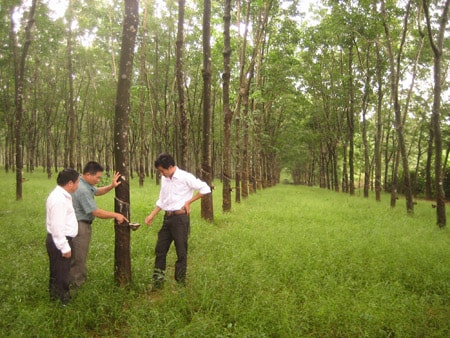
Rubber plantations in Tan Ky yield high economic returns. Photo: Van Truong
Mr. Nguyen Van Phuong, Deputy Head of the Household Economy Department - Nghe An Rural Development Sub-Department, said: "Thanks to the encouragement from the Central Government and the People's Committee of Nghe An province, there are now 2,345 farms operating under the revised 2003 criteria. In 2010 alone, an additional 196 new farms were established." From the statistics of the General Statistics Office, we can see the role of farms in developing a commodity economy. In 2010, the volume of cattle and buffalo sold was 6,684 head and 10,490 tons; wholesale fruit sales included 20,000 tons of oranges, 18,000 tons of pineapples, 3,000 tons of longan, and nearly 4,000 tons of lychee. This commodity production mainly comes from farm-based businesses.
The economic role of farms is not only reflected in the concentrated volume of goods and production value, but also in the provision of essential services such as new, high-yield, and economically efficient plant and animal breeds to rural areas, especially mountainous regions. Farm owners like Mr. Nguyen Dang Tu and Mr. Le Dinh Hai (Hamlet 1, Nghia Hanh, Tan Ky district) raise over 100 pigs for meat and dozens of sows, supplying breeding stock to surrounding communes; Mr. Dang Khac An (Nghia Tan) supplies rubber tree seedlings to local farmers. Shrimp seedling farms in Quynh Luu also meet the local demand for shrimp seeds. In reality, these seed suppliers often share their experience in advanced farming methods and techniques with local farmers. Furthermore, the economic role of farms is also evident in their role as collection points and technical service providers, enabling successful local producers to become "satellite" farms producing goods together. Mr. Bui Van Vinh (Quynh Thang, Quynh Luu) raises 60 dairy cows and calves. He not only milks them and supplies breeding stock but also provides a service of collecting "raw milk" for local farmers and transporting it to processing plants. The collectors profit, but the local farmers also benefit from their services, enabling the development of small-scale livestock farming.
Besides its role in the commodity economy, farm work also has a significant social impact, such as providing employment for surplus labor in rural areas. On average, each farm, large or small, employs 4 to 5 workers. A summary report on farm economics in Tan Ky district also indicates that, on average, for every 4.8 workers in a farm, 1.8 workers are hired from outside. Thus, in Tan Ky, with 305 farms, at least 500 workers are employed regularly, not including seasonal workers. Mr. Nguyen Trong Huong's farm (Nghia Hoan) typically needs 30 seasonal workers annually. Therefore, across the province, with over 2,300 farms, over 5,000 jobs have been created. Income from farm work is also quite high compared to rural areas. According to the list of outstanding household businesses (including farm businesses) compiled by the Nghe An Farmers' Association, the average income of farm-based households ranges from over 1.5 million VND/worker/month to 6 million VND/month. Many farms, such as those of Mr. Luong Ngoc Thoat (Chau Binh, Quy Chau) and Mr. Lo Thanh Thieu (Quang Phong, Que Phong), have an average worker income of over 2 million VND/month; notably, Mr. Le Si Minh's farm (Quang Tien), with 15 hectares of sugarcane, has an average worker income of 6 million VND/person/month.
Besides increasing material wealth, creating jobs, introducing scientific advancements into agricultural production, and generating large quantities of goods, farm economics also has many other equally important impacts, such as positive effects on the ecological environment. According to statistics, currently over 7.8% of the total number of farms in the province are engaged in forestry production. Mr. Van Tho in Yen Thanh, in addition to protecting dozens of hectares of lush green forest, has also preserved a rare and valuable chestnut tree species. Mr. Le Thanh Than's farm (Dien Lam, Dien Chau) has also solved the lighting needs of hundreds of households in villages along the power line that were far from the center and lacked investment from the commune. Many farm owners have invested their own capital in building roads, upgrading reservoirs and dams, and extending electricity to benefit the people in their areas.
However, the farm economy still has many issues that need to be addressed before it can develop sustainably. In recent times, this type of economy has also revealed many problems that need to be resolved by all levels and sectors. These include the skill level of the workforce and the business management capacity of farm owners; issues related to land consolidation and access to capital for production and business development; the efficiency of different farm models; product consumption; and the "consequences" of classifying farms according to new criteria...
Hoang Chinh - Van Truong


