
Lesson 10: The Lo Family and the Muong Chai Festival
In Vinh Hoa district, formerly Tuong Duong prefecture (now Con Cuong district), along with Muong Qua, there was also Muong Chai. The Muong consisted of 11 Thai villages, governed by several clans such as Luong, Lo, and Luu, encompassing the entire present-day Chi Khe commune. According to legends still passed down in the Dinh and Chai villages, the Luong clan, along with the Luong clan, were instrumental in establishing Muong Chai...
According to documents by Vi Van An, a doctor of ethnology, there were instances of individuals like Lo Van Ty and Lo Van Thinh holding the position of "Khoan Muong" (a local administrative position) towards the end of the French colonial period. This was a village-level position in the old government. According to some elderly people, such as Mrs. Dien in Dinh village, this family once had several members holding positions such as "bang ta" (it's unclear whether this was at the district or provincial level) and "pho ly" (deputy village headman), such as Pho Quyen and Bang Quyen. The name "Muong Chai" commemorates the event of people clearing the paddy fields called Tong Chai, now the largest paddy field in Chi Khe commune, located between Lien Dinh village and Tong Chai.
On a stormy summer night, we had the opportunity to listen to Mr. Lo Ba, an elder of the Lo clan, recount the legend of the Lo family... Long ago, many generations ago, there was a high-ranking official who fled from Laos with the Luong clan, establishing the Chai village. Being a less powerful clan, the Lo clan members were not allowed to hold official positions but instead served as village chiefs, managing irrigation ditches and responsible for ancestral worship. They were also given land near the temple to cultivate without paying taxes. Once, while leading troops on a long journey back from suppressing rebels in Laos, they ran out of food. Upon reaching the area of Chan Nhan village (present-day Chi Khe), they saw a persimmon tree laden with fruit. The official stopped his horse, climbed up, and picked the fruit to help his soldiers overcome their hunger. Unfortunately, a branch broke, and the official fell to the ground and died. When the soldiers found him, termites had built a large mound of earth around his body. Believing this to be an auspicious sign, his descendants brought him back and established a shrine at Xop Huoi Temple, where the Khe Chai stream flows into the Lam River...
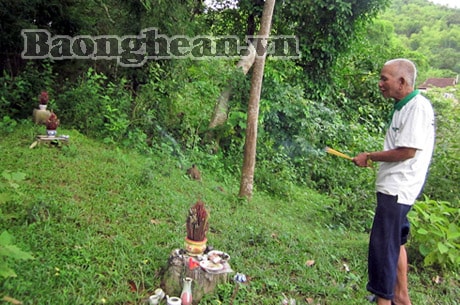
The only remaining trace of the Xop Huoi temple is a crudely erected incense stick.
This sacred temple is dedicated to the spirit of the Left Official, one of the first members of the clan in Muong Chai. Besides the Xop Huoi Temple, there is also the Nua Temple in Bai Van village (Chi Khe). This temple is dedicated to the Right Official (the ancestor of the Luong clan) and a Duke from another branch of the Lo clan. The Nua Temple is a wooden house in the style of a pagoda, with a main worship hall and two side halls. The Xop Huoi Temple is the most sacred, consisting only of a wooden house. Whoever is entrusted with overseeing the incense burning and rituals is allowed to "eat" (cultivate) the land adjacent to the temple. Thus, it can be said that, although not the most powerful clan in Muong Chai, as power later passed to the Luong clan, the Lo clan contributed greatly to the establishment of this region. This is evidenced by the fact that the spirits of two of the three people worshipped at the Xop Huoi Temple are from the Lo clan.
Mr. Lo Ba (born in 1939), a veteran of the war against the Americans, said: His father, Lo Lien, used to be the head of the association, overseeing the ancestral worship at Xop Huoi Temple. From 1948, he followed his father to help and was less afraid of tigers. In those days, the area around the temple was still covered with dense forests, inhabited by tigers and leopards. In 1956, the State implemented a policy to eradicate superstition, and worship was banned. In the past, on the 15th and 30th of each lunar month, Mr. Ba and his father would go to the temple to light incense and pray. The temple ceremony was held during the Lunar New Year. The offerings from that time included flags, fans, hammocks, and five sets of robes and hats. After the ceremony, they were carefully stored in two chests.
According to the book "History of the Con Cuong District Party Committee," in Chi Khe commune there is still a temple dedicated to King Tran at the beginning of what is now Chai village. Elderly people say that during the temple festival, a procession is held down the stream on rafts from this temple to Xop Huoi Temple. The purpose was to ward off bad luck and disease for the villagers in the past. The exact age of Xop Huoi Temple is still undetermined. Based on ethnographic studies, Chai village was the dwelling place of the Thai Tay Muong group, the first Thai people of the southwestern Nghe An region, at the latest during the Tran Dynasty. It is possible that these temples were also built very early, following the migration of the Thai people from the North.
Mr. Lo Ba said that Xop Huoi Temple is not a village temple. In the past, each village had its own temple, located on a hill within the village. When we arrived, the only remaining traces of the sacred temple of Muong Chai were three incense sticks recently erected by members of the family a few years ago. Mr. Vi Kham, the head of the household occupying the land adjacent to the temple, said: "Every month, on the 15th and 30th of the lunar calendar, our family still comes to light incense. Recently, we've seen members of the Lo family going to the temple on the 15th of the seventh lunar month."
The Xop Huoi Temple Festival used to be held annually on the 15th day of the 6th lunar month. Each time the festival took place, the village would organize a buffalo sacrifice for all the villagers to attend. From all directions of the villages, festival-goers carried flags and fans, beat gongs and drums, and lined up neatly to make their way to the temple. After the sacrifice, the festivities were held in a large open field, with a large fig tree standing majestically between the Xop Huoi Temple and the Nua Temple. During the festival, there was no distinction between the village chief and the villagers; everyone was free to enjoy themselves and eat and drink equally. The festival only ended when it was dark and the chickens had gone to roost.
According to the villagers of Chai, both historical sites were destroyed in the late 1950s and early 1960s. Many religious artifacts were also burned. Members of the family who kept some of the old official robes had them burned three years ago. That time, when the descendants were cleaning the family temple in Tong Chai village, they found many religious artifacts such as hats and robes riddled with holes from termites, so they burned them to return to their ancestors. Mr. Lo Ba sadly said, "I witnessed the burning of those artifacts firsthand, but I didn't dare look." However, according to Mr. Ba, the Lo family temple still preserves two thrones for the Left Mandarin and his wife, along with two swords...
Today, the Lo family still holds ancestral commemoration ceremonies, although the timing has changed. In the trend of integration, the Lo family now celebrates the Mid-Autumn Festival (the 15th day of the 7th lunar month) like the Kinh people at their ancestral temple. This is an occasion for descendants to gather and strengthen family unity. Their customs regarding marriage, funerals, and festivals are similar to those of the Thai Tay Muong group in Con Cuong. A young member of the family said: "Previously, I heard that the Lo family worshipped the 'noc tang lo' bird. When hunting this bird in the forest, they had to bury it carefully..."
Huu Vi


