
Lesson 2: Not living up to potential
The potential of land and human resources in mountainous regions is abundant and diverse, but we lack a comprehensive investment policy, resulting in unsustainable development of many crops and livestock, failing to live up to their potential. In many localities, management agencies cannot provide guidance on what crops to plant or what livestock to raise because they lack control over the consumption and distribution process.
(Baonghean)The potential of land and human resources in mountainous regions is abundant and diverse, but we lack a comprehensive investment policy, resulting in unsustainable development of many crops and livestock, failing to live up to their potential. In many localities, management agencies cannot provide guidance on what crops to plant or what livestock to raise because they lack control over the consumption and distribution process.
Western Nghe An province possesses vast land potential and an abundant labor force, but lacks stable employment, presenting opportunities for economic development in the mountainous region. For a long time, we have identified many crops and livestock suitable for each region's potential, but the economic efficiency remains low. The mountainous region has vast land, but the problem lies in the need for planning. Only with specific regional planning can products become marketable and their potential fully exploited. Many people have left their hometowns to settle in the Central Highlands, where land is also abundant, and they have become wealthy from growing coffee and pepper. The desire to get rich right in their own homeland is a common aspiration. They know the potential exists, but the difficulty lies in where and to whom to sell their products. Meanwhile, the authorities are struggling with this issue. Therefore, in some localities, the area under cassava cultivation has increased uncontrollably in recent times. Cassava is being intercropped by farmers in areas of unclosed forest canopy. Some families even clear acacia forests to plant cassava, seeking immediate profit.
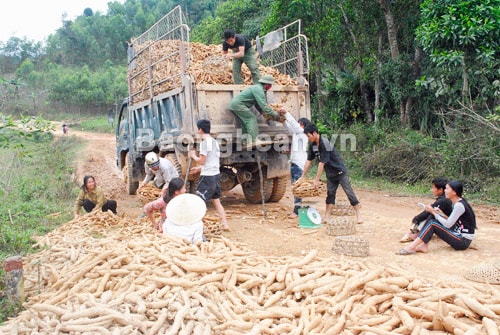
Farmers in mountainous areas have been planting cassava on a massive scale, beyond the control of the district authorities, leading to low prices and even difficulty in selling the product.
So why do people choose cassava as an intercrop? Mr. Tran Tu Ba, Vice Chairman of the Tan Ky District Gardening Association, said: "Cassava cultivation requires little investment; even with minimal effort, it yields a profit. This is very suitable for families with difficult economic conditions and, frankly, those who are lazy. Families with better resources and diligence would never plant cassava. There are three drawbacks to cassava cultivation: firstly, it depletes soil fertility; secondly, the product has low value; and thirdly, the money from selling cassava often doesn't cover the harvesting costs. For cassava growers, it's like 'a house on fire, burning down both ends.' The problem is that local authorities, from the commune to the district level, are aware of this but are powerless to act, even though the land could be used to grow many other crops with higher economic value and market demand. For example, lemongrass, ginger, or galangal... but if they plant those, they don't know where to sell the produce." In particular, the ginger plant, once its tubers are harvested, its leaves and stems benefit the soil.
A crucial issue is identifying suitable crops for development. For example, in Tan Ky district, the land is very suitable for rubber trees, so the focus should be on developing rubber cultivation. The district has long been interested in developing rubber plantations according to the plan, but currently, the area under rubber cultivation is only over 4,000 hectares, which is insufficient. The demand for rubber latex in the domestic and export markets is very large, so Tan Ky needs a strategy for rubber tree development that includes planning, acreage, yield, and protection procedures. According to surveys, Tan Ky needs to plant 10,000-15,000 hectares of rubber trees to match its potential. Besides rubber trees, sugarcane is also a potential crop in Tan Ky. However, this should not lead to indiscriminate development, as it must rely on the capacity of the Song Con Sugar Mill. Currently, the area of standing sugarcane in Tan Ky is over 4,000 hectares, which is reasonable. The issue that needs attention is finding solutions to increase productivity. Currently, the average sugarcane yield in Tan Ky is 50 tons/ha, which is low; farmers demand double that yield to be satisfied.
Paper pulp plantations, or timber plantations, are perhaps the greatest potential for the districts of Con Cuong, Anh Son, Tan Ky, Nghia Dan, and Quy Hop. Timber plantations are harvested after 6-7 years, a cycle of planting, harvesting, and then replanting. This process repeats itself, creating an endless cycle of reforestation. Therefore, this area attracts a large and sustainable workforce. However, in terms of efficiency, forest planters are at a disadvantage. The selling price of timber is too low. Mr. Lo Van Dai, a forest owner in Tan Hop commune, Tan Ky district, has 11 hectares of timber planted six years ago, now ready for harvest. According to Mr. Dai, at the end of 2011, someone offered to buy the timber for 10 million VND per hectare. Finding it too cheap, he didn't sell. His hope is for the price to increase so he can sell and then plant another crop. In Tan Hop commune, at the end of 2011, some families had to reluctantly accept selling their forests for only 7-8 million VND/hectare. According to some transport drivers, the reason for selling the forests at such low prices was the difficult transportation conditions, which put pressure on the forest owners.
The bamboo plant has been identified as a key crop for poverty alleviation in Tuong Duong and Con Cuong districts, but sales have not met expectations. Even within Con Cuong district, the price of bamboo varies greatly. At the beginning of 2012, in communes with good transportation links like Bong Khe, Yen Khe, and Chi Khe, a large, beautiful bamboo plant sold for 8-10,000 VND, but in communes like Mau Duc, Don Phuc, Binh Chuan, and Thach Ngan (Con Cuong), it only sold for 5-6,000 VND. Mr. Duong Van Ngan, Vice Chairman of the People's Committee of Mau Duc commune, stated: "The commune currently has about 100 hectares of bamboo. Every year, people harvest and prune the bamboo, providing them with money during lean seasons. Thanks to bamboo, poor households are less burdened. However, due to the extremely difficult transportation network during the rainy season and the lack of a stable market, the selling price of bamboo is too low."
Even the Bai Phu oranges, grown in Anh Son and Con Cuong districts, have been popular with consumers for decades. Although there is still plenty of land in the area for developing orange cultivation, the current system and people's awareness hinder expansion. Meanwhile, the current Bai Phu orange production does not meet the needs of the domestic market, let alone supply processing plants. Replanning the Bai Phu orange growing area is essential. Currently, a very real issue is that many traders are taking advantage of the Bai Phu orange brand, transporting oranges from other places to sell along National Highway 7, the section running through Yen Khe commune (Con Cuong), to customers.
The decision on what crops to grow and what livestock to raise is guided and managed by the agricultural sector. However, this has long been neglected in mountainous regions. There are many reasons for this, including the limited expertise of agricultural officials and an unreasonable mechanism. The mechanism here is that we have been investing half-heartedly for a long time. Mr. Le Cong Tam, Head of the Agriculture and Rural Development Department of Ky Son district, stated: "Every year, the State invests in building many crop and livestock models for mountainous districts, but a review shows that very few models are adopted and replicated by farmers. The reason is that the models are only implemented for 2-3 seasons, which is not enough time for farmers to follow. Agricultural officials, especially at the district level and above, must guide farmers on what crops to grow and what livestock to raise to suit the conditions and potential. But because they cannot proactively manage the consumption aspect, they cannot provide guidance. Therefore, this leads to a situation where people plant whatever they want, without any management or direction." Pumpkins in Tuong Duong and ginger in Ky Son are two products that could enrich farmers, but once they've grown them, nobody knows where to sell them. They only know the price this year and how it sold last year… entirely dependent on the free market. If only those localities had planned areas for growing pumpkins and ginger… and the government invested in building processing plants on-site, then those products would surely develop sustainably. Why is it that we know this potential, and it's very suitable for ethnic minorities, but we still haven't exploited it? The clearest example is ginger. Last year, the price in Ky Son reached 20,000 VND/kg, and many families in the communes of Muong Long, Huoi Tu, and Pha Danh rushed to grow ginger, hoping to change their lives. However, this year, the price has dropped to 5,000 VND/kg, dampening the spirits of the farmers. And it's very realistic that next year the ginger acreage will likely decrease, while prices will increase. This is hardly surprising, given that agricultural products are entirely dependent on a " каждый за себя" (every man for himself) market. A long-standing paradox is that farmers are solely responsible for selling whatever they grow!
To sustainably exploit the potential for developing crops and livestock in mountainous regions, many believe that localities must have long-term investment plans. Government support policies must be synchronized, with market forces acting as a decisive lever to stimulate demand and effectively develop crop and livestock production.
Xuan Hoang


