
Lesson 2: Runaway Workers and Their Consequences
(Baonghean) - As mentioned, the South Korean labor export market is attractive in terms of income and stability. However, in Nghe An, there are currently 1,031 workers who have passed the Korean language exam and have certificates but are still waiting anxiously to work in South Korea. The main reason is that Vietnam has not yet controlled the situation of workers absconding in the host country.
The arduous task of dealing with runaway workers.
Instead of signing long-term contracts, for the past three years or so, due to the high number of Vietnamese workers absconding and residing illegally after their contracts expire, the South Korean government has only signed labor cooperation agreements with Vietnam once a year. Therefore, since 2011, Vietnam has not organized any further Korean language proficiency tests, and those allowed to return to South Korea are prioritized only for two groups: firstly, those who have passed the Korean language proficiency test under the EPS program, and secondly, Vietnamese workers who have completed their labor obligations and returned home to retake the test. In addition, priority is given to certain groups, including those from impoverished households (the Ministry of Labour, Invalids and Social Affairs organizes a separate test for these households) and the E7 permit program for highly skilled workers (typically those with English proficiency, internationally recognized skills, and many years of experience).
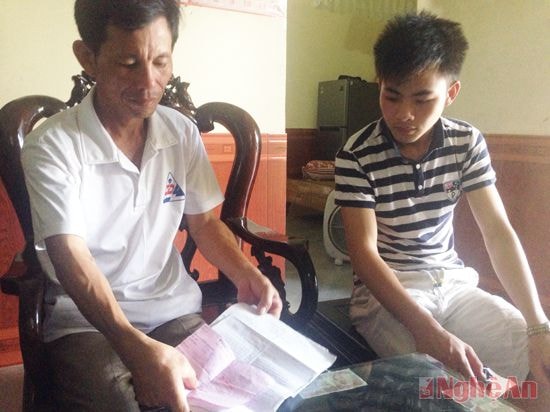 |
| Cong's family in Nghi Phong commune (Nghi Loc district) told reporters about being scammed by a labor export brokerage company. |
Although the number of applicants is very limited, mainly focusing on "priority" candidates, the number of Korean workers recruited annually is still restricted, meaning thousands of workers with certificates have yet to go to South Korea to work. In Nghe An province alone, this number currently stands at 1,031. This significantly impacts those who return home on time and negatively affects the morale of those already working in South Korea.
Regarding this situation, Mr. Ngo Trung Dung, Vice Chairman of the People's Committee of Nghi Hai Ward, the area with the highest number of Vietnamese workers in South Korea in Cua Lo Town, shared that: Every year, Nghi Hai Ward is notified of nearly 20 cases of people who must return home on time. Besides disseminating information and encouraging them through mass media, the ward has also organized many campaigns to reach individual families; but while staying home and making a commitment is one thing, whether those in South Korea actually return is another matter entirely...
In a conversation with Mr. Nguyen Huu Viet from Dien Hai commune (Dien Chau district), who returned from working in South Korea for eight years, he said: “Although I only worked for one company for eight years, I clearly saw the difference between official and illegal labor. Specifically, it's about rights: If you're a contract worker, you get insurance coverage and full benefits like holidays and leave. When you're an illegal worker, you have to be constantly on guard, and a single mistake can lead to arrest by the police. Besides paying your salary, your employer doesn't give you any other privileges...”
Mr. Viet also added that Vietnamese workers who abscond and stay illegally in South Korea do so mainly for three reasons. Firstly, it's for economic reasons, as most of those participating in labor export programs have low incomes and often borrow large sums of money, ranging from tens to hundreds of millions of dong, to cover expenses before going abroad. Therefore, the pressure on them to quickly repay their capital and accumulate savings for business upon returning home is immense. Furthermore, the income paid to workers in South Korea is quite high, so many, after their contracts end, refuse to return home and instead deliberately stay illegally to work, regardless of the risks.
The second group consists of workers who have been scammed. These are people who have been deceived by brokers and intermediaries. Upon arriving abroad, they realize they are not following the legitimate route, so they resort to illegal residency to find work and recoup their expenses. Through interviews with some individuals who have previously worked in South Korea, we learned that: According to the regulations of the host country, when workers are employed under a contract, their employers pay all necessary insurance and social security contributions. However, when they work illegally, because the employer is not required to pay these contributions, these funds are paid to the workers. Therefore, these undocumented workers also receive higher wages.
Further elaborating on this issue, Mr. Dang Cao Thang, Deputy Director of the Department of Labor, Invalids and Social Affairs, added that: The core issue remains the awareness of the workers. Illegal immigrants in South Korea lack awareness of complying with Vietnamese and South Korean laws, focusing only on personal gain without considering the interests of the community.
Disadvantage for workers in their hometowns.
The issue of runaway workers also affects those who return home on time. Ms. Ngo Thi Trang, from Tan Phuc Hamlet, Nghi Hoa Ward (Cua Lo Town), returned from South Korea more than a year ago, fulfilling her contract. When Ms. Trang returned, her family had high hopes, as regulations prioritize exemplary workers for re-employment. However, for the past two years, due to Vietnam's failure to curb runaway workers, South Korea has only allowed a small number of people to go abroad for work each year. Therefore, despite having submitted her application to the Department of Overseas Labor Management a long time ago, Ms. Trang and many others who returned on time have not had the opportunity to return to South Korea for work. Despite her difficult circumstances, in early April this year, upon learning that her younger brother, Ngo Quoc Viet, had completed his EPS program, she and her family continued their efforts to get him back home on time. When we arrived, Viet was in Hanoi studying Korean to continue preparing for the Korean language exam organized by the Ministry of Labor, Invalids and Social Affairs for workers returning home who had fulfilled their commitments.
In a conversation with us, Mr. Ngo Van Nam, the father of Trang and Viet, honestly recounted: Although Trang and Viet both went to work under the EPS Program, the amount of money the family had to pay for each person was much more than the 636 USD stipulated by the Ministry of Labor, Invalids and Social Affairs. Even in Viet's case, despite having learned from experience and knowing that Viet's application was selected randomly by South Korea, the family still had to reluctantly pay nearly 100 million VND (in addition to the main expenses) just before departure, fearing that intermediaries might cause difficulties.
Opportunities to go to South Korea are increasingly limited, so many workers have resorted to various ways to circumvent the law. The most obvious example is going to South Korea through the "study abroad" route. Recently, in a conversation with Mr. Luu Giang Nam, Head of Marketing at Incomex Company, he stated: The study abroad program is actually very good, and if done correctly, workers can legitimately live in South Korea. Simply put, because most students studying abroad have good foreign language skills and knowledge, they have many opportunities to find high-paying jobs such as interpreters or tour guides.
Furthermore, since the students are legally residing in South Korea, they don't have to pay taxes while working, which is very economically advantageous. Of course, to achieve this, students need at least two years to familiarize themselves with the language, customs, and traditions of the host country and acquire a certain level of knowledge and skills. Currently, however, most students who go abroad for study are looking for quick gains, viewing studying abroad as the shortest path to legally entering South Korea. After a few weeks, they find ways to sneak out and work illegally. Incomex Company is currently facing a major headache because since the beginning of 2015, 80% of students who went through the company have escaped after only one month, accepting living in hiding to work. The company is also helpless and has not yet found a solution to curb this situation, even including mortgaging the land ownership certificates of the students.
This is also a problem for many study abroad companies today. At a study abroad consultation session at Atlanta Company, a representative frankly stated: "I regret to see that our students, supposedly going abroad for studies, are actually going to South Korea to find work. This is a huge risk, because the cost of studying abroad (including tuition fees) is very high, nearly 200 million VND per person. If they are caught and deported after escaping, the economic burden on their families will be enormous." Further investigation revealed that, besides studying abroad, many other workers choose to go to South Korea through tourism, by going through an intermediary country, via sea routes, and then escaping to work on shore...
Recently, the Investigation Police Department of the Provincial Police has received numerous complaints from workers regarding the fraudulent activities of Bui Van Phuc, Director of Phuc Duc Construction and Import-Export Trading Company Limited, located at 134 Kim Dong Street (Vinh City), in illegally sending workers to South Korea. Visiting the home of Nguyen Chi Cong, in Phong Thinh hamlet, Nghi Phong commune (Nghi Loc district) – one of the victims of Phuc's fraud, who lost nearly 200 million VND – it was learned that: Because his older brother was working in South Korea, after finishing high school, the family intended to send Cong to work there as well.
Through an acquaintance in the village, the family was introduced to Phuc Duc Construction and Import-Export Trading Company Limited and was guided to study in South Korea. After some time, because the plan failed, Phuc promised to arrange for their children to go to South Korea through sponsorship. To be sure, Phuc called Cong's family and many other families, showing them a stamped visa. Although at that time, the visa image was only seen online, trusting Phuc, the families still agreed to pay him $11,000 and went home eagerly awaiting the day their children would fly to South Korea.
A month later, Cong was also informed by the company to go to Ho Chi Minh City to complete the procedures, but after waiting for more than 30 days there, he was still unable to leave the country. At the end of March 2014, Cong and five others were told by the company they would be going to Chechua Island via tourist visas. However, upon arriving at Chechua Island airport, they were deported back to Vietnam on suspicion of illegal labor. Since returning to Vietnam, knowing they had been scammed, Cong and many other workers searched everywhere for Phuc to get their money back, but without success. Overwhelmed with worry, their families had to turn to the police to file a complaint.
Upon inquiry at the Professional Education Department of the Department of Education and Training, it was learned that currently, in Nghe An province, there are dozens of companies registered to offer study abroad programs in South Korea, but in reality, only about 10 units have been licensed. However, even those units that meet the requirements have not been able to demonstrate effective business operations.
Regarding our question about laborers being scammed into going to South Korea, Lieutenant Nguyen Tuan Anh - Deputy Head of the Investigation Team - Office of the Criminal Investigation Agency, Nghe An Provincial Police, said: "Most of the victims of this scam knew beforehand that it was an illegal labor route, but they still accepted the risks, as long as they could go to South Korea. By the time the scam was exposed and they reported it to the police, it was too late; the perpetrators had fled the area, making investigation and verification very difficult..."
(To be continued)
My Ha - Khanh Ly
| RELATED NEWS |
|---|


