
Lesson 2: The "Weakening" Role of Scientists
(Baonghean)In the "four-party" linkage model, science and technology play both a supporting role and a breakthrough in developing production, increasing productivity and output, and reducing production costs for farmers. However, the reality in Nghe An has not yet clearly demonstrated the role of scientists in linking research with production, connecting with businesses and producers in the process of production, processing, and consumption of products.
>>Lesson 1: Benefits for farmers and factories
Thanks to the proactive efforts of the Nghe An Tea Investment and Development Company (now Nghe An Tea Investment and Development Company Limited), in collaboration with the Tea Research Institute (now the Northern Mountainous Region Institute of Agricultural and Forestry Science and Technology (NOMASI)), research has been conducted and special drought-resistant hybrid tea varieties, LDP1 and LDP2, have been introduced to Nghe An. Currently, in Thanh Chuong, Anh Son, and Con Cuong districts, there are approximately 6,000 hectares out of a total area of 7,000 hectares planted with these tea varieties, yielding high productivity and efficiency, and extending the business cycle. The Tea Research Institute has also introduced safe tea cultivation techniques to Nghe An, with the use of machines for tea harvesting being a breakthrough and a crucial step in safe tea production.
From tea grown from seeds, farmers in Nghe An have learned to cultivate tea using cuttings, and after two years, the product can be sold. Advanced intensive farming methods have been applied, increasing fertilizer from 25 kg of nitrogen to 35 kg of nitrogen (N) per ton of product, in addition to 70-75 kg of magnesium sulfate (MgSO4) per hectare and organic fertilizer. This new intensive farming method increases tea yield by 10-15% per year, compared to only 4-5% previously. Mr. Ho Ngoc Sy, Director of the Department of Agriculture and Rural Development of Nghe An, and former Director of the Nghe An Tea Investment and Development Company at that time, stated: Thanks to the role of scientists, although the tea growing area in Nghe An is not large, it has benefited from many new technical advancements, from investment and intensive farming to replacing tea varieties, harvesting with machines, and modern CTC tea processing. The tea company has fundamentally reformed its seed varieties, introducing new varieties such as Hong Dinh Bach, Keo Am Tinh, LDP1, and LDP2 into production.
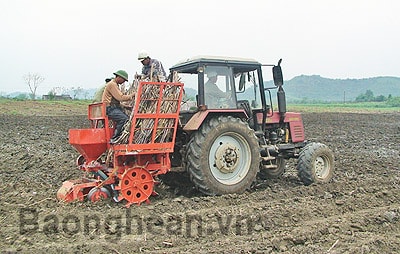
Using sugarcane planting machines in Quy Hop, operated by the Sugar Company.
Nghe An Tate & Lylle. Photo: Chau Lan
In sugarcane growing areas, many new sugarcane varieties have been introduced by sugar factories with high efficiency, such as ROC 10, MI, and Que Duong... However, sugarcane yields have not increased after many years, especially since sugarcane grassy shoot disease is still rampant on nearly 2,000 hectares, showing that the role of scientists is not yet clear. In the Song Con sugarcane growing area, the "scientific" solution is to convert nearly 1,000 hectares of low-yield rice and other crops to sugarcane cultivation, meaning planting sugarcane at lower elevations, while converting sugarcane areas on higher hills to rubber plantations. This appropriate conversion has increased the average sugarcane yield from 50-55 tons/ha to 75-80 tons/ha.
During the 2012-2013 crushing season, Tate & Lyle Sugar Company introduced a highly efficient drip irrigation technology for sugarcane, known as "Netafim High-Tech Drip Irrigation - Israel." The company selected sugarcane farmers with 2 hectares or more of land and access to irrigation water, sent them to Thanh Hoa province for study tours, and then implemented the technology. The company invited Israeli experts to directly survey and design irrigation systems for the sugarcane fields. Participating farmers also received interest-free loans of 60 million VND/hectare from the factory to invest in drip irrigation equipment.
Mr. Vo Van Luong, an agricultural extension officer at the factory, said: "With drip irrigation, the sugarcane receives water directly to the root zone, thus reducing weeds compared to flood irrigation. Fertilizers and water are supplied according to each stage of the sugarcane's growth and development. Water penetrates deeply, nourishing the sugarcane from the time the cuttings are planted until they develop, so sugarcane yield can increase to 120 tons/ha. Scientists at the factories have also demonstrated their efforts by diligently innovating and improving parts and equipment to increase capacity, recover sugar, reduce pressing time, and reduce machine cleaning time at the sugar factories." Many people have won top prizes in the Provincial Science and Technology Innovation Award, such as Nguyen Hoang and Dao Thanh Hai from the Song Con Sugar Factory… Product classification, commitment to product quality, as well as delivery and procurement methods… are professional practices in production and business that factories have applied information technology and equipment for classification and procurement. However, there has been a lack of clear explanation to the people, causing skepticism and resentment among many households who feel disadvantaged.
Nghe An Materials Joint Stock Company has successfully researched, produced, and transferred several high-yield, high-quality crop varieties in Nghe An province. The purebred rice variety NA2, the selected variety Q.ưu No. 1, hybrid corn L14, peanut 26, etc., have brought significant benefits to farmers in Nghe An. The company has also successfully researched and developed NPK 15-5-20 fertilizer for topdressing hybrid rice, replacing the previous method of applying separate nitrogen, phosphorus, and potassium fertilizers. The company has also invested 3.3 billion VND in building a research, testing, selection, and breeding farm covering 12 hectares in Kim Lien and Nam Linh (Nam Dan).
Sugar, tea, and cassava factories have also made efforts to improve equipment, invest in modern processing lines to enhance product quality, invest in environmental protection, reduce costs, and produce electricity and fertilizers to increase business efficiency.
Nghe An Sugar Company Tate & Lyle produces electricity and fertilizer directly from waste materials to serve its production. Nghe An Tea Investment & Development Company Limited currently operates 4 CTC black tea processing plants with a processing capacity of 80-90 tons/day and 5 modern green tea processing lines. Song Con Sugar Company has increased its sugarcane crushing capacity from 1,250 tons/day to 2,500 tons/day; Nghe An Sugar Company Tate & Lyle has increased its sugarcane crushing capacity from 6,000 tons/day to 9,000 tons/day.
The application, research, and implementation of scientific and technological advancements by scientists in factories are significant for raw material areas. Except for tea-producing regions, the role of state-run scientists is not yet clearly defined. The leading scientific agencies in the provinces have not made many contributions to the "four stakeholders" role as stipulated in Decision 80 of the Prime Minister.
(To be continued)
Chau Lan - Van Truong


