
Lesson 2: Appropriate Policies
Large-scale model fields are agricultural production models that require a clear linkage of four stakeholders: the State, scientists, businesses, and farmers. This linkage involves intensive investment in cultivating one or two crop varieties on contiguous land, applying scientific and technological advancements to increase productivity and product value, thereby benefiting farmers. In this linkage, each "stakeholder" plays a different role and has a specific task. The State plays a leading role in directing, managing, and developing plans for large-scale field development; simultaneously, it organizes the connection between the "stakeholders" through supportive policies and initiatives. Scientists play a role in transferring scientific and technological advancements to farmers and supervising their application of these advancements to improve productivity and product quality. Businesses play a role in supplying seeds and materials and organizing the purchase of products from farmers. As for farmers, they need to follow the production processes guided by scientists and strictly adhere to the contracts signed with businesses.
The development of high-income fields is a process, primarily reflected in policies and guidelines. In 2010, the Provincial People's Committee issued Decision 10/2010/QD-UBND, which included provisions for supporting the development of high-income fields. Accordingly, a subsidy of 5 million VND/ha was provided for the establishment of a new crop rotation formula with a total income exceeding 50 million VND/ha and a profit margin of over 30%, for replication purposes. The minimum scale for each formula was 5 ha; a subsidy of 2 million VND was also provided for promotional and communication activities to expand the model to mass production for a minimum of 20 ha with a confirmed high income.
Although the support is not substantial, this policy has enabled many localities to develop fields with relatively high productivity and value. Following the Ministry of Agriculture and Rural Development's initiative to establish model fields, the Provincial People's Committee issued Decision 09 in February 2012 to support investment in agricultural development during the 2012-2015 period. This included policies encouraging the application of scientific and technical advancements to build model fields using high technology. These policies encompass the following crops: rice, corn, and peanuts (minimum 30 hectares), oranges (minimum 2 hectares), rubber and tea (minimum 10 hectares), various vegetables (minimum 5 hectares), and forest planting using tissue culture (minimum 10 hectares)... with the aim of reorganizing agricultural production to achieve high commodity value and ensure sustainable production. This is also a crucial part of the current rural development program in Vietnam.
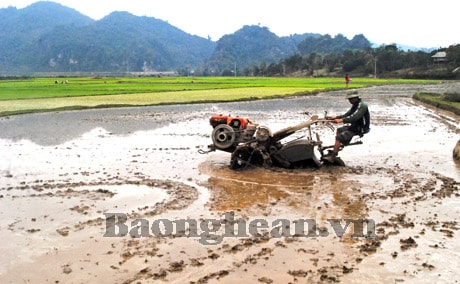
People in Tien Phong commune (Que Phong district) use tractors for land preparation.
According to this decision, production facilities that have established model fields will receive support from the Provincial People's Committee covering 30% of the value of materials invested according to current production processes, as well as funding for workshops, propaganda, and study tours, at a rate of 15 million VND per model field. In 2012, the entire province established 40 model fields with a total area of 2,222 hectares for the main crops of rice, corn, and peanuts.
Evaluating the results of these models, Mr. Phan Duy Thieu, from the Finance and Planning Department of the Provincial Department of Agriculture and Rural Development, said: After the model was completed, product productivity increased by at least 10-15%, and the economic value per hectare increased by 15-20 million VND. The production practices of the people are gradually changing with the application of scientific and technical measures and the stronger application of mechanization in the fields.
The above results provide a basis for reorganizing production according to the model of model fields to achieve high productivity, quality, and economic efficiency, in line with the current needs of domestic and international consumers, which is the need for high-quality and bio-safe rice varieties to protect human health. Some rice varieties such as VTNA2 and AC5 have high quality and are basically purchased entirely by companies and businesses. Many fields have an income of over 100 million VND, such as in Phuc Thanh commune (Yen Thanh district) reaching 140 million VND/hectare/season. Through these models, a transformation has been created in agricultural production, bringing high economic efficiency and gaining the trust and support of the people.
Following the review and evaluation of model fields in 2010, on December 13, 2012, the Provincial People's Council issued Resolution No. 68/2012/NQ-HĐND on a number of policies to support investment in the construction of "large-scale model fields" in the province, for the period 2013-2015. To ensure the resolution was quickly implemented, the Department of Agriculture and Rural Development promptly advised the Provincial People's Committee to issue Decision No. 02/2013/QĐ-UBND, dated January 15, 2013, specifying the mechanisms and policies for investment support in agricultural production.
In this decision, the Provincial People's Committee has clearly and specifically stipulated the subjects of application, objectives, and criteria for selecting and developing large-scale agricultural land consolidation projects. To achieve the set objectives, the Provincial People's Committee has decided to support localities in the work of land consolidation after the completion of land rearrangement; support the costs of purchasing seeds, materials, fertilizers, and other support policies for technical training for farmers.
In the spring of 2013, the entire province implemented an additional 15 model new rural development projects in 13 districts. These included 10 rice production models, 3 corn production models, and 2 peanut production models. To date, these models are developing relatively well, gaining public support and contributing to the successful construction of new rural areas.
Pham Bang


