
Lesson 2: Misappropriated Expenses!
Currently, caring for education not only attracts the attention of parents but also receives active support from organizations, associations, and society as a whole. The socialization of education is a correct policy, receiving widespread support and positive response. However, the lack of transparency in spending and the unreasonable expenditure of socialized funds have caused resentment and negative public opinion...
Circular 6890/BGDĐT-KHTC from the Ministry of Education and Training, guiding the management and use of voluntary contributions to educational institutions, clearly states: “Given the limited state budget that cannot meet the needs for upgrading facilities to serve teaching and learning in schools, one of the solutions used by schools is to mobilize contributions from organizations, individuals, and parents to renovate, upgrade, and build auxiliary facilities such as toilets, schoolyards, parking lots, school gates, surrounding walls, etc., or to purchase additional teaching and learning equipment.” However, for the past three years, Thai Lao High School (Hung Nguyen) has been forced to use the money mobilized annually through social contributions to pay off debts for the construction of a three-story school building.
In the 2010-2011 school year, the school put into use a three-story school building (comprising 12 classrooms) with a total investment of over 6 billion VND. Of this, 4.2 billion VND was allocated from the state budget under the school building reinforcement project, while the school had to contribute 1.8 billion VND from its own legitimate revenue sources. With no other revenue sources available, the school was forced to use funds raised from parents to pay off the construction debt. Mr. Tran Van Dong, Principal of Thai Lao High School, said: “Social contributions are only used for minor repairs and purchasing teaching equipment, not for large-scale projects. However, when the school had to contribute 30% of the cost to build a three-story school building, there were no other sources, so we had to rely on social contributions. In the 2011-2012 school year, out of 530 million VND from parents' contributions, the school had to use 400 million VND to pay the contractor, and the remaining amount was used to purchase teaching equipment; it is expected that the total amount raised this school year will be about 600 million VND, of which 500 million VND will be used to pay off construction debts, and the remaining amount will be invested in building a clean water system for students and teaching equipment...” Currently, Thai Lao High School is facing shortages of teaching equipment, substandard practice rooms and libraries, and a lack of tools... but the amount of funding mobilized annually for this investment is very limited because priority must be given to paying off construction debts.
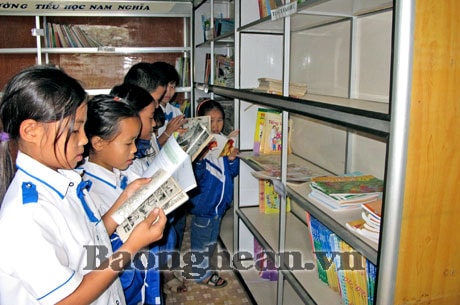
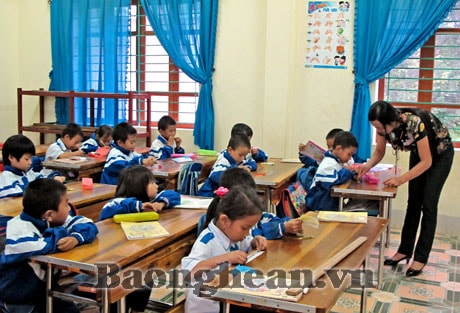
While the library is short of books, Nam Nghia Primary School (Nam Dan) is buying new desks and chairs.
Meanwhile, Nam Nghia Primary School (Nam Dan district) has been spending socialized funds inappropriately. Located in a special area (a mountainous commune with a large Catholic population), the school has a high percentage of impoverished students (25 students from poor households and 16 from near-poor households, accounting for 14%), thus limiting its ability to mobilize social contributions. On average, the school only manages to raise about 50 million VND in voluntary contributions from parents each year. However, instead of using this money to purchase teaching equipment – a more urgent need – the school spends the entire amount on new desks and chairs to replace old ones that "do not meet the required standards."
In the 2011-2012 school year, the entire school raised 42.8 million VND, which was used to purchase 50 new sets of desks and chairs (desks with attached beds to serve boarding students); in the 2012-2013 school year's social mobilization budget, the school expects to raise approximately 43 million VND and will purchase 40 new sets of desks and chairs to "replace some old ones that are no longer suitable for the new designs." Meanwhile, according to the library and equipment room records, for many years, the number of books and equipment added has been negligible. Teaching equipment is no better; many subjects, even entire grade levels (2-3 classes), have to share one set of equipment, and many subjects have to be taught without it or rely entirely on the "creativity" of each teacher. Ms. Nguyen Thi Ha, homeroom teacher of class 3B at Nam Nghia Primary School, said: “Teaching materials are mostly made by the teachers themselves. Many subjects lack them, such as social studies, writing, and reading. The whole grade only has one set for everyone to use, so it's old and torn...”. Books and equipment that directly serve teaching and contribute to improving the quality of teaching are not given attention or priority by the school, which only focuses on the appearance of desks and chairs... This is really unreasonable.
In the 2011-2012 school year, Cua Nam Kindergarten (Vinh City) raised 115 million VND through educational socialization. According to the school's records, this amount was used to purchase 40 stainless steel sleeping mats and 33 toy racks for 9 classrooms. In the 2012-2013 school year, the school raised nearly 94 million VND and allocated the funds as follows: supplementing desks and chairs, replacing toy racks, and purchasing winter carpets. The allocation of these funds reveals a wasteful expenditure. Given the current cramped conditions, classroom supplies and equipment are overflowing into the hallways; donated supplies and toys have no designated storage space and are temporarily placed under the stairs. Therefore, is it really necessary to use socialized funds to replace toy racks in the classrooms?
From the survey of the spending of socialized funds in some of the aforementioned schools, it can be said that the spending is still unreasonable and has many shortcomings. Firstly, the proportion of money allocated to purchasing books and equipment directly serving teaching and learning is very small compared to the amount of funds raised. According to statistics, in the 2011-2012 school year, the entire province raised 105,423 million VND, but the funds allocated to purchasing books and equipment was only 54,662 million VND, with some units having low figures such as Dien Chau (7.2%), Tan Ky (15%), and Thanh Chuong (16%). Secondly, the socialized funds have not been used for the essential needs of students, serving their personal interests. Many schools have built grand entrance gates with investment costs of hundreds of millions of VND, but the toilet area is just a wall without a roof, damp and smelly. To date, only about 40% of schools in the province have standard-compliant toilets. Some schools pour money into social mobilization to replace desks and chairs, while teachers and students lack equipment in the classroom, forcing them to teach and learn without proper facilities, and students lack proper sports equipment. The most illogical aspect is that many schools, in their budget estimates, often include "supplementing desks and chairs, replacing toy shelves..." and this is repeated every year. Whether the desks and chairs are made of wood, stainless steel, or plastic, they must have a certain "lifespan" and "durability"; they cannot be used only temporarily for one year before being replaced.
Furthermore, the monitoring of revenue and expenditure has not been implemented consistently and rigorously. According to Official Letter 1787/SGD&ĐT-KHTC from the Department of Education and Training regarding the implementation of revenue and expenditure for the 2012-2013 school year, schools must "report to the directly supervising agency to request approval and may only proceed with fundraising and implementation after obtaining the approval of the directly supervising agency." Accordingly, the Education and Training Departments of districts, cities, and towns are responsible for approving the policies for kindergartens, primary schools, junior high schools, and vocational training centers at the district level; the Department of Education and Training is responsible for approving the policies for high schools, continuing education centers, and units under the province's direct management. After completing the work, schools must publicly post and report the final accounts of the funds raised and the results of implementation to the organizations and individuals who contributed the funds. However, according to data from the Department of Education and Training, as of now, only 36 out of 92 high schools have requested approval from the Department to conduct fundraising; and in some districts like Nam Dan, only about 50% of schools have reported to the District Department of Education and Training to request approval for fundraising... Thus, even the process of conducting social mobilization has not been seriously implemented by the schools, failing to comply with the regulations according to the Department's guidance document, let alone the actual expenditure of socialized funds.
It can be said that the lack of clarity in revenue collection and the irrational use of socialized resources have made the mobilization of social resources for education unconvincing, creating negative public opinion.
(To be continued)
Thanh Phuc


