
Lesson 2: Going to Bao Thang to eat "nhooc" dish
(Baonghean) - "Nhoọc" is a popular delicacy of the Khmu and Thai people. On a day when the cold weather suddenly arrives, having this dish on the dinner table is truly a delightful experience.
Delicious food amidst the green forest.
For us, although not entirely unfamiliar, eating "nhoọc" (a type of stew) was still a truly meaningful experience on a day when the weather, in its capricious mood, brought the chill of early autumn in a foreign land.
A new acquaintance in Bao Thang (Ky Son) called us and said the cold weather was coming. Let's go eat "gru." That's the Khmu word for a dish that the Thai people call "nhooc" or "nham noc." It's made from wild game meat cooked with several kinds of vegetables such as chili leaves, lemongrass, gac fruit leaves, green squash, and some spices. Like many other mountain dishes, "nhooc" cannot be without chili peppers and "mac khen" fruit. But what makes "nhooc" special is the wild eggplant.
Luckily, we were on a trip to the border district of Kỳ Sơn, so we conveniently headed straight to Bảo Thắng, the land of the Khơ Mú people. This area is one of the most challenging in the Nghệ An highlands. The entire commune consists of only five villages nestled among mountains and valleys, wild and mysterious. Despite the hardships, it is also a place rich in human kindness.
From the Xieng Thu intersection in Chieu Luu commune, Ky Son district, about 200km from the provincial capital, we had to travel another 30km to reach the commune center. The single-lane paved road passed through the high-altitude villages of Luu Thang and Ta Thoong, into part of Tuong Duong district, and then over several long mountain slopes before finally reaching Bao Thang commune. The weather these days is strange; it's only the beginning of August in the lunar calendar, but the cold has already arrived. Along the way, we saw figures in warm coats. A few young women sat by the fire, looking out at the road, creating a tranquil and poetic autumn scene.
Having been to Bao Thang a few times, I know that the road only extends to the center of the commune, at Cha Ca 1 village. The remaining four villages—Cha Ca 2, Ca Da, Tha Lang, and Xa Va—are only accessible by motorbike. This road is probably only suitable for skilled forest drivers, as it's full of short and long slopes, with some sections barely wide enough for a motorbike wheel. However, the journey through this pristine area offers many interesting experiences. After passing through lush green forests of Săng Lẻ trees along the path, a small village appears. A few houses nestle along the stream's edge, seemingly playing hide-and-seek in the wilderness.
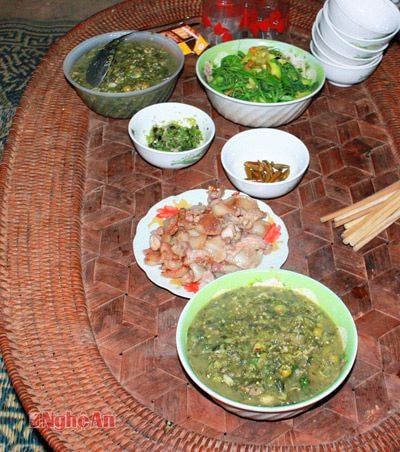 |
| A dish that is difficult to eat on the dinner table of people in the highlands. |
"The hardships" of the past
Today, our visit to this area wasn't as arduous as previous trips. Our new acquaintance's village, Cha Ca 1, is located right in the center of the commune. Fortunately, a paved road has reached here. The only thing missing is national grid electricity to make the night less dark. In the drizzling afternoon, the chill seeped into the small kitchen. Several dried squirrels were already on the loft – the wild game meat our friend was preparing to cook. By the fire, some wild vegetables had also been carefully gathered. "As the Thai people say, tonight we'll be eating 'nhom nhoc'," our friend said with a gentle smile, his hands moving nimbly by the fire.
I suddenly remembered that the Party Secretary of Bao Thang commune, the village elder Moong Pho Hoan, once told me: Actually, no one knows which ethnic group the Khmu people call "gru" originally came from. They only know that the Thai people also eat this dish. Initially, when people hunted squirrels, deer, or other animals in the forest, they put them in a bamboo or rattan tube along with some wild vegetables. Finding it delicious, the forest dwellers tried to improve the dish to make it even tastier. Thus, the origin of the "nhooc" dish stems from the working life connected to the mountains and forests. It's not linked to some fairy tale like some mountain dishes. If you call it a story, it's simply the story of making a living in the forest.
Nowadays, people in Bao Thang occasionally cook "nhooc" in bamboo tubes. We also witnessed the Khmu people in Tuong Duong district cooking bone broth in bamboo tubes, which is offered as a sacrifice during Tet (Lunar New Year). However, the ingredients are somewhat different from "nhooc" because this dish includes wild eggplant, which is what gives it its unique character. For the Khmu people in Yen Na (Tuong Duong), their bone broth in bamboo tubes is an indispensable item on their Tet offering tray.
A meal on a cold day
In the evening, we returned to our friend's thatched house in Cha Ca 1 village. As the host prepared to put the pot on the stove, I wondered why he wasn't using the bamboo tube. He said he wanted to show off his cooking skills today by making a Thai-style "nhoc" dish. He said he learned it from the Thai community in Tuong Duong district. He claimed that the "gru" cooking method in bamboo tubes was only really suited to the local palate. It turned out he wanted to cook it specifically to treat his guests.
My friend guided me to the garden to pick wild eggplant and some green squash leaves. A young green squash was also gathered. The squirrel meat was washed and minced. The young leaves and the green squash were also cut in half and finely chopped to be cooked together. The tiny wild eggplants were left whole. Besides "mác khén" (a type of spice), lemongrass, and chili, coriander and onions were added to the seasoning. And so, the ingredients for the "nhoọc" dish were ready.
“When cooking, you have to stir-fry the meat with chili peppers, lemongrass, mac khen (a type of spice), and fish sauce and salt first. Only add the remaining vegetables and water when the meat is almost cooked,” my friend explained. At this point, you just need to keep the heat steady. “Nhooc” is also a meticulous dish. The longer it’s cooked, the richer the flavor. So we had to wait another hour or so before the meal could begin.
On a chilly evening, the meal in the small house in the remote village felt warm thanks to the dish called "nhoọc." Our traveling companion jokingly compared it to eel soup in the city. Thanks to his skillful cooking, the bowl of "nhoọc" looked incredibly appetizing. Squirrel meat, wild vegetables, and other locally grown ingredients blended together to create a soup with a vibrant green color – truly unique. Our friend said: "Whenever the cold weather comes, my family cooks this dish to treat our neighbors. It's a delicious winter dish in the highlands."
Our cheerful conversation over the meal, featuring the traditional "nhoọc" dish, was interrupted when the host suddenly stood up and announced the start of "part two" of the festivities. A jar of rice wine, prepared beforehand, was brought out of the sacred kitchen, a forbidden area for strangers. For the Khmu people, a jar of rice wine is indispensable when visiting a home. It seems the "nhoọc" dish is merely an excuse for celebrations, a way to strengthen community bonds. For us, it was a truly fascinating discovery.
Huu Vi - Dao Tho
| RELATED NEWS |
|---|


