
Lesson 3: Active cooperation is needed.
(Baonghean)How can we persuade the residents who are "clinging" to the reservoir area to relocate to new homes? How can we prevent those who have already been resettled from returning to their old homes? To answer these questions, active involvement and coordination from all levels of government, relevant departments, and the community are needed.
All the people who stayed or returned to the Bản Vẽ reservoir area shared the same sentiment: they wanted to stay in the reservoir. Although the people who "clung" to the reservoir area all understood that staying there meant having no community, no village, their children would have to be sent to school elsewhere, and there would be no support system... But why did some people still deliberately stay?
According to Mr. Trinh Minh Chau, Vice Chairman of the People's Committee of Tuong Duong District, regarding the remaining population in the reservoir area, especially in Cha Coong village (formerly Huu Duong commune) and some households in other villages, since 2004, the People's Committee of Tuong Duong District has sent many delegations and mobilized the entire political system to persuade them to relocate. The vast majority of people have moved to Thanh Chuong and other resettlement areas and settled down. However, due to the traditional livelihoods of the people in the high mountainous region, some have encountered many difficulties upon arriving at the resettlement area in Thanh Chuong, leading them to return to the reservoir area.
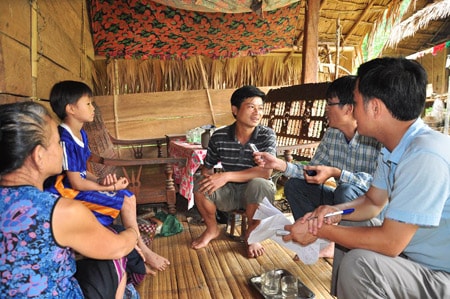
A reporter from Nghe An Newspaper interviewed a family that still "clings" to their old hometown.
in Chà Coong village.
Some households remained, including 32 households in Cha Coong village, who were persuaded, guided, and assisted. The vast majority have moved to resettlement areas in Thanh Chuong or registered to relocate to other districts according to their wishes. However, despite the district's full implementation of policies and regulations, some households still disagree and show resistance. Others who applied for relocation based on personal wishes have "changed their minds" and decided not to leave, resulting in the continued presence of these "unwilling" residents.
According to our investigation, the current problem is that the remaining households cannot be provided with roads or schools because all of them have registered to relocate and leave the reservoir area. Another issue is that these households have filed complaints with authorities at all levels, from the commune, district, province to the central government (including Mr. Luong Khac Phung - Head of Cha Coong village), stating their sole desire to remain. However, if the district allows these households to stay, the 2,800 households in the reservoir area who have already relocated to other areas will lose faith in the policies of the Party and the State!
In Thanh Chuong, the Management Board of Hydropower Project 2 has provided sufficient land for housing, gardens, and production. However, according to the customs and traditions of the ethnic minority people in Tuong Duong, the amount of forest land needed to ensure slash-and-burn farming as in their old hometowns is not feasible under Thanh Chuong's conditions. Therefore, the people must adapt to new farming practices. However, currently, the people lack the necessary awareness and education. This is also a major reason why some households, when their land was reclaimed by the district but not yet compensated, returned to their old places to farm and clear land for cultivation. Since these households returned, the district has established four working groups to investigate and persuade the people to return to the resettlement area. The district has organized many meetings with the People's Committees of Huu Duong and Kim Tien communes, as well as respected village elders and heads, along with local government officials who previously worked in the reservoir area and are now continuing their work in Ngoc Son and Thanh Son (Thanh Chuong). In addition, the resettlement areas continue to welcome their residents back to their new homes, even though these households may still feel inferior or self-conscious.
As a result, these households, who were initially determined to carry out their relocation plan by filing complaints everywhere, have now gradually realized that all residents of the seven communes in the upper region have a very good understanding of the relocation process. In particular, those who left and stayed behind belong to areas with a good sense of community and feel ashamed in front of those who left. Due to this feeling of shame, they don't want, or perhaps don't dare, to return.
To overcome this psychological barrier, the district invited mass organizations such as women's groups, youth groups, and the Fatherland Front to mobilize support, and even brought relatives, such as siblings and cousins who continue to live in Thanh Chuong, to persuade and talk to the people. The district's attitude and responsibility is to continue working with the Party Committee and local government to encourage people to move to the Thanh Chuong resettlement area, which already has very good infrastructure. Land may be scarce, and customs may not be suitable yet, but there will be many new policies from the State to support the resettled people. Recently, the Provincial People's Committee assigned the Thanh Chuong District People's Committee to develop appropriate projects to improve the lives of the people. Specifically, there is a project to plant tea, providing seeds and fertilizers to the people. Currently, in the resettlement area, many households already have cars, motorbikes, and other living amenities.
For the Management Board of Hydropower Project 2, all policies and regulations for the people in the reservoir area within the resettlement zone will be paid 100%. Any new expenses will be paid in full after receiving the opinion of the Provincial People's Committee. Regarding land compensation, after the issuance of Decision 34 by the Prime Minister on land compensation policies for irrigation and hydropower projects, there is a problem with the surveying of the area above the flooded zone because there is no basis for measuring it, as that land has not been issued a land title. The farming practices of the people, constantly changing hills, make it impossible to verify the area of that land. However, the people still believe that the total area of land they cleared for slash-and-burn farming over the years equals the area they are entitled to compensation for. This is an unreasonable issue and reflects the people's poor understanding.
Therefore, the province needs a policy that identifies the origin of land use and simultaneously surveys the areas of land cultivated by the people to provide compensation according to the law, rather than simply compensating them for whatever amount they demand. Basically, the land policy for the 2,800 households in the reservoir area regarding resettlement sites has been implemented according to temporary regulations, which include residential land, garden land, and production land. Only the 230 households who migrated freely remain, and the district is continuing to submit a proposal because the regulations clearly state that compensation for those residents will be provided by reallocating them to residential land, garden land, and production land, with the remaining amount being offset by a difference. This difference can only be calculated in Tuong Duong district once the Thanh Chuong District People's Committee has the data on land allocation to the resettled households.
For Thanh Chuong district, it is thought that more proactive measures are needed to continue encouraging people to return to the resettlement areas. Even for households remaining in the reservoir area, the district needs to continue persuading them to move to the resettlement areas; otherwise, it will create conflict between the 2,800 households that have already moved and those who remain. The district should create the best possible conditions for those moving to the resettlement areas by providing financial assistance for transporting stilt houses and mobilizing all militia forces in the district to help the people, in addition to the policies and regulations of the Hydropower Project Management Board 2. The district is also ready to assist them in all aspects, such as unloading and transporting rafts to Thanh Chuong, and other immediate needs such as healthcare and food.
It is evident that the residents who "stay" and those who return to the Bản Vẽ hydroelectric reservoir do so simply to remain on the land where their ancestors have lived for generations, ensuring their livelihoods. Creating a new life for them with all the necessary amenities is not something that can be done overnight, but it is the responsibility of the government and the community. For the Bản Vẽ power plant to operate and for the residents of the reservoir to return to peaceful lives in the resettlement areas, these things depend on genuine cooperation between the people and the government.
Tran Hai - Thanh Chung - Cong Kien


