
Lesson 3: Developing concentrated livestock farming
(Baonghean) - Promoting investment attraction to shift from small-scale, scattered livestock farming to concentrated, industrial-scale livestock development; farm, family farm, and household livestock production... applying appropriate techniques and technologies, is a fairly effective direction for the livestock sector in implementing the restructuring of the agricultural sector over the past two years.
The inevitable direction
This is also the direction of the livestock sector in the restructuring of the industry, with the aim of gradually shifting livestock farming from high-density areas in the plains to low-density areas in the midlands and mountainous regions; forming livestock farming areas far from cities and residential areas; shifting the structure towards increasing the proportion of poultry in livestock herds; encouraging the application of high technology, organizing closed-loop production or linking stages in the value chain from breeding and feed production to processing to improve productivity, reduce costs, increase efficiency and added value; developing livestock farming in conjunction with waste treatment, minimizing environmental pollution, ensuring food safety and hygiene and preventing diseases. Effective disease monitoring and control; strengthening veterinary services; strictly regulating the management and use of veterinary drugs; applying food safety standards along the value chain; Develop a centralized slaughterhouse system to manage disease outbreaks and control slaughtering. Focus on developing livestock products that are advantageous to the province, meeting consumer and processing needs, contributing to economic growth and structural transformation.
Starting with intensive farming in 2004, the farm of Mr. Le Quoc Tan's family in Hamlet 5, Hung Tien Commune, Hung Nguyen District, initially covered only 2 hectares and raised a mix of pigs, chickens, and ducks. In 2014, due to the need to expand, he leased an additional 4 hectares from households in the hamlet that did not need land for production, and for the past two years, he has completely switched to raising lean pork. Currently, his farm consistently has 200-300 pigs, selling approximately 700 pigs annually, equivalent to 70 tons of pork. Mr. Tan shared: “Concentrated pig farming has many advantages and yields quite high economic efficiency. Although it still depends on objective conditions such as weather, diseases, and market prices for both input and output, if the technical procedures are followed correctly, vaccinations are complete, feed is sourced from reliable suppliers, the barns are well-ventilated and clean, and pigs are fed according to their needs at each stage... then the pig herd will basically develop favorably and yield high efficiency. The concentrated production volume also makes consumption easier, mainly with traders coming to buy and sell in Vinh City. Currently, I am applying for approval for a project to raise 150 foreign breed sows because the demand for piglets in the market is very high. In addition, I plan to expand the scale of fattening pigs to about 1,000. Currently, my family is focusing on building barns, and we expect to release the sows around April next year and have piglets for sale in the market by October.” Farm owner Nguyen Quang Dai in Hamlet 7, Nam Xuan (Nam Dan) also invested heavily in his farm, with a total herd of over 300 pigs at one point. In addition, he focused on investing in supplementary feed for his livestock. According to Mr. Dai, running a large farm allows him to connect with feed suppliers and provides a more reliable source of supply when needed.
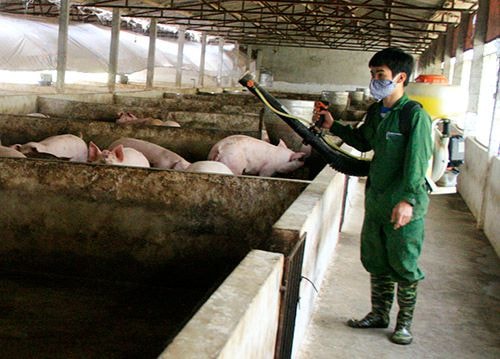 |
| Disinfectant spraying at Mr. Truong Dinh Thong's farm (Nghia Long, Nghia Dan). |
In 2014-2015, Nghe An's livestock sector achieved significant results, reaching 44.6% of the agricultural sector's share, an increase of 3.38% compared to 2013 and 8.52% compared to 2012. Mr. Luu Cong Hoa, Head of the Livestock Department of the Department of Agriculture and Rural Development, stated: “In recent years, we have actively attracted investment, especially from businesses, to develop livestock farming, shifting from small-scale, scattered farming to concentrated, industrial-scale farming. The objectives outlined in the sector's restructuring plan have yielded noteworthy initial results. In 2014-2015, Nghe An's livestock sector shifted in the right direction. The proportion of livestock in agriculture reached 44.6%. The total herd shifted towards maintaining and increasing the proportion of poultry in the livestock population. The buffalo, cattle, and pig herds throughout the province remained stable, slightly decreasing in the plains and slightly increasing in the mountainous areas; The total poultry population has gradually increased compared to previous years. Consequently, the total output of the livestock industry continues to grow. Nghe An has also focused on developing livestock products that have advantages for the province, meeting consumption and processing needs, contributing to economic growth and structural transformation. To date, TH True Milk's dairy farm has over 30,000 cows, and Vinamilk's farm has 3,000 cows. Besides these two large enterprises, there are also beef cattle farms in Nghi Lam commune, Nghi Loc district, with a scale of 7,500 cows/year; Tan Ky farm with 4,500 cows/year; and a farm in Quynh Luu currently under survey for project planning. There are also farms raising foreign breed pigs (9 pig farms linked with JSC, 38 chicken farms linked with JAFA Company: 9 chicken farms with a scale of 5,000-8,000 chickens); Thai Duong pig farm with 5,000 pigs... Simultaneously, the province is implementing the transfer of... Land, long-term land leases, tax incentives, or exemptions from land use fees are provided to research, testing, production, and business establishments dealing with livestock breeds. State management of livestock farming has also been strengthened. Nghe An province has issued decisions on state management of livestock breeds and animal feed, tailored to the province's specific conditions. Management of breeding boars, animal feed, and policies supporting livestock farming have also been implemented.
According to Mr. Vi Luu Binh, Deputy Director of the Department of Agriculture and Rural Development, it is noteworthy that small-scale household livestock farming has decreased by 30-35%, with the most significant reduction being in pig farming; gradually shifting from farm-based livestock production away from residential areas, most commonly the pond-and-barn farm model in Nghi Loc, Yen Thanh, Hung Nguyen, Nam Dan, Do Luong districts... and livestock farming according to the VietGAP model (under the Lifsap Project).
The province has 457 livestock farms, accounting for 16.5% of the total farms in the province. Of these, 121 farms meet the criteria, including 54 pig farms, 32 poultry farms, and 41 mixed livestock farms. Notably, integrated supply chains have been formed in pig and poultry farming through contract farming (CP and Japfa farms); investment and product procurement linkages in pig farming (Thai Duong and Yen Thanh farms); and cooperative provision of breeding stock and consumption of dairy products (Vinamilk). Group-based cooperatives and livestock cooperatives have also been established (Lifsap project).
The implementation of legal regulations on livestock breed management, tailored to the specific farming conditions in the province, has also been emphasized. Nghe An has issued a plan for managing breeding boars throughout the province, while continuing to implement programs to improve buffalo and cattle breeds. Artificial insemination is being carried out to improve cattle breeds towards Zebuization... Simultaneously, efforts are being intensified to manage animal feed to ensure a quality feed supply that meets the needs of herd development in both quantity and quality. Furthermore, through various policies, programs, projects, and agricultural extension models, diverse and comprehensive approaches have been implemented, contributing to raising awareness and changing behaviors in household livestock farming towards biosafety and minimizing environmental pollution.
High-tech applications
Looking back, Nghe An has focused on exploiting its potential and leveraging the advantages of regional livestock farming, building and developing medium and large-scale specialized livestock farming areas in the form of farms, family farms, and high-tech industrial livestock zones for dairy and beef cattle; while maintaining the scale and methods of household production, diversifying to suit regional conditions, and focusing on domestic products with medium competitiveness such as pig and poultry products. Therefore, the livestock sector has achieved encouraging results: indicators of total product and livestock income have increased and met annual targets; the total livestock population is stable, the poultry population is increasing, and technical advancements in livestock farming are being applied and transferred more widely in production, achieving high quality and efficiency.
Nghe An province aims to achieve a total output of 30,000 tons of live beef cattle by 2020; focusing on developing high-quality beef cattle farming in suitable areas and continuing to develop industrial-scale dairy farms, striving to reach 147,000 head of cattle (90,000 for milk production) and 850,000 tons of milk by 2020. It will also develop high-quality pig farming to increase added value, focusing on improving herd quality through artificial insemination and using good breeding boars for direct mating, aiming for a live beef output of 180,000 tons by 2020; and a poultry meat output of 45,000 tons by 2020. Simultaneously, it will focus on directing the development of feed crops for livestock, aiming for a concentrated area of feed crops (corn, grass) of 20,000 hectares by 2015 and 40,000 hectares by 2020.
To achieve that goal, Nghe An province has identified the following priorities: continuing research, development, and application of pig and chicken farming processes according to VietGAP standards; developing beef cattle farming on a large scale, focusing on modern, concentrated farms from breeding, production, feed processing, care, and slaughtering; developing industrial-scale dairy farms; and gradually expanding household cattle farming through linkages with milk processing businesses. The province will also apply high technology to livestock development, control and ensure safe farming practices, and treat livestock waste using biogas technology and probiotics to minimize environmental pollution.
(To be continued)
Phu Huong
| RELATED NEWS |
|---|


