
Lesson 4: Muong Qua
(Baonghean)- As one of the major districts in southwestern Nghe An province, Muong Qua district belongs to the present-day Mon Son and Luc Da communes. This district is associated with the legend of Muong Hau Bong, originating from Muong Ca Da (western Thanh Hoa province) to reclaim land and create a two-crop rice paddy...
>>Lesson 3: Legends and Ancient Festivals
Many people, young and old, in Con Cuong district know about Muong Qua. Since 2002, a high school named after this ancient village has been located in Khe Lo hamlet, Mon Son commune. However, when asked about the origins of Muong Qua and why it bears this name, few can offer a convincing explanation, even those knowledgeable about the region's culture. Some believe that the village's founders, upon arriving, saw flocks of crows and named it that way. Others suggest it's a corrupted version of Muong Pha (Heavenly Village). But it seems none of these explanations are satisfactory!
There is a legend collected years ago by ethnic culture researchers in Xieng Pun village (the name, in Thai, means center of good fortune; now called Lang Xieng village, in Mon Son commune), considered the center of the early days of the village's establishment. When we returned, we couldn't find anyone who remembered this legend anymore. The younger generation also couldn't remember the name of Xieng Pun village.
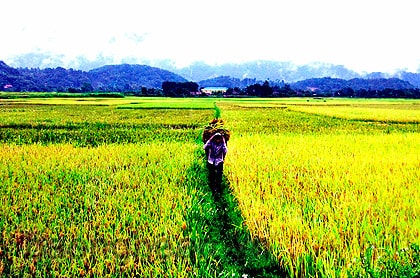
A corner of the rice fields in Xieng Pun village, the center of the ancient Muong (district).
Legend has it that over a hundred years ago, a man named Hau Bong (Mr. Luong Van Que, born in 1919, residing in Tan Son village, Mon Son commune, called him Hau Bong), whose given name was Lang Van Ut, came to the area of what is now Yen Khe. He was originally a Tay Thanh man from another place, and was therefore looked down upon by the Tay Muong people. One day, he climbed to the summit of Pu Ong, the border between the two communes of Yen Khe, and discovered a vast valley with a clear stream. He was overjoyed and immediately gathered his relatives to establish a new village. Later, Hau Bong also gathered people to dig a canal about 31 meters long connecting Hua Na village (Luc Da commune) down to Thai Son village - Mon Son. This can be considered one of the ancient irrigation works in western Nghe An. Currently, this canal still plays an important role in irrigating the fields of many villages in Muong Qua.
In Xieng village, the center of the ancient district, the oldest residents are only in their 70s, most having migrated from other villages within the last few decades. The older generation has all passed away. The younger generation vaguely remembers that there used to be a seven-room house belonging to a district official at the beginning of the village, but no one knows their name. Elder Doan, the oldest person in Met village (Luc Da commune), only heard that after conquering Tra Lan citadel, King Le Loi allowed his soldiers to rest in this area for six nights, hence the name Luc Da (Six Nights).
Upon introduction, we visited Mr. Luong Van Que, residing in Tan Son village (Mon Son). He participated in revolutionary activities from the time of the seizure of power in Mon Son in 1945, holding the position of platoon leader of the village guerrilla force. Currently, this 94-year-old gentleman is still agile, sharp-minded, and enjoys participating in the activities of the local Senior Citizens' Association. Mr. Que recounted that in the past, Muong Qua had two districts, called Xong To and Xong Nua. Xong To belonged to Mon Son commune and Hua Na village (Luc Da) today. Xong Nua was headed by Mr. Xong Ngat as the district chief and Mr. Ly Hao as the village head. Xong To was headed by District Chief Phung and Mr. Thieu as the village head.
In the past, the village of Xieng Pun was the residence of the Lord. It was a large house thatched with rattan leaves, with very large pillars, larger than any other house in the village. Once, Mr. Que helped the Lord with the thatched roof. Although there were many people helping with the roofing, the Lord stayed inside the house all the time, and no one ever saw him. The thatched roof was twice as durable as a thatched roof made of palm leaves, so it only needed replacing every 15 years or so. Therefore, throughout his youth until 1945, when the old government was abolished, Mr. Que only visited the Lord's house once to thatch it. The roofing was usually signaled by gongs and drums.
After each drumbeat and gong sound, the people on the roof were allowed to pick up the rattan leaf clamps and begin roofing. This method ensured that the leaf roofing sheets were neatly aligned, durable, and beautiful. The rhythmic drumming and gongs added to the bustling and joyful atmosphere of the work. In those days, the Lord did not force anyone to plow or clear the fields for him; he only gathered the villagers for tasks like roofing, as building stilt houses required many people. Those who did not participate were not punished or reprimanded. The Lord's fields were all managed by his family and descendants. Because his family was large, they had many fields and gardens...
In Hau Bong, the person who pioneered the development of the Muong Qua region, according to Mr. Que, was only told the story by his grandfather. Mr. Hau, who hated the French, called on various communities to gather in Muong Qua, and then he began clearing land for farming.
In the Muong region, there is the Puc Temple, the largest temple in the Mon village. Anyone passing by the temple must remove their hat or cap and refrain from talking. On festive occasions, the temple usually slaughters buffalo or pigs. On the day of the village's dignitaries' feasts, the villagers must sit outside. The temple is made of wood, like the stilt houses of the Thai people. In those days, only Mr. Pho Ngoan in the entire village spoke fluent Vietnamese and knew how to trade, so he was able to buy roof tiles from the lowlands to roof his house.
Besides Muong Qua, in the former Vinh Hoa district (now Con Cuong), there was also Muong Chai. This ancient Muong encompassed the entire present-day Chi Khe commune. The Muong had 11 villages of the Thai ethnic group, Tay Muong. The last people of the old regime who headed Muong Chai were from the Luong family...
Photo credit: Huu Vi


