
Lesson 4: Stilt houses - structures of community solidarity
As Thai people, almost everyone knows the legend of the stilt house: Long ago, humans were hunted by wild animals and lived precariously in caves. A turtle god, feeling pity, appeared in a dream and said, "Look at my body and build your house accordingly." So, the people discussed building houses in the shape of a turtle. The house pillars resembled the four legs of a turtle, the thatched roof was its shell, the floor was its belly, and the bamboo walls were its body. From then on, they avoided wild animals and lived in peace. They built stilt houses side by side, thus forming villages and hamlets.
A community achievement
The stilt house architecture of ethnic minorities in Vietnam is quite diverse, ranging from the square-columned stilt houses of the Tay people in Cao Bang and Ha Giang to the communal houses of the Ede, Gia Rai, and Bah Na people (Central Highlands). Currently, the Khmu and Dan Lai people in Nghe An often live in houses with buried columns and thatched roofs made of palm leaves, with low floors that require bending over to enter. This is also the same type of stilt house architecture as the Thai people, a community with a long tradition of living in stilt houses.
The original stilt houses of the Thai people in Nghe An province used to have only 2-3 rooms, with posts buried in the ground. The outer room, where the altar was located, was forbidden for women to sleep, rest, or eat. The inner room served as both a living area and a kitchen; later, families with better financial means would often build a raised house (with the house posts supported by stone pillars). Underneath the floor, they would raise chickens, ducks, and livestock, and place a rice mortar... Depending on the family's circumstances, the stilt houses varied in length, but the outermost room near the stairs always housed the altar, and the innermost room usually contained a square kitchen for cooking.
Building a stilt house requires the collective effort of the entire community. Larger houses require even more help. In planning the construction of a stilt house, the first step is to discuss with relatives and family members, then the head of the household goes to the forest to select wood. The first difficulty is choosing the wood for the pillars, followed by other parts of the house. To complete a stilt house according to the architecture still seen today in villages along National Highway 7, dozens of cubic meters of wood are needed. Sometimes it takes years to gather enough wood to build a stilt house, after which neighbors are asked to bring buffaloes from the forest to haul it back for the builders.
During the house construction process, two winches and dozens, even hundreds of people are needed to erect just one roof truss. After that, other components such as rafters and purlins, all heavy wooden beams, are installed at height, requiring skill and experience from the builders. Finally, roofing requires a large workforce to transport materials (usually palm leaves or tiles).
After completing the construction of a house, Thais typically hold a housewarming celebration. Besides the homeowner, those who contributed to building the house are also present, so these celebrations often last all night. However, nowadays, the traditional housewarming customs have almost disappeared. Gone are the days of drinking rice wine and singing; instead, there is loud dance music and boisterous dancing.
Stilt houses are not just living spaces; they are the masterpieces of the entire community, where the solidarity of the village community is most clearly expressed. It can be said that stilt houses are the bonds that bind the villages and hamlets of the highlands together.
Stilt houses are being revived.
Like other cultural products of ethnic minorities, the stilt houses of the Thai people have also faced many ups and downs. From the 1990s onwards, stilt houses have almost completely disappeared from many Thai communities in the districts of Que Phong, Quy Chau, Quy Hop, and Nghia Dan.
There was a time when many people believed that stilt houses were no longer suitable for modern living, so in many communities, people rushed to sell their stilt houses to build new ones. However, many also sold their stilt houses due to economic difficulties. After selling their stilt houses and building new ones, people often had a considerable amount of money left over, so many easily parted ways with their traditional stilt houses that were 40 or 50 years old. In the 11 communes of Nghia Dan district, with over 30,000 Thai people living there, recent statistics from the District's Culture, Information, and Sports Center show that there are currently only 80 stilt houses scattered throughout the communes. In Dong Xang hamlet (Nghia Hoi), the hamlet with the most stilt houses in the district, there are only 5 left. In this community, people still speak Thai, but the living space, including the stilt house architecture, has disappeared for many years. Mr. Vi Ngoc Chau moved from Tan Thang commune (Quynh Luu) to Dong Xang hamlet nearly 20 years ago. Back then, his children and grandchildren urged him to sell the stilt house because transporting it dozens of kilometers was very expensive, and to sell it to build a modern brick house, but he resolutely refused. Therefore, his family remains one of the rare families that still possesses a stilt house.
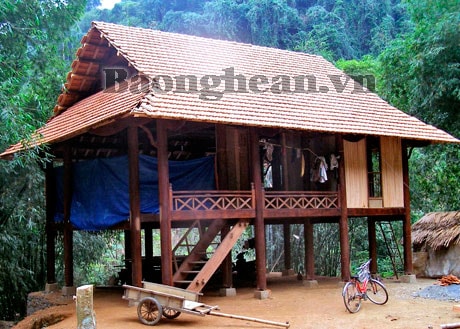
More and more stilt houses are being built.
In many localities, when asked about the plan to restore stilt houses, we received the same answer from cultural leaders: There is no plan for this yet. Mr. Luong Ba Vien, Director of the Culture, Information, and Sports Center of Nghia Dan district, shared: “As a Thai person, and having witnessed the ‘loss of stilt houses’ happening right in my homeland, I deeply understand that losing a stilt house means losing a traditional living space, losing something sacred. We are also waiting for a policy from the higher authorities to restore stilt houses, which are the traditional living spaces of the Thai people.”
While the government has yet to take any action to restore traditional stilt houses, in many places, including Con Cuong district, stilt houses are truly experiencing a revival. In recent years, life in many areas of this mountainous district has improved significantly, and the movement to build stilt houses has never been as vibrant as it has been in the last few years, especially since the government implemented a policy to provide financial support for the elimination of thatched houses in disadvantaged areas. However, forests are now dwindling due to the impact of widespread slash-and-burn agriculture and deforestation. Now, securing enough wood for a substantial stilt house is becoming increasingly difficult, so many people are choosing concrete pillars instead of wooden ones. Other parts such as beams and rafters are also cast in concrete. This is a less expensive method, requiring less forest wood, while still ensuring the distinctive architectural features of the traditional Thai stilt house.
Now, back in the village, seeing the stilt houses gradually being revived along with the economic improvements, people's hearts have calmed down somewhat. Just two days ago, I had the opportunity to attend a housewarming ceremony. It was a house of gratitude donated by the Hanoi City People's Committee to Mr. Luong Yen, a victim of Agent Orange in Chi Khe commune (Con Cuong district). In indescribable joy, he sang a housewarming song about the village's efforts in building the house. Listening to him sing, I understood that stilt houses are truly being revived.
Huu Vi


