
Lesson 5: Reflections on the distinctive melodies of folk songs
The Lam, Khap, Xuoi, and Nhuon melodies of the Thai people, as well as the folk songs of the Tho, Kho Mu, Thanh, and Mong people in western Nghe An, have been refined over thousands of years and possess unique cultural and artistic values. However, folk music, especially the folk songs of ethnic minorities, is currently declining and at risk of disappearing.
Folk music, in particular, is often closely linked to the cultural life of a region. People in mountainous areas are blessed by nature with abundant material for musical composition, such as picturesque landscapes, majestic mountains and rivers; diverse and fascinating sounds, the chirping of birds and monkeys, the clear murmur of streams... All of these elements have created melodies, combined with lyrics that have been refined and created by generations, forming a unique folk music tradition. However, the younger generation today is turning its back on its own traditional music. This is partly due to the strong influence of foreign music trends, but also because traditional folk music has not kept pace with the rhythm of modern life.
As someone who has written dozens of songs about mountainous regions, composer Tran Vuong believes: "Nowadays, society is developing, life is more hectic and fast-paced, so music demands faster and stronger rhythms. Western music fulfills this, so young people follow it. Meanwhile, folk melodies remain unchanged, with sprawling melodies and slow, drawn-out rhythms, so young people don't like them and consider them outdated."
Mr. Le Hoang, an amateur musician of the Thai ethnic group, has composed many songs based on folk melodies of ethnic minorities and is very passionate about researching Thai culture. He expressed his concern: “The folk songs of the Thai people in Nghe An differ significantly from those of the Thai people in the Northwest region. Besides the popular Khap melody, the Thai people in Nghe An also have Lam, Xuoi, and Nhuon. These are very valuable cultural heritages left by our ancestors, but they are gradually disappearing. Now, those who sing Lam, Xuoi, and Nhuon authentically are very rare. Currently, there are only a few people left, such as Mr. Luong Nghiep and Ms. Ha Thi Bang in Xieng village (Mon Son commune), but both of them are old and their voices are no longer as good. In addition, the preservation of traditional musical instruments is also a problem. Currently, only Mr. Lo The Luc in Thach Ngan commune in the whole province knows how to make Thai musical instruments, but Mr. Luc is over 80 years old. Previously, in Tuong Duong, there was Mr. Vi Cong who made them very accurately, but Mr. Vi Cong is now over 80 years old.” They are gone. Now, if Mr. Luc doesn't have anyone to pass on the knowledge to, the traditional Thai musical instruments will gradually disappear.
According to Mr. Le Hoang, he has repeatedly suggested the need for a project or policy to preserve the music of the Thai people in particular and the folk music of ethnic minorities in general, but a leader in the Culture sector said: "That's a good idea, but right now we need to focus on ensuring our people have enough food and clothing; we can think about singing and dancing later!"
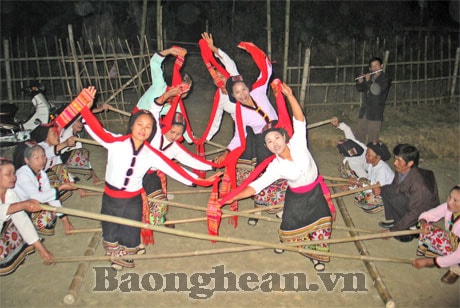
Thai folk song club in To village (Con Cuong).
The preservation and promotion of traditional folk music is part of the Party and State's major policy on safeguarding and promoting national cultural identity. In fact, in mountainous districts like Quy Hop, Con Cuong, and Tuong Duong, over the years, during festivals, the Department of Culture has organized arts competitions to encourage people to participate with self-composed and self-performed pieces based on their ethnic folk songs. Particularly at the ethnic cultural festivals in Quy Hop and Con Cuong, the Lam, Khap, Xuoi, and Nhuon folk songs of the Thai people, as well as the Tho folk songs, have been prominently featured by many performing arts groups. Local people have even established dozens of Thai folk song clubs and organized performances in various locations.
However, based on our observations at the Thai folk song clubs in Bản Tờ, Bản Nưa, Bản Xiềng (Con Cuông district), etc., we noticed that the majority of members are elderly, with very few young members. Therefore, when this generation passes away, it will be very difficult for the clubs to continue to thrive.
Mr. Nguyen Huy Chuong, Head of the Culture Department of Con Cuong District, said: “Preserving and promoting the value of traditional music of ethnic groups is an issue that needs the attention of all sectors and levels, as well as the government from the central to the local level. It's difficult if only the Culture Department is involved. Currently, we are proposing to the District People's Committee to draft a project to restore traditional cultural values in the area, including music. One of the things that needs to be done is to issue policies to encourage artisans and provide financial support for them to open classes to pass on their knowledge to local children. In the long term, the Education sector should organize additional classes on traditional music for students, helping them better understand the value and beauty of their ethnic folk melodies, so that they naturally develop a love for it rather than passively absorbing it.”
We went to meet Mr. Lo The Luc in Thach Ngan commune. Although over 80 years old, Mr. Luc is still quite sharp-minded. He said: “I can make four types of musical instruments: the la horn, the pi flute, the bamboo flute, and the khen be. Anyone who wants to learn, I'm willing to teach them, but no one has come to ask to learn yet.” Mr. Luc also expressed his concern that even his own children have gone away to work and none of them are willing to learn how to make musical instruments from him.
It is clear that the preservation and promotion of traditional folk music is extremely necessary today. Without appropriate policies and early implementation, the risk of the unique folk melodies of ethnic minorities disappearing is very real.
Hoang Hao


