
Lesson 6: The Identity of the Tujia People in Jiaxuan
(Baonghean) - The Tho ethnic group is a community that mainly lives in the mountainous districts of the Northwest of Nghean province...
(Baonghean) - The Tho ethnic group is a community living mainly in the mountainous northwestern districts of Nghe An province: Quy Hop, Nghia Dan, Thai Hoa, and Tan Ky... with a population of over 80,000 people. There are many different Tho subgroups: Keo, Mon, Cuoi... and among these groups, their languages also differ.
>>Lesson 5: The Dan Lai People in the Trend of Integration
The Tho people have many clans: Truong, Le, Nguyen, Lang, Tran, Dinh... Although there are many complex components, the Tho groups, with different names and living separately from each other, share fundamentally similar cultural characteristics and have preserved many of their identities to this day.
I visited Giai Xuan commune, the area with the largest population of the Tho ethnic minority in Tan Ky district, with over 5,500 people, accounting for more than 70% of the commune's total population. Mr. Nguyen Van Hanh, a long-time cultural officer of Giai Xuan commune and also a member of the Tho ethnic group, said: "You'll find very few documents about the Tho people, none at all. But if you're looking for information from people living there, you can find it right away. Ask me anything you want, and I'll try my best to answer."
It turns out that Mr. Hanh has been involved in the commune's cultural work for nearly 20 years, and has thoroughly researched the culture of his Tho ethnic group. According to him, the Tho ethnic people's villages are mainly concentrated in areas with water sources or streams, in clusters and according to clan groups. Like many other ethnic minorities, in the past, they mainly cultivated upland rice by poking holes to plant seeds, and a portion of paddy rice. The paddy fields were trampled by buffaloes, not plowed as they are now. The typical tool of the Tho people is the "cày nại" (cây nọn), similar to the split plow of the Kinh people. Next to the "cày nại" is a stick used to poke holes to plant seeds. Later, as society developed and they learned from other places, the Tho people also learned to cultivate paddy rice.
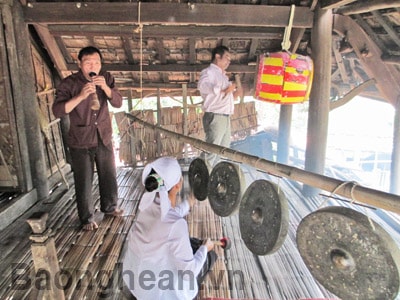
Many Tu people in Giai Xuan are still skilled at playing gongs, drums, and horns.
The Tho people are also famous for growing hemp and processing hemp products such as hammocks, hunting nets, and fishing nets. They trade these items for things they cannot produce themselves, mainly clothing, because the Tho people do not know how to weave cloth.
The Thổ people have a custom of "sleeping under the same roof." "Nowadays, many people think differently about the custom of sleeping under the same roof, but when I grew up, it was very innocent. Boys and girls would sleep together, talk to get to know each other, and the girl's parents would also facilitate it, giving them a separate room. From those nights of 'sleeping under the same roof,' they would decide on their life partner," Mr. Hạnh said.
The wedding customs of the Tho people involve many rituals such as the engagement ceremony, the proposal, the request for marriage, and the wedding procession. When the bride is brought through the gate of her husband's house, she must wash her feet before entering the house to perform the ancestral worship ceremony. The bride's attire on her wedding day must include a new hat and new sandals. Currently, many weddings have abandoned this custom, while some still maintain it.
The funeral customs of the Tho people in Giai Xuan used to have many unique features, the most special of which, according to Mr. Nguyen Van Hanh, was the Lang Bang dance when someone passed away. The Lang Bang dance began at midnight, with the coffin placed inside the house. The dance was performed by a troupe from the ward. It was like a reenactment of the deceased's entire life, from birth, growth, marriage, daily activities, etc. During the Lang Bang dance, there were horns, gongs, drums, and other instruments creating mournful, sorrowful, and moving sounds. No one present could watch the scenes or listen to the music without weeping. When someone in the village died, everyone would gather, each household bringing a chicken or a pig as an offering.
Over time, some time-consuming and expensive customs and festivals have been simplified by the people, retaining only the most important rituals. Many folk songs have been lost. The Tho people have also adopted clothing, costumes, and housing styles from the Kinh people for convenience. Many believe that these changes have led to the loss of the Tho ethnic identity, but upon interacting with the Tho people in Giai Xuan, one can see that they still possess unique characteristics that they are striving to preserve.
Traditional Tho folk songs and dances such as "du du dien dien," "tap tinh tap tang," and call-and-response singing have now been introduced into schools to teach children. In particular, call-and-response and courtship singing are performed by almost every Tho person in Giai Xuan, anywhere, as a form of greeting and conversation. Usually, during festivals and holidays, with the addition of music and gongs, people sing along to the rhythm.
I visited Mr. Truong Cong Yen (Bau Sen hamlet, Giai Xuan commune), a man who can play any musical instrument, from gongs and drums to horns... He said: "Here, from the 1st to the 7th day of Tet (Lunar New Year), it's very lively, with the sounds of gongs, horns, call-and-response singing, traditional games... all night long. People compete in games like swinging and throwing the ball... Children, thanks to holidays like these, imitate and learn the songs and traditional musical instruments of their ethnic group without needing anyone to teach them. I learned that way in the past, and now my children do too, it's just passed down orally."
The Tet (Lunar New Year) celebration of the Tho people is basically the same as that of the Kinh people. During Tet, they also hold ceremonies and feed cakes to their buffaloes and cows to thank them for their hard work throughout the year. The Tho people value the Ky Yen ceremony before sowing rice seedlings, the ceremony of going to the fields, the hunting ceremony, the new rice ceremony, etc. Associated with any production activity, the Tho people perform very thorough ceremonies to thank and pray to the gods for a bountiful harvest.
Text and photos: Ho Lai


