
Lesson 6: The Imprint of Emperor Quang Trung on Nghe An Province
Nghe An was not the site of the decisive battles that led to the victory of the Tay Son movement. However, in all their marches north, the Tay Son army stopped in Nghe An, and Quang Trung Nguyen Hue's choice of Phuong Hoang Mountain as the capital shows that he highly valued the land and people of this region.
(Baonghean)Nghe An was not the site of the decisive battles that led to the victory of the Tay Son movement. However, in all their marches north, the Tay Son army stopped in Nghe An, and Quang Trung Nguyen Hue's choice of Phuong Hoang Mountain as the capital shows that he highly valued the land and people of this region.
The ruins of Phuong Hoang Trung Do Citadel
According to some researchers, the ancestors of the three Tay Son brothers were originally from Thai Lao village (Hung Thai commune, Hung Nguyen district). Between 1655 and 1660, this family, originally the Ho family, followed Lord Nguyen to Tay Son hamlet in Phu Ly district, Quy Nhon prefecture (now Binh Dinh province) to reclaim and expand the land. Upon arriving, the Ho family changed their surname to Nguyen, and several generations later, the three brothers Nguyen Nhac, Nguyen Hue, and Nguyen Lu were born.
In 1771, Nguyen Nhac, along with his two brothers Nguyen Hue and Nguyen Lu, raised the banner of rebellion in Tay Son village. Within a short time, the Tay Son rebels took control of Dang Trong (Southern Vietnam). Subsequently, Nguyen Hue twice marched north, successively overthrowing the Trinh lords and the Le kings.
In 1788, Le Chieu Thong led 290,000 Qing troops to invade Northern Vietnam. Nguyen Hue ascended the throne as Emperor, adopting the reign name Quang Trung, establishing the Tay Son Dynasty, and swiftly led his army north to repel the invaders. Along the way, the Emperor stopped in Nghe An to recruit troops.
After defeating the Qing army, Quang Trung clearly recognized the strategic importance of Nghe An province and the loyalty of its people. Therefore, he entrusted Tran Thu Than and La Son Phu Tu Nguyen Thiep with the construction of Phuong Hoang Trung Do Citadel. The book "Hoang Le Nhat Thong Chi" writes: "King Quang Trung believed that Nghe An was located in the center of the country, with roads from the South and North being of equal length, and that his ancestors' homeland was there. He ordered the mobilization of many craftsmen to transport wood, stone, bricks, and tiles to build palaces and castles. He built earthen ramparts around the citadel and ordered soldiers to excavate laterite stone from the local area to build the inner citadel. He erected a three-story dragon tower, the Thai Hoa Palace, and two rows of corridors for use during court ceremonies. This citadel was called Phuong Hoang Trung Do or Trung Kinh Phuong Hoang Citadel." Just over a year later, on October 5th of the Year of the Rooster (November 21st, 1789), in a royal decree sent to La Son Phu Tu Nguyen Thiep, Nguyen Hue Quang Trung once again affirmed the construction of Phuong Hoang Trung Do to establish his capital in Nghe An: "I now establish my capital in Nghe An, close to you, sir. Later, please come and help me govern the country." According to surviving historical records, King Quang Trung worked at Phuong Hoang Trung Do at least twice. The first time, in May 1791, King Quang Trung led his troops from here to the upper reaches of Nghe An, crossing into Laos to fight the reactionary forces who were conspiring with Le Duy Chi's faction against the Tay Son dynasty. The second time, in January 1792, on his way back from fighting the enemy in the upper reaches of Nghe An, King Quang Trung stopped here.
Unfortunately, King Quang Trung died suddenly on July 29th, 1792 (the year of the Rat), before he could move the capital from Phu Xuan to Phuong Hoang Trung Do. Phuong Hoang Trung Do is a glorious testament to the cultural vision of Nguyen Hue Quang Trung in the process of fighting for national unification and building a peaceful, prosperous, and happy life for the Vietnamese people.
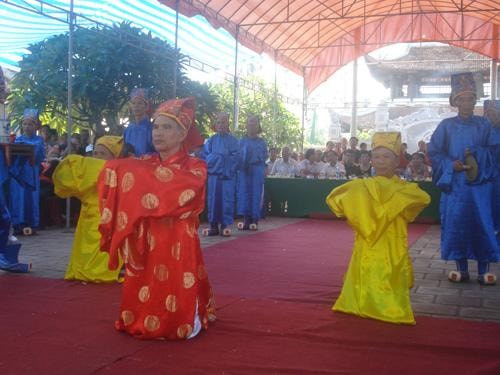
A grand ceremony is held at the Temple of King Quang Trung to commemorate the anniversary of his death.
The temple dedicated to King Quang Trung on Dung Quyet mountain.
From a peasant uprising that developed into a national movement, the most glorious victory of the Tay Son movement was the overthrow of the rule of reactionary feudal forces, the unification of the country, and the protection of national independence.
In accordance with the wishes of the people and to express gratitude to the "commoner" hero, on July 23, 2004, the People's Committee of Nghe An province issued a decision to build the Temple of King Quang Trung, located on the second peak of Dung Quyet mountain, 97 meters above sea level, in the sacred land where King Quang Trung chose to establish his capital more than 200 years ago. The entire temple is made of ironwood, with pathways, sidewalks, and courtyards creating a majestic, modern yet ancient appearance. The temple's truss system is of the "gong-shaped" type with overlapping beams, carved with motifs in the Nguyen dynasty style. The roof is covered with two layers of curved tiles: flat tiles and flat tiles. The floor is paved with antique Bat Trang tiles, restored from Ha Tay. The walls are built of Bat Trang bricks, and the doors and windows are of the "upper-panel, lower-panel" style. The temple has two entrances on either side, with the central outer gate (four-pillar gate) designed in a two-story, eight-roofed architectural style. Next is a four-pillar screen erected directly on the main axis, made of elaborately and beautifully carved stone. On either side of the screen are carved brocade seals, in the middle is a scroll with the two characters "Thọ Đế" (Longevity Emperor) inscribed. Above that is a dragon bowing to the moon, and at the bottom is a kneeling figure with a fish-like back, carved with tiger motifs. On either side stand two mythical creatures (Nghê), symbolizing guardians controlling the souls of those entering and leaving. Beyond the four-pillar screen are two stele houses facing each other, parallel to the main axis. Following these are the left and right side buildings. Beyond this area is the large main hall, also called the front hall, where preparations and arrangements are made before ceremonies. The front hall can be considered the center of the temple, designed in the style of Vietnamese folk architecture, consisting of three bays, two wings, and four rows of columns. The structure was inaugurated on May 7, 2008.
Every year, the Quang Trung Temple hosts important ceremonies such as the anniversary of King Quang Trung's death on the 29th day of the 7th lunar month; the 5th day of the 1st lunar month commemorating the victory at Ngoc Hoi - Dong Da; and the 1st day of the 10th lunar month commemorating the day King Quang Trung issued the decree to build Phuong Hoang Trung Do.
Tomb of La Son Phu Tu Nguyen Thiep
La Son Phu Tu Nguyen Thiep (1723-1804) was from Nguyet Ao village, La Son district (now Duc Tho district, Ha Tinh province). He was a distinguished Confucian scholar and an upright and diligent official during the reign of Emperor Quang Trung.
As the Director of the Sùng Chính Institute, Nguyễn Thiếp initiated cultural and educational reforms in Vietnam at the end of the 18th century. His greatest contribution was implementing Quang Trung's policy of revitalizing and promoting the Nôm script, making it the official writing system of Vietnam. At the court, he advocated using Nôm script in imperial decrees instead of Chinese characters. He and his colleagues at the Sùng Chính Institute diligently translated many important classical texts from Chinese into Nôm. La Sơn Phu Tử was also a highly influential educator. At the first Hương examination under Quang Trung's reign, held in Nghệ An in 1789, Nguyễn Thiếp was appointed Chief Examiner. In addition to the Sùng Chính Institute, Nguyễn Thiếp was entrusted by Emperor Quang Trung with an extremely important task: selecting a location for the new capital of the Tây Sơn dynasty in Nghệ An.
When La Son Phu Tu Nguyen Thiep passed away, the people and his descendants buried him at Bui Phong Mountain, Nam Kim commune, Nam Dan district. To promote the tradition of remembering one's roots and to educate the younger generation about historical and cultural values, the Ministry of Culture and Information has classified La Son Phu Tu Nguyen Thiep's tomb as a National-level historical site.
Currently, his tomb has been renovated and developed into a beautiful garden on Bui Phong mountain by the State and his family, with easy access roads, making it convenient for people and tourists to come and pay their respects to him – a highly talented and virtuous scholar with a brilliant spirit, a prime example of Vietnamese character. Every year, during holidays, Tet (Lunar New Year), and the anniversary of his death, his descendants and local people organize solemn and thoughtful ceremonies.
Along with other landmarks, the tomb of La Son Phu Tu Nguyen Thiep is one of the important historical and cultural relics located in a spiritual destination for tourists from inside and outside the province.
Dai Tue Pagoda on Dai Hue Mountain
Emperor Quang Trung once ordered his troops to cross Dai Hue Mountain and rest on its summit during the final days of 1788, before marching north to defeat 290,000 Qing troops. Legend says that he visited Dai Tue Pagoda to offer incense, and the monks there guided him on the fastest route through Nghe An province to reach the North.
Upon returning victorious from the Qing invasion, he granted 20 acres of rice fields in what is now Nam Anh commune (Nam Dan district) to Dai Tue Pagoda. These fields were cultivated by monks, Buddhist followers, and local people to help the pagoda. Thus, from the time of Emperor Quang Trung's reign, Dai Tue Pagoda had a close relationship with the Tay Son Dynasty.
Dai Tue Pagoda is an ancient temple built in the 14th century to worship Buddha, located on Dai Hue Mountain in Nam Anh commune, Nam Dan district. Legend says the pagoda is over 600 years old and has long been a majestic and sacred spiritual space, not only for Nghe An province but also for the whole country. The pagoda sits on a 600m2 plot of land at an altitude of over 450m above sea level, in a tranquil setting with picturesque and charming scenery.
Over the course of hundreds of years, amidst numerous historical and natural events, Dai Tue Pagoda has become a ruin, with its ritual objects lost or scattered. Currently, the remaining traces of the pagoda are three brick statues, 2.2 meters high and 0.5 meters thick, surrounded by a stone embankment approximately 20 meters wide and 30 meters long. To the east is a tomb made of stone, about 1 meter high, which the locals believe to be the tomb of King Canh Thinh. About 50 meters to the northeast of the pagoda is a stone-lined well used for religious ceremonies. More than 10 years ago, local people voluntarily contributed to restoring a small building on the site of the old pagoda. The 4th Military Region Command and several businesses contributed to building a road from the foot of the mountain to the historical site, making it easier for people, Buddhists, and tourists to visit the pagoda.
To preserve and promote a valuable historical and cultural relic, and to meet the spiritual and cultural needs of Buddhists and the people in the region, the Provincial Party Committee and the Provincial People's Committee agreed to the restoration of Dai Tue Pagoda. In early October 2009, the Department of Culture, Sports and Tourism organized a scientific seminar on "Restoring Dai Tue Pagoda" with the aim of clarifying the origin, content, architecture, landscape, culture, and current state of Dai Tue Pagoda. In April 2010, representatives of the Central Committee of the Vietnam Buddhist Association presented the Decision appointing Venerable Thich Tho Lac as the abbot of Dai Tue Pagoda and announced the Provincial People's Committee's Decision on the restoration of Dai Tue Pagoda. The upcoming restoration of Dai Tue Pagoda is of great significance in preserving and promoting national cultural heritage, fulfilling the aspirations of the people for Buddhist worship, virtuous conduct, and spiritual and cultural activities. It will also create a beautiful architectural and spiritual landmark, connected to the scenic Dai Hue Mountain and the tomb of Mrs. Hoang Thi Loan, to serve domestic and international tourists.
In Nghe An province, besides Phuong Hoang Trung Do, the tomb of La Son Phu Tu Nguyen Thiep, and Dai Tue Pagoda, there are also royal decrees from Emperor Quang Trung to Dau Yen and Dau Kham, two uncle and nephew from Yen Dung Ha village, Yen Truong commune, Hung Nguyen prefecture (now Ben Thuy and Trung Do wards, Vinh City); the family of Mr. Le Quoc Co in upper Anh Son district (formerly Quan Lang commune, now Tuong Son commune, Anh Son); Ho Phi Tu in Quynh Hong, Quynh Luu; Nguyen Sy Xung in Thanh Luong, Thanh Chuong; Dao Dinh Truat in Luu Son, Do Luong; and Tran Suat in An Hoa, Quynh Luu. All these decrees are carefully preserved in their ancestral temples. Dau Yen and Dau Kham are honored with a Tam Toa temple built by the people of Yen Dung Ha village, where they are worshipped day and night. Every year, on the 15th day of the first lunar month, on the anniversary of Dau Yen and Dau Kham's death, the people hold a very solemn ceremony to remember the two uncle and nephew who brought glory to their homeland and country. |
Thanh Thuy


