
Lesson 7: The Tomb and the Shrine
(Baonghean) - The unique wedding customs have created distinctive cultural features of the Hmong people in western Nghe An. However, in some articles we have mentioned when researching the cultural identity of the Hmong people, we have noted that they believe that a person has both a soul and a body. The soul is most clearly manifested when a person dies. Therefore, they have flutes, paper offerings, or ceremonial scrolls used in the worship of the deceased.
The funeral of Mr. Pà Dênh
One May afternoon, we received a phone call from Mr. Va Chay Xa (the blacksmith from Lien Son village, Nam Can commune, whom we introduced in a previous issue) saying, "My father's father has passed away." Mr. Chay Xa was referring to Mr. Va Pa Denh, who lived to be nearly a hundred years old. We hurried through the scorching sun to light an incense stick for Mr. Pa Denh.
Upon arriving at Lien Son village, we saw people from all the surrounding villages coming to pay their respects to the deceased. Everyone was saying that Mr. Pa Denh was one of the oldest people in the commune. He was nearly a hundred years old, and his passing was like that of a tree; too old, it must wither. Inside the house, beside the coffin, his children and grandchildren wept for him. Mr. Xong Ga Sau was playing the "Cho Chia" flute to send the soul of the deceased to the afterlife. The deep, resonant sound of the flute mingled with the sobbing and lamenting, chilling the hearts of those who came to pay their respects.
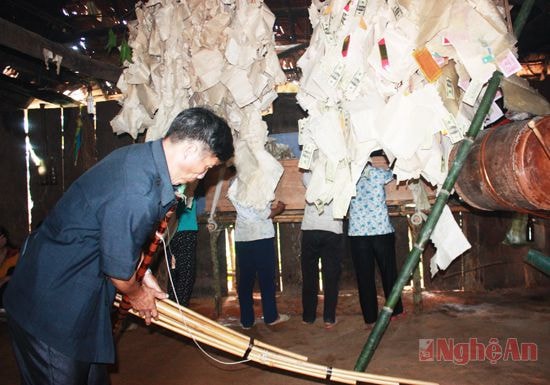 |
| The funeral of Mr. Va Pa Denh (Lien Son Village - Nam Can). |
Mr. Lau Ba Cha from Nam Khien village told us: "In the old days, the Hmong people used to leave the deceased lying in the middle of the house for several days, choosing an auspicious day to put them in a coffin and bury them. Now, with the implementation of a new cultural life, the deceased are placed in a coffin immediately after death, at the latest not leaving them past the second day before burial." The coffin of Mr. Pa Denh was placed right in front of the family altar, propped up on two chairs about a meter above the ground so that visitors could easily light incense at the coffin. In front were numerous handmade paper offerings hung densely on both sides, according to the traditional customs of the Hmong people.
Curious, I asked Mr. Lau Ba Cha: "In the past, when visiting the deceased, the Hmong people used to place a bowl of rice next to the body so that visitors could take a small handful, dip it in the deceased's mouth, and eat it?" Mr. Cha replied: "Yes, I heard the elders say that in the past. This also stemmed from the belief that the deceased would be well-fed after going to the afterlife. But now the Hmong people have a higher level of understanding, and no one practices that custom anymore."
Outside, the young men of Lien Son village were butchering a large pig to offer to the deceased. Lau Ba Cha explained that for the Hmong people, a pig must always be slaughtered for the deceased. After the pig is prepared, a flute melody is played to signal the offering to the deceased. Only when the shaman declares that the deceased has received the pig can everyone eat. The flute is only played while the deceased is inside the house; once the body has left, it is no longer played.
The following day, the funeral of Mr. Pà Dênh was held. He was buried on a hill about a kilometer from his house. Along the way, we noticed many Hmong graves, some made of stone, others beautifully constructed. After traveling about 300 meters, the procession stopped beside a small hut. Seeing our curiosity, an elderly man accompanying us explained that it was a hut for the deceased, erected the day before. Here, the funeral procession performed some rituals and then continued on to the burial site. The burial also took place quickly so that the deceased could rest in peace. Mr. Dênh's grave was filled with earth level with the ground, topped with a raised stone mound, like many other graves.
The hut and the stone tombs
The story revolves around the funeral of Mr. Va Pa Denh. We were curious because we noticed some customs that were different from the funerals of other ethnic groups in western Nghe An, especially the stone tombs and the hut in the middle of the road used to worship the deceased. To find out the underlying reasons for this, we went to Nam Khien village to meet the village elder, Lau Xai Phia.
Through the story, village elder Lầu Xái Phia explained that the stone tombs of the Hmong people originated from a war between the Han and Hmong people centuries ago. At that time, the Hmong were defeated and fled across the border between Vietnam and Laos because the Han used roosters to exchange for all their crossbow triggers. The Han pursued them relentlessly, killing anyone they encountered. Those Hmong who were still fully clothed were killed and stripped naked by the Han. Some were luckier because they were poor and wore ragged clothes, so their clothes were not taken when they were killed. Therefore, nowadays, in Hmong funerals, when placing the deceased in the coffin, people often cut off all their clothes with knives and scissors so that when they reach the afterlife ("Tủa sò") and meet the Han, they can say, "I was a poor person, I didn't have enough to eat, my clothes were ragged," thus preventing the Han from disturbing them and ensuring the soul's peace.
Also related to this story, Mr. Lau Xai Phia recounted that: On the way to the border between Vietnam and Laos, countless Hmong people died. During the pursuit, the Han Chinese encountered earthen graves. Recognizing them as Hmong graves, they dug them up and exposed the bodies to the rain and sun. To avoid this, the Hmong devised a way to build graves similar to those of the Han Chinese, using stones to construct them. Seeing these stone graves, the Han Chinese assumed they belonged to their own people and stopped digging. The custom of placing stones on graves continues to this day.
From China to the "Tua La Chua Gua" mountain range, on the Vietnam-China border, the Hmong people encountered high mountains, a cold climate, and many thorny insects. Without sandals, the Hmong could not cross this mountain range. So they took flax bark, stripped it into fibers, and wove them into sandals. These flax sandals helped the Hmong penetrate deep into Vietnam and Laos. Since then, when Hmong people die, whether old or young, male or female, they weave sandals from flax bark so that their souls can cross the "Tua La Chua Gua" mountain range to return to their ancestors in "Tua So".
The shaman Lầu Vả Tu in Nậm Khiên village told us the story behind the roadside shrines for the dead as follows: Long ago, there was a Hmong family with two children, a son and a daughter. The son stayed home to care for his parents in their old age, while his daughter married and moved far away. Unfortunately, the older brother fell ill and died young. Relatives, grieving, sent someone to inform his sister of the sad news. But by the fifth day, the sister had not returned to bid farewell to her brother, so they had to bury him. Midway through the funeral procession, the sister arrived just in time. Overwhelmed with grief at not being able to see her brother one last time, she earnestly begged her parents to stop so she could see him one last time. Out of love for their daughter, the parents built a small shrine so the siblings could meet. There, they slaughtered buffalo and cattle to eat before taking the deceased to the grave. The custom of building a shrine in the middle of the road to worship the dead has persisted to this day.
Thus, the funeral customs of the Hmong people originate from their struggles for survival during their migration from China to Vietnam. It clearly reflects the unique cultural identity of the Hmong people in western Nghe An province, from the time they settled there to the present day.
Dao Tho - Huu Vi
| RELATED NEWS |
|---|


