
Final article: The tamarind and a beautiful memory
(Baonghean) - People in the lowlands hide money and valuables in chests, boxes, and safes to prevent theft. The Thai people also have a device for hiding valuables that is not as sturdy as a safe. That is the "ca bem"...
NThe Thai people call it a "ca bem," a woven utensil. It's usually cylindrical, with a square base and a lid, woven from bamboo or rattan. Outwardly, the ca bem resembles a basket, but its function is completely different. A basket is carried on a woman's back when she goes to the fields or farms. The ca bem, however, is kept in a secluded room, only to hold what the highlanders consider most valuable. In the past, this included fabrics, dresses, even silver ingots, gold, or jewelry...
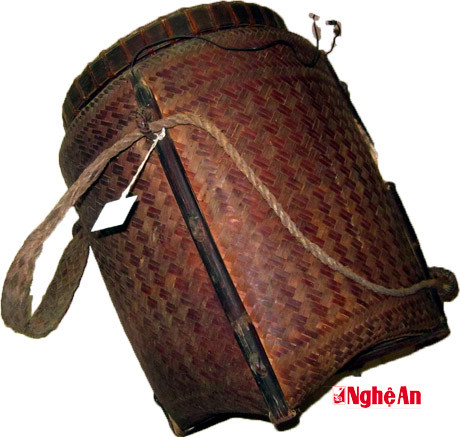 |
| The "cum," another form of cà bèm, is on display at the Museum of Ethnic Groups of Northwest Nghe An. |
| RELATED NEWS |
|---|
Mr. Lo Xuan Hoa, now over 60 years old, seemed surprised when we asked about the "ca bem" (a type of traditional Vietnamese chest), but then he happily nodded and said, "That's right, the press should learn more about mountain culture so that more people know about it." He added that for many years, people have been using chests, suitcases, and briefcases, seemingly forgetting about the "ca bem."
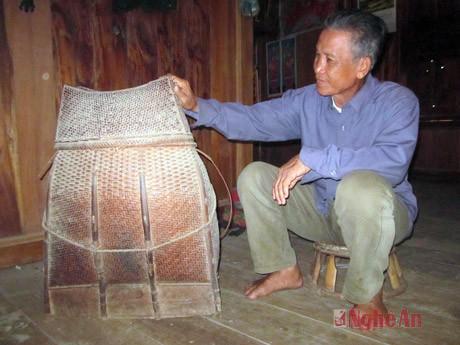 |
| Mr. Lo Xuan Hoa next to his betel nut container. |
After happily opening the room and bringing out the bamboo basket to place in the middle of the house, he recounted: Fifty years ago, when he was just 17 years old, he chose a girl he liked, so he went home to ask his parents to choose someone to be his matchmaker. On the wedding day, one of the indispensable gifts was cloth and silver coins, all of which had to be put into the bamboo basket and carried on his back. At that time, there were no bamboo baskets at home, so he had to go to the Khmu village to buy one. The bamboo basket has two layers, the inner layer made of bamboo strips, and the outer layer made of woven rattan. Because of this meticulous craftsmanship, and because it was only kept indoors, the bamboo basket, even after half a century, is still very sturdy.
According to Mr. Lo Xuan Hoa, nowadays, no one in Ban Ve village, like many other villages, makes these "ca bem" (a type of woven bamboo pouch) anymore. The reason is simple: no one needs to buy them anymore. For many families, it's just a superfluous item. Valuable items like money and jewelry are carefully stored in chests, boxes, or even safes. Life has changed a lot these days; the "ca bem" is no longer a safe place to hide valuables!
In Mong 1 village, near the center of Cam Muon commune (Que Phong district), some people still know how to make baskets. However, this is only to serve the needs of elderly people who appreciate traditional items. According to Mr. Lang Van Cuong, one of the skilled basket weavers, there are two forms of baskets: one with a round lid like a winnowing tray, called a cum; and another with a tetrahedral lid (as seen at Mr. Lo Xuan Hoa's house). In some villages in Con Cuong, there used to be box-shaped baskets with square lids and legs made of rattan. These are different forms of baskets, but they are all used to store fabrics and family treasures.
Regarding this item, in Mon Son commune, the revolutionary homeland of western Nghe An province, a story is still passed down: The bamboo basket was once used to hide Party leaflets. In 1931, while the first Party cell of western Nghe An, led by Secretary Vi Van Khang, was holding a secret meeting at the house of Vi Van Lam, they were discovered. The revolutionary fighters hastily retreated into the forest to avoid capture by the village chiefs and district heads. In the rush, without time to take the leaflets with them, Mrs. Vi Thi Lan (Mr. Lam's wife) quickly hid the Party documents in the bamboo basket in the house. When the enemy withdrew, she returned the leaflets to the revolutionary fighters.
Like many other items, the "ca bem" (a type of basket) has almost disappeared from the lives of the highland villages. For many households, it is now just a superfluous item. It will likely only exist in museums, such as the Museum of Ethnic Groups of Northwest Nghe An (Tan Lac town - Quy Chau). Here, the "ca bem" is displayed alongside other baskets. While its appearance is somewhat similar to a basket, it is actually used for different purposes.
Ha Phuong


