
Final article: Practical solutions are needed.
In his series of articles on "Ensuring Farmers' Interests in Agricultural Production," author Doan Tri Tue specifically addressed the issue of farmers' interests in agricultural production and the causes leading to this situation. However, to ensure food security and social welfare, people's commitment to farming is unavoidable. The question is what solutions we need to improve the economic efficiency of agricultural production and enhance farmers' lives in a concrete and practical way.
(Baonghean)In his series of articles on "Ensuring Farmers' Interests in Agricultural Production," author Doan Tri Tue specifically addressed the issue of farmers' interests in agricultural production and the causes leading to this situation. However, to ensure food security and social welfare, people's commitment to farming is unavoidable. The question is what solutions we need to improve the economic efficiency of agricultural production and enhance farmers' lives in a concrete and practical way.
Currently, Nghe An province has 105,000 hectares of rice-growing land, with a total annual output of over 900,000 tons. However, in recent years, hybrid rice has consistently accounted for over 70% of the crop structure. For example, in the spring of 2012, hybrid rice accounted for 73% of the area, of which only about 1,000 hectares (nearly 2%) were high-yielding, relatively high-quality rice varieties such as the GS9 three-line hybrid, THB71, Bio 404, Nghi Huong 2308, etc. In the spring of 2013, despite efforts to introduce high-quality rice varieties to meet market demand, the area of high-quality rice only increased to nearly 20,000 hectares, achieving an output of about 50,000 tons. This was not even enough to meet the province's domestic consumption needs, let alone to generate additional income.
While low-quality hybrid rice varieties have been both cheap and difficult to sell in recent years, high-quality rice varieties are experiencing the opposite trend. Even now, the export prices of various types of Vietnamese white rice have increased rapidly, with high-quality rice being the most impressive. Customers from China and Africa are primarily buying high-quality rice, while the price of similar rice from Thailand remains quite high. Despite the ongoing downward trend in the global rice market and weak, slow demand, Vietnamese rice, especially fragrant and high-quality rice, still has opportunities.
It is evident that high-quality rice varieties are enjoying a good market, both for export and domestic consumption. Therefore, to increase the economic efficiency of rice cultivation and improve farmers' income, we first need to consider market demand to determine appropriate production methods and variety changes.
Furthermore, it is necessary to consider synchronized solutions to reduce rice production costs, such as land consolidation to create larger areas, facilitating the formation of specialized high-quality rice cultivation zones, and introducing mechanization into production to reduce labor costs, while simultaneously creating a large volume of marketable products and facilitating the "output" of agricultural products. Post-harvest solutions such as preservation and processing also need to be given importance, helping our rice products "value" better in the market.
Mr. Tu Trong Kim, Head of the Crop Production Department of the Department of Agriculture and Rural Development, said: Currently, the province's policy is to plan concentrated areas covering over 30% of the total rice-growing area to develop high-quality rice varieties to meet the increasing demand of domestic consumers and for export. The key areas are expected to be located in the districts of Yen Thanh, Dien Chau, Quynh Luu, Hung Nguyen, Nam Dan, and Do Luong.
To improve sugarcane cultivation, a comprehensive set of solutions is needed. In reality, many farmers still don't prioritize investing in proper care to achieve high yields. In many areas, farmers leave sugarcane ratoons for too long, neglecting weeding, leaf stripping, and adequate fertilization, resulting in low yields.
Besides introducing new high-yielding varieties into production, it is necessary to advise farmers to implement good care measures to improve sugarcane productivity. The province also intends to direct investment in intensive cultivation from the outset, combined with gradually reducing the area of sugarcane on hilly land to achieve a yield target of 700-750 quintals/hectare in 2015 and 800 quintals/hectare in 2020. At the same time, it will allocate appropriate capital to build irrigation works for sugarcane, striving to have about 10-15% of the sugarcane area irrigated by 2015, corresponding to about 4,000 hectares, in order to increase sugarcane productivity.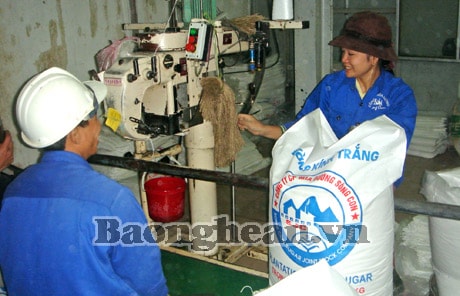
Production line at Song Con Sugar Company. Photo: Cong Sang.
Along with those measures, addressing the "output" of sugarcane remains a concern for farmers. The planted area is always calculated to match the capacity of the factories located in the area, such as Tate & Lyle, Song Lam Sugar Factory, and Song Con Sugar Factory, striving to avoid surplus raw materials and implementing measures to ensure a harmonious balance of interests between sugarcane growers and factories. To encourage farmers to remain committed to sugarcane cultivation in the long term, sugar factories need to offer reasonable purchase prices in line with the national average and distribute profits fairly between the factories and farmers.
At the same time, it is necessary to implement policies to support and insure farmers in case of crop failure due to natural disasters. Continue to effectively implement policies supporting sugarcane growers, and invest in research and selection of new, superior sugarcane varieties to gradually replace older ones.
Despite having a long tradition of livestock farming, our province's livestock production is mostly small-scale, lacking industrial scale and concentration, making it difficult to improve efficiency and prevent disease outbreaks.
According to Mr. Luu Cong Hoa (Head of the Livestock Department - Department of Agriculture and Rural Development), Nghe An province is gradually shifting from small-scale, fragmented livestock farming to medium and large-scale, industrial-scale concentrated farming; ensuring veterinary hygiene, food safety, and environmental protection; creating high productivity, quality, and economic efficiency, sufficient to compete in the domestic and regional markets. This involves combining household livestock farming with investment in breeding techniques, feed, and biogas digesters to treat waste, ensuring environmental hygiene, controlling diseases in household livestock farming, thereby creating jobs, increasing income, and contributing to poverty reduction in rural areas.
With the goal of reaching a total pig population of 1,600,000 by 2015 and an output of 230,000 tons of live pig meat for slaughter, we need appropriate solutions. First and foremost, we must focus on breeding and breed management, ensuring the availability of good, standard-compliant pig breeds to help farmers achieve real efficiency.
In reality, the prices of animal feed are currently too high, raising production costs and affecting people's incomes. It is necessary to develop more animal feed processing businesses right in the area, producing feed locally. At the same time, expand the area for growing corn and soybeans in the winter and spring/summer seasons with new, high-yield, high-quality varieties in areas along the Lam River and in the districts of Do Luong, Anh Son, Tan Ky, and Nghia Dan to address the main local raw material needs and lower production costs.
In particular, it is necessary to strengthen state management of animal feed to ensure the rights of the people. Along with strengthening veterinary work, the farm system must ensure the growth and development of the pig herd, facilitate management, and implement biosecurity measures.
In particular, appropriate solutions are needed to build new facilities and upgrade and strengthen the infrastructure of some centralized livestock slaughterhouses to enable proactive and efficient consumption of pork through export and supermarket sales. A strong linkage should be established between the five stakeholders (breeding stock suppliers, feed suppliers, livestock farmers, traders, and scientists), with a focus on the role of state management.
Phu Huong


