
Final article: We need to invest in exploiting our potential and strengths.
The potential for economic development in the coastal area (Quynh Luu district) has been identified in three key areas: vegetable production, seafood fishing, shrimp farming, and coastal tourism… To date, only two areas have shown clear development: seafood fishing and intensive vegetable cultivation... -->> Article 2: Clinging to the Sea - Coastal Tourism in Quynh Luu Remains Untapped
Quynh Beach tourism remains undeveloped.
Quynh Luu boasts 34 km of coastline, including many beautiful beaches in the coastal area: Quynh Phuong, Quynh Lien, Quynh Bang, Quynh Minh, Quynh Lap, and Quynh Nghia. These long, smooth stretches of sand are considered among the most beautiful beaches in Northern Vietnam. Besides swimming, visitors to Quynh Luu can enjoy unique seafood dishes such as shrimp, crab, and dried fish, as well as traditional fish sauce production.
Furthermore, in Quynh Phuong commune, there is the famous and sacred Corn Temple, which hosts many festivals and entertainment activities every year, attracting many people. Although Quynh Beach has shown signs of improvement, the local authorities have not yet focused on investing in attracting tourists. When we arrived, the leaders of Quynh Bang and Quynh Minh communes introduced us to the potential of beach tourism. Late in the afternoon on a scorching hot day, posing as tourists, we arrived at Quynh Bang beach. There were dozens of service establishments, but the services seemed rather poor. The beach itself was quite beautiful, with a wide, smooth sandy beach and clear water. According to the people of Quynh Bang, most visitors were locals; very few stayed overnight.
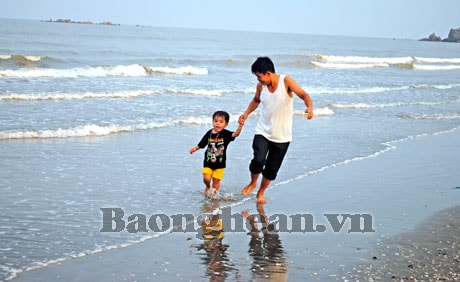
Quynh Bang beach remains deserted of tourists.
In general, based on our observations, all the beaches here are largely unspoiled, lacking significant investment in infrastructure and services from local authorities and relevant agencies. Therefore, they are not yet attractive enough to draw tourists. This means that Quynh Luu has not yet fully exploited its existing tourism potential. Even the transportation network from National Highway 1 to the coastal areas and the coastal road serving tourism is not yet well-developed. Provincial Road 537B, running along the coastal area and serving the beaches, is the main route connecting the beaches, but many sections are dilapidated, narrow, and difficult to navigate. Currently, the government is investing in the construction of a coastal dike connecting An Hoa commune to the end of the coastal area. Once completed, this dike, in addition to flood control, will also serve the Quynh Luu coastal tourism industry.
Investing in vegetable growing areas
For the coastal area, although it is a high-lying region, the pressing issue is flood control, not drought, unlike other areas. This is because it is bordered by the Mai Giang River on one side and the coastline on the other. During floods and storms, the river water on the inside and the rising sea level on the outside can easily cause crop crops to be submerged for 2-3 days. However, unlike other localities, the soil in this coastal area is sandy loam; after the water recedes, the soil quickly returns to a dry, loose state, allowing for immediate vegetable cultivation. Therefore, a flood control system for the crop area is a crucial issue for the coastal region, the largest vegetable production center in the area. Each year, this region produces over 30,000 tons of various vegetables, supplying markets both within and outside the province.
People in the coastal areas of Vietnam have long observed that years with heavy rain and storms tend to see high vegetable prices, while years with little rain and storms result in low prices, or even unsold produce. The reason is that the soil in these areas is not sandy, so it takes time after floods and inundation to prepare the land for planting. Meanwhile, the people of the coastal areas take advantage of this favorable soil, seizing the opportunity to intensively cultivate vegetables and transport them to flood-affected areas for supply. This inevitably drives up vegetable prices, leading to substantial profits for many families, especially those involved in the vegetable service industry. That's the nature of vegetable farming; today it's unsold, tomorrow it's incredibly expensive. But for those in the agricultural sector, perhaps few rural areas offer as high an income as the coastal vegetable growing region. On average, one hectare of vegetables yields an income of 170 million VND per year.
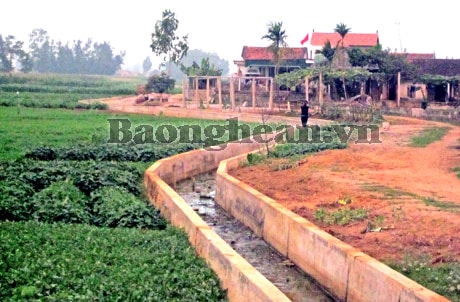
The flood control canal system was built using funds from government bonds.
Taking advantage of the strengths and aspirations of the people, in 2011, the Government decided to invest 100 billion VND from bond sources to build a main drainage canal system for the coastal area. Mr. Ho Nghia Dung – Vice Chairman of the People's Committee of Quynh Bang commune – said that the locality received 20 billion VND from the project to build 13 km of main drainage canals in the area. To date, the locality has basically completed the project, serving to drain water from 700 hectares of cultivated land in the locality and some areas of Quynh Lien commune. This main drainage canal system is built according to a design with concrete and steel reinforcement poured directly from the bottom to the sides, with widths ranging from 60cm to 2m in some places. When draining water, this main canal system partly drains into the Mai Giang River and partly directly into the sea. However, to drain water quickly and effectively, a system of branch canals is needed to connect to this main canal. Therefore, Quynh Bang is re-surveying the entire system of branch canals in the fields to develop a plan for investment and construction, using contributions from the local people.
Mr. Nguyen Xuan Dinh, Head of the Agriculture and Rural Development Department of the district, said: With this 100 billion VND capital, Quynh Luu district has designed and built nearly 50 km of main drainage canals for the coastal area. It is known that the government also plans to continue investing in the construction of a drainage and irrigation network for this region in the near future.
One persistent problem in the coastal area is the difficulty in land consolidation and reallocation. Quynh Luong commune is a center for vegetable production, with the highest level of intensive farming expertise among its residents. Mr. Ho Canh Sau, Chairman of the Commune People's Committee, stated: "The biggest difficulty for vegetable growers is the fragmentation of land. According to Decree 64, the average land allocation per worker in the locality is 330m2, but each family currently owns at least 2 plots, with some households owning 5 plots. On average, each household in the commune is allocated 4.2 plots of land. This fragmentation significantly impacts several aspects of intensive vegetable farming. Firstly, each family has to invest in drilling and digging multiple wells (one well per plot) to obtain water for irrigating the vegetables. Secondly, it affects the care, harvesting, and intensive cultivation of vegetables for multiple harvests." According to Mr. Sau, land consolidation and reallocation are very important for the intensive vegetable farming area of Bai Ngang, so people need to be clearly aware of this.
Shrimp farming is also a strength of several communes in the coastal area, with Quynh Bang commune being the most prominent. People here have been raising shrimp since 1992, with the strongest growth since 2002. They have shifted to intensive farming, and the shrimp farming area in Quynh Bang has now expanded to 185 hectares. To raise shrimp, people have to invest a lot of capital in digging ponds, buying fry, and purchasing equipment… And if everything goes smoothly, the profits from shrimp farming are very large. Many households here have become "millionaires" thanks to shrimp.
However, the biggest drawback for the shrimp farming area is the insufficient power supply. One hectare of shrimp pond requires eight aeration machines, meaning Quynh Bang currently has over 1,000 aeration machines. Shrimp farming typically involves simultaneous aeration, so even with eight transformer stations (4,000 KVA), the demand is still insufficient. Currently, Quynh Bang needs at least ten transformer stations of the same capacity to adequately meet the electricity needs for shrimp farming...
The coastal region possesses strengths that are favorable for diversified economic development and are being exploited by the local people. However, to exploit these strengths effectively, investment from the state is needed, especially in the marine tourism industry, a readily available potential of the locality.
Xuan Hoang


