
Final article: The need to strengthen inspection and supervision.
The purpose of mobilizing social resources in the field of education is clearly stated: to serve the students, and the children of their parents. Therefore, building trust and confidence among parents is crucial. The most important issue is ensuring that expenditures are used for the intended purpose, directly serving the students' learning, in order to build trust with parents.
Although at the beginning of the school year, the Ministry of Education and Training and the Department of Education and Training issued a document guiding the collection and expenditure of funds in schools, including specific regulations on the use of socialized resources, there has been no supervision from the education sector regarding how these regulations are implemented in practice.
Mr. Nguyen Trong Hoan, Deputy Chief of the Office of the Department of Education and Training, acknowledged: “The inspection of fees collected at the beginning of the 2012-2013 school year has not been carried out. Furthermore, inspections are only conducted on a probabilistic basis at a few schools, and it's impossible to inspect 100% of the units...”. Therefore, along with issuing guidelines and regulations, it is necessary to have strict supervision and increased inspections. In particular, it is noteworthy that after inspections, there must be a clear mechanism for handling violations, avoiding the situation of “starting something and then abandoning it,” and ensuring that disciplinary actions are not strict enough and lack deterrent effect.
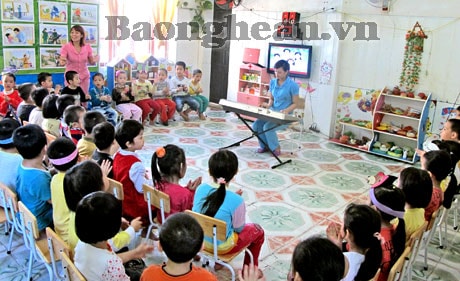
A music lesson for students at Cua Nam Kindergarten (Vinh City).
In the 2011-2012 school year, an inspection revealed that 31 schools were violating regulations (including 8 kindergartens, 9 primary schools, 9 junior high schools, and 5 high schools). Accordingly, the Director of the Nghe An Department of Education and Training requested that the violating units refund the improperly collected fees to students and parents; conduct self-criticism and reprimand the principals of the schools involved; and seriously review and propose appropriate disciplinary action against units with major violations. However, in reality, only a few schools seriously and promptly complied with the Director's conclusions, while the rest ignored them. This is one of the reasons for the excessive fees and expenditures in schools.
Socialization in education aims to mobilize resources to invest in the "nurturing of human potential." However, data on social mobilization in schools shows that the revenue from social mobilization is being heavily borne by parents and divided equally among students, failing to attract the contributions of philanthropists, or only receiving very limited support. Therefore, many parents suggest reverting to the old system of contributions. Many education administrators also believe that currently, mobilizing social resources is extremely difficult for teachers and schools, and carelessness can easily lead to negative publicity.
Therefore, perhaps a minimum contribution to school infrastructure development should be set at the beginning of the school year for all parents, while also focusing on businesses, philanthropists, and parents with the means to solicit additional contributions. Mr. Thai Khac Tan, Head of the Education and Training Department of Vinh City, shared: “My personal opinion is that it is best to revert to the previous regulation requiring students at each educational level to contribute to the school construction fund. If that is not possible and we still have to continue with the social mobilization of education, then we should follow two approaches: for parents, a minimum contribution amount should be set for each individual; on the other hand, each school should have its own way of mobilizing and attracting investment resources from philanthropists and other sources besides parents.”
Another point to note is that currently, schools focus primarily on mobilizing cash contributions, neglecting the mobilization of labor and in-kind donations, thus failing to attract resources from social organizations. For schools located in disadvantaged areas where the living standards of the people are low, mobilizing labor and material contributions would be more effective and receive more positive support from the local population.
It is known that the Provincial People's Council recently issued Resolution No. 76/NQ-HĐND on the development of a monitoring program for 2013, which includes monitoring the socialization of education in public schools. Ms. Ton Thi Cam Ha, Deputy Head of the Culture and Social Affairs Committee of the Provincial People's Council, stated: “The monitoring of the socialization of education may be carried out in the first quarter of 2013. Based on that, the Committee will work with the Department of Education and Training and relevant sectors to develop solutions for the 2013-2014 school year, resolutely addressing the issue of excessive fees and expenditures in schools; at the same time, it will require all levels and sectors to strengthen the inspection of school revenue and expenditure, ensuring that the socialization of education movement stays on track, contributing to improving school facilities and creating better conditions for students' learning and living.”
Thanh Phuc


