
Final article: Leveraging the advantages of each production region.
(Baonghean)Over the years, agricultural production in our province has undergone fundamental changes, creating a large volume of agricultural commodities. However, reality presents significant challenges in ensuring a stable market for farmers.
In recent years, our province has developed many important projects on economic restructuring in agriculture, especially identifying development plans for industrial crops to serve as a basis for investment and development. As a result, there have been clear shifts in the structure of the crop production sector… And especially, it has created fundamental changes in the mindset of farmers and local authorities, guiding them to focus on commodity production and gradually abandon the previous small-scale, opportunistic farming and livestock practices.
According to Mr. Ho Ngoc Sy, Director of the Department of Agriculture and Rural Development: Within the sector, there have been positive shifts, gradually reducing the proportion of crop cultivation and increasing the proportion of livestock and service industries. The crop cultivation sector itself has undergone fundamental changes. While agricultural land increased by over 568 hectares between 2000 and 2005, it decreased by nearly 300 hectares by 2009, with significant reductions in agricultural and forestry land, and increases in aquaculture, pasture, and perennial crop cultivation. It is noteworthy that the area planted with food crops has increased only slightly, and rice cultivation has decreased, but grain production has continuously increased in recent years, thanks to the rapid growth of hybrid rice and hybrid corn in all regions of the province. "Over the next five years, we aim to reduce rice paddy land by over 20,000 hectares, focusing on intensive cultivation of high-quality rice, while still ensuring an annual food production target of over 1 million tons by improving the uniformity among localities in terms of intensive farming techniques, new varieties, and productivity," Mr. Sy said.
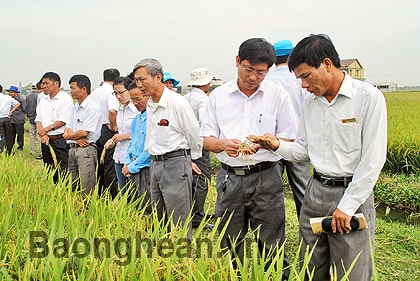
Field workshop on new rice varieties in Dien Thai commune (Dien Chau).
Along with rice, other crops have also achieved significant results in the restructuring of crop varieties and the level of intensive farming. Recognizing advantages such as land, water resources, and traditional production methods, in recent years, our province has focused on developing and expanding specialized areas for growing traditional industrial crops with advantages; implementing crop restructuring to increase acreage, investing in intensive farming to increase productivity, output, and product quality; and, at the same time, prioritizing the development of processing technology to gradually ensure stable output for farmers.
Ranked among the top in the country in terms of both quantity and quality, Nghe An's peanut cultivation area has gradually decreased in recent years due to investment in efficiency, and productivity has improved significantly, increasing from 12 quintals/hectare in 2002 to 14 quintals, then 16 quintals, and now reaching an average of about 20 quintals/hectare. With the livestock development program towards commercial production, from a time when farmers had no concept of growing fodder grass, the province now has tens of thousands of hectares of high-quality, high-yield grass varieties such as VA66… Along with that are tens of thousands of hectares of corn used for animal feed, sorghum for dairy cows… In fact, both the area and yield of corn have increased significantly, with local corn varieties gradually being replaced by hybrid varieties, bringing the average yield up from 20 quintals/hectare (in 2007) to 40 quintals/hectare.
In purely agricultural production, there is a shift towards a gradual decrease in the proportion of crop cultivation and a gradual increase in the proportion of livestock farming and services. In 2012, the value of crop cultivation reached 55.3%, livestock farming 41.1%, and services 3.6%. Food production reached 1,171,139 tons, an increase of 19.32% compared to 2003; income value increased from 35 million VND/hectare in 2003 to over 50 million VND/hectare in 2012... Many concentrated raw material areas for processing and export have been established, such as tea raw material areas of over 7,500 hectares, sugarcane raw material areas of 25,500 hectares, and concentrated aquaculture areas of nearly 2,000 hectares... Livestock farming has shifted towards concentration and the application of high technology; the total number of buffalo and cattle currently reaches over 701,000, the pig herd over 1.2 million, and the poultry flock over 16.8 million, an increase of 59.60% compared to 2003; the total number of dairy cows and calves reaches over 28,500.
In particular, several high-tech agricultural zones have been established, such as vegetable and flower growing areas and dairy farming areas. The entire province has built 40 "large-scale model fields" for the production of rice, corn, peanuts, tea, sugarcane, etc., with a minimum 10% increase in yield and quality, creating effective linkages within the "four stakeholders" relationship and increasing farmers' income. Many effective production models have been successful and replicated on a large scale, contributing to the shift in production structure and increasing income for people, especially ethnic minorities in mountainous areas, such as the Tuyet Shan tea model, Que Phong passion fruit, and the raising of Muscovy ducks, black pigs, and black chickens in Ky Son and Quy Chau...
Thanks to appropriate and effective policies from the State, the agricultural production structure in our province has undergone significant changes in recent years, creating a comprehensive intensive farming movement with a diverse and rational crop structure. However, while these correct shifts have resulted in a large volume of agricultural products, they also present new demands, challenges, and difficulties, especially in the preservation, processing, and consumption of these products.
Due to limited product quality management, some crop varieties are of low quality, leading to frequent surpluses in recent years, especially with hybrid rice and peanuts. Furthermore, the cost of food production remains high due to weather conditions, high input costs, and poor post-harvest preservation technology, resulting in low competitiveness in the market. Agricultural production is currently focused on increasing output rather than improving quality and reducing costs. In addition, the weak link between businesses and farmers has often left farmers in dire straits due to unstable markets. Many enormous potentials remain untapped, and land use is inefficient, particularly in the hilly and mountainous regions.
To enhance the effectiveness of structural transformation in agriculture, it is necessary to leverage the unique advantages of each region to produce commodities, gradually increasing the proportion of livestock farming and agricultural services. This includes building and developing concentrated agricultural production areas, forming raw material zones to supply raw materials for processing; and linking production with processing and product consumption.
Text and photos: Phu Huong


